Sep 17, 2026Business Solutions
Exclusive Case Designs: Beyond Printing Your Logo
An exclusive design and a logo on an open mold are different purchases. The three levers of exclusivity, what each costs, and how to settle ownership.
An iPhone and Samsung case buyer asked us a question most suppliers answer too quickly: they wanted exclusive designs, not their logo printed on an existing case. Those are two different products with two different price structures. Exclusive tooling is a project; logo printing is a service. Knowing which one you are buying decides your cost, your timeline, and whether your design stays yours.
Last updated: September 17, 2026.
Logo Printing and Exclusive Tooling Are Not the Same Purchase
An exclusive design is a case shape, material combination, or hardware set that belongs to one buyer. Logo printing is a mark applied to a shape that already exists and that other buyers also sell.
That distinction is the whole decision, and it is worth stating plainly because the market blurs it. When a supplier says "we do OEM," they may mean either one. A logo on an open mold takes days and costs almost nothing beyond the print setup. A new tool takes weeks and carries a tooling charge, because steel has to be cut.
The honest version of the offer is to say which one you are getting before you compare quotes. We have written before about the full private-mold process, and this article is about the decision that comes before it: whether an exclusive design is the right purchase for your stage of business.
What Makes a Design Exclusive
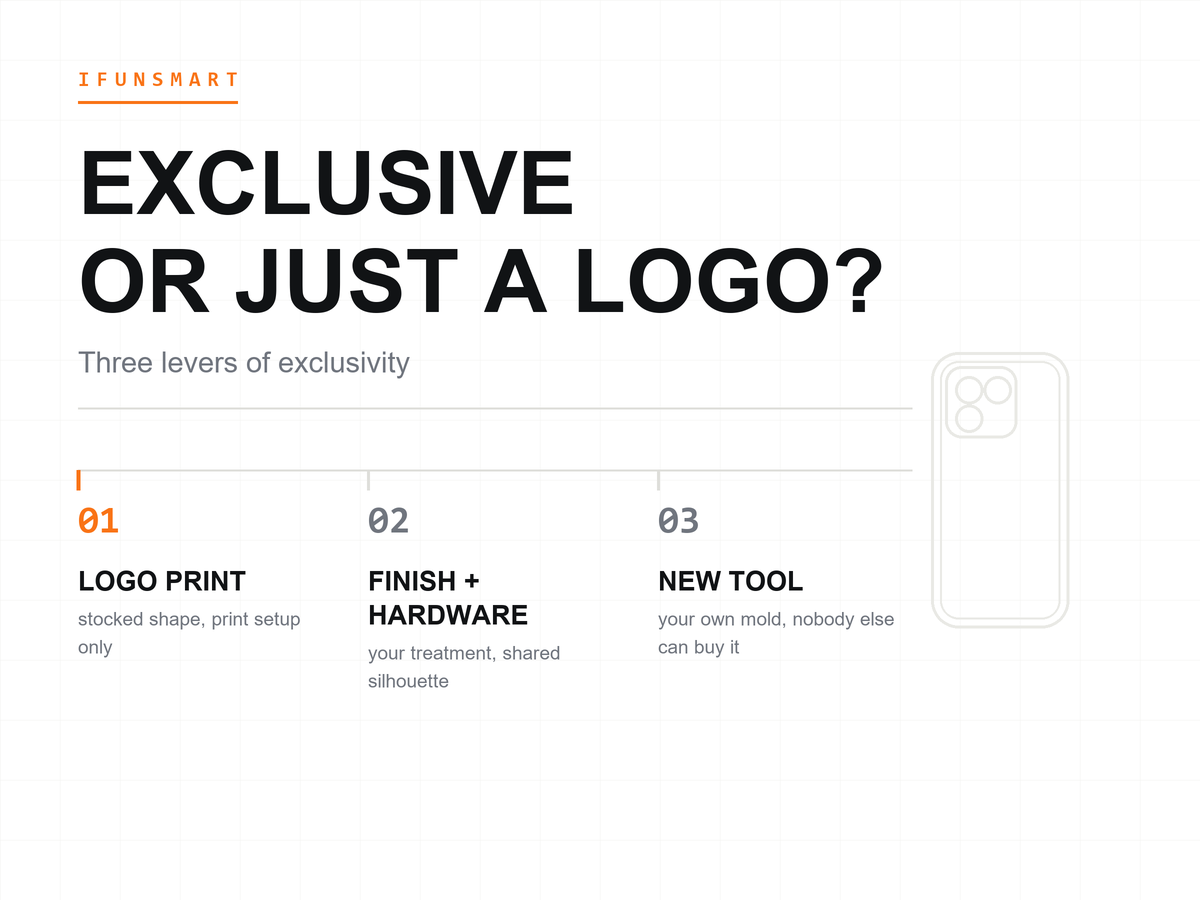
Exclusivity comes from three levers, and you do not need all three to have something of your own.
The first lever is the shape. A distinct silhouette, a different camera treatment, or an unusual corner geometry means the tool exists for you. A raised metal camera frame is a small version of this lever; a wholly new silhouette is the largest. This is the strongest form of exclusivity and the most expensive.
The second lever is the material and finish combination. The same shape in a specific TPU formulation, a specific back plate, and a specific surface treatment reads as a different product in the hand. Our micro-matte MagSafe build and our translucent matte build share a family of shapes but not a surface, and that difference is what a customer feels first. This lever is cheaper to reach than a new shape and is often enough for a brand with a clear aesthetic.
The third lever is the hardware and branding. Detachable metal buttons, a custom ring, an embossed internal logo, or a custom logo plate change how the case presents without changing the mold. Our detachable metal-button case is this lever in practice: same category, different hardware. Buyers asking for "custom logo hardware" are usually describing this lever, and it sits between the other two in cost.
Most successful first exclusives use the second and third levers together. A brand with a strong visual identity rarely needs a novel shape on day one; it needs a shape nobody else has in the finish and hardware it sells.
What an Exclusive Design Costs You
There is no single number, and any supplier who gives one before seeing your specification is guessing. What can be explained honestly is the structure of the cost.
An exclusive design carries a tooling charge that a logo-printed case does not, because a new tool is being made rather than reused. It also carries a minimum order that reflects that tooling, and a production timeline that includes drawing approval and a physical sample before mass production.
Against that, an exclusive design has a long-run advantage: once the tool exists, nobody else can buy your shape from us. A logo-printed open-mold case can be sold to the buyer next door with a different logo on it, which is a competitive risk that does not appear on the invoice.
The right way to compare the two is to look at what you get for the extra cost over a realistic volume, not at the tooling charge alone.
How to Talk About Exclusivity Without a Mistake
Three questions keep the conversation honest, and a supplier should be willing to answer all three in writing.
The first is ownership: who owns the tool, and what happens to it if you stop ordering. The second is scope: exclusive to your market, exclusive to your brand, or exclusive entirely, and for how long. The third is what happens to the design if you pause.
We are direct about this because vagueness here causes disputes later. Terms belong in your order confirmation, not in a verbal understanding, and the time to settle them is before the tool is cut rather than after your first order ships.
Is exclusive tooling worth it for a new brand?
It is worth it when you have a design intent you can specify and a market you intend to hold. It is not worth it if the plan is to test a category cheaply; a stocked design in your own finish will tell you more for less. The rule we give buyers is to prove demand first, then buy exclusivity.
Can I get exclusivity without a new mold?
Yes, in the two cheaper levers. A specific finish and hardware combination can be reserved for you on an existing shape, which is how most first exclusives are built. It is a weaker exclusivity than owning the tool, and for a young brand it is usually the correct first step.
Working With a Manufacturing Partner Long Term
The original inquiry had a second half worth answering: they wanted a manufacturer for a long-term partnership, not a single order.
Long-term changes what you should look for. A partner should be able to grow with your range, which means covering the accessories that sit around the case, not only the case. We produce cases and the adjacent pieces, including magnetic accessories and the straps and grips that attach to them, so a brand can consolidate rather than coordinate several factories. We have written about that one-stop approach separately.
It also changes how samples should be used. A first sample is not a formality; it is the cheapest test of whether a partner's build quality matches your brand. Buyers who start with samples before a larger order are doing exactly that, and a supplier should make that easy rather than treat it as a delay. Our own order timeline lays out where the sample sits and why it gates production.
One Honest Boundary
Not everything can be promised before a specification exists, and we would rather say so than quote a placeholder.
Tooling cost, unit price, minimum order, and lead time are all outputs of the design you specify: the shape, the material, the finish, the hardware, and the packaging. A supplier who quotes those numbers before receiving your specifications is not committing to them, they are estimating, and the estimate will move. The specification conversation is what converts an estimate into a price.
Common Questions From Buyers
How do I start an exclusive design project?
Send the design intent in whatever form you have it, a 3D file, a 2D drawing, or a sketch with the key details marked, and describe the finish and hardware you want. We confirm whether it is workable, then quote tooling, unit price, and minimum for that specific design rather than for a generic case.
What if I only want to adjust an existing design slightly?
That is a real middle path and often the right one. Changing a finish, a button treatment, or a camera frame detail on an existing shape costs far less than a new tool and can still give you a product that is not on every other shelf. Ask for that option explicitly, because it is not offered by default.
How long does an exclusive project take?
It runs in four stages, specs, quote, 3D sign-off, then tooling and a T1 sample, and the length depends on the design and how quickly the drawing is approved. Rather than a blanket number, ask for the stage plan against your target date and judge whether the supplier can actually describe it.
What to Do Next
If you are building a brand rather than buying stock, the useful first step is not a price list, it is a specification conversation. Our own range shows the range of finish and hardware treatments available on existing shapes, including pieces like our case with detachable metal buttons and our slide camera-cover build, so you can see which lever fits your design intent.
Send us your brand direction and the models you plan to cover, and we will come back with which of the three exclusivity levers fits your stage, plus a quotation for tooling and unit price once the specification is fixed.
Tell us what you want your product to be, and we will map it to the right exclusivity lever and quote it properly.
Apple, iPhone, Samsung, and Galaxy are trademarks of their respective owners, used solely to indicate compatibility. iFunSmart is an independent manufacturer of phone cases and accessories.