Sep 17, 2026Business Solutions
Private Molding a Phone Case: From Your Design to T1 Sample
Opening a private mold runs in four stages, each with a sign-off. What file to send, what each stage produces, and why tooling cost and MOQ come after specs.
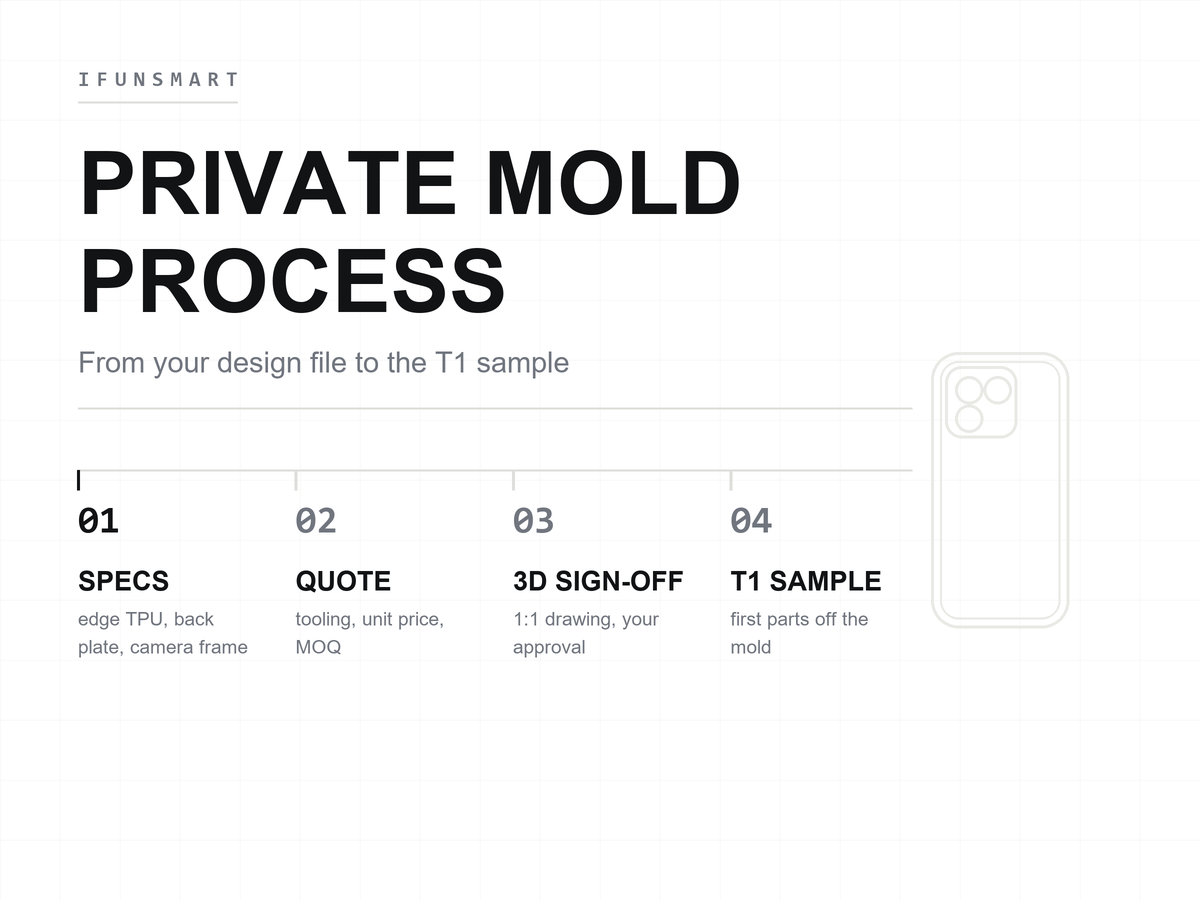
Opening a private mold for an iPhone or Galaxy case is a four-stage process with a sign-off between each stage: specs, quote, 3D drawing approval, then steel and T1 samples. The file you send decides how much engineering sits before stage one, and no factory can quote tooling cost, unit price, or MOQ without your specifications.
Last updated: September 17, 2026.
What a Private Mold Actually Is
A private mold is a steel tool cut to one buyer's own case design, used for that buyer's product rather than shared across a catalogue. The distinction matters because it changes who the design belongs to and what the tooling cost is buying.
A public or open mold is a shape many buyers sell; you choose a color and a logo and ship. A private mold is yours. You specify the edge material, the back plate, and the camera frame, and the resulting case is not something another buyer can order from the same factory.
That is the trade. A private mold costs more up front and takes longer before the first sellable unit exists, and in exchange nobody else has your shape.
What Files We Need From You
The first question most buyers ask is what to send. Two formats work, and the format you have decides how much of the design work is already done.
A 3D file is the cleanest starting point. STP, STEP, and IGS files carry the actual geometry, so our engineers are working from your surface rather than rebuilding it. If your design team has one of those, send it and the process starts from your model.
A 2D file works too, and so does a sketch. If all you have is a CAD, AI, or CDR drawing, or a hand drawing with the dimensions marked, we can build the 3D model from it and send it back for approval. We do that step often, because most brand owners have a design intent rather than a finished 3D model.
A real buyer asked us whether a random file from an unrelated project was acceptable, purely to test the format. It was, and that is the right way to check. Send any representative file before you have finished your own design, and we will confirm the format works rather than discovering it at the quote stage.
The Four Stages of Custom Tooling
Our process runs in four stages, and each one ends with something you approve before the next begins.
The first stage is design and specification confirmation. This is where you describe the case in the terms the mold is cut in: the edge TPU style, the back plate material, the camera frame shape, and any internal embossed logo you want inside the case. A camera frame is the kind of detail that decides the mold, which is why one of our own builds ships with a raised metal camera frame rather than a plain lip. Vague input here becomes a vague mold, so this stage is a conversation rather than a form.
The second stage is quotation. Once the specification is fixed, we calculate the tooling cost, the unit price, and the MOQ for that specific design. All three are outputs of the specification, which is why we do not quote before it.
The third stage is deposit and 3D drawing sign-off. After the tooling deposit, our engineers finalize the detailed 1:1 3D drawings of your design and send them for your approval. This is the last cheap moment to change your mind; altering a drawing costs nothing, altering a cut steel mold does not.
The fourth stage is mold tooling and T1 samples. We cut the steel mold and send the initial physical T1 samples for hands-on testing before any mass production. You hold the case, check the fit, the button feel, and the camera clearance, and production starts only after you sign off.
The Original-Design Question
One buyer opened the conversation with a sentence worth quoting: they did not want to copy a brand, they wanted something similar. That instinct protects them, and a factory should support it rather than work around it.
Copying a competitor's case geometry is a bad trade for a brand owner. It invites a design complaint, it gives you a shape you cannot defend, and it usually produces a worse product, because a tool cut to imitate rarely fits as well as one cut to a specification. What we ask for instead is your intent: the silhouette you like, the feel you want, the camera treatment you need. Similar in spirit is easy to build. Identical in geometry is a problem we will not take on.
We do not need to see a competitor's product to develop your mold, and if you send one as a reference we will treat it as a direction rather than a template.
What We Cannot Quote Without
This is the honest boundary, and it is the part buyers find most frustrating until they see why it exists.
Tooling cost, unit price, MOQ, and production time are all functions of the specification, so a supplier who quotes them before receiving your specs is guessing. A number given that way is not a commitment; it is a placeholder that will move once the work is actually defined. The stage-one conversation is what converts a placeholder into a price.
The same applies to file formats. A 3D file removes a modeling step, a 2D drawing adds one, and a sketch adds more, so the shape of your input affects the workstream, not just the drawing itself. Tell us what you have and we will tell you what that means for the schedule.
Common Questions From Buyers
What if I only have a sketch?
Send the sketch. A hand drawing with the key dimensions marked is enough to start, and we will build the 3D model from it and send the drawing back for your approval before any steel is cut. Plenty of private molds begin as a sketch and a conversation.
Do I own the mold after it is built?
Mold ownership is a term we agree in writing before production, not an assumption, so raise it at the quotation stage. What matters is that the terms are settled before the tool is cut rather than negotiated after your first order.
Can I see a sample before committing to mass production?
Yes, and that is what the T1 stage is for. T1 samples are the first physical parts from your own mold, sent for hands-on testing before mass production. Production should not start until you have approved them.
What to Do Next
The design variables in a private mold are the same ones that separate one build from another in our own range, so if you want to see how different treatments read in the hand, ask us for samples of the closest existing builds alongside your own project. A detachable metal-button treatment and a slide camera-cover mechanism feel like different products on the same phone, and both begin as specification decisions in stage one. The variables are the same; only the shape changes.
Send us the specifications for your design and whatever file you have, including a sketch, and we will confirm the file is workable and come back with a proper quotation for tooling, unit price, and MOQ.
Send your design file or sketch and we will confirm what is workable and quote your tooling, unit price, and MOQ.
Apple, iPhone, and Samsung are trademarks of their respective owners, used solely to indicate compatibility. iFunSmart is an independent manufacturer of phone cases and accessories.