Business Solutions
Rumors About Unreleased Phones: What a Factory Can Say
Buyers arrive with leaks about the next model and ask a supplier to confirm them. Here is what a case factory knows, and why the honest answer is short.
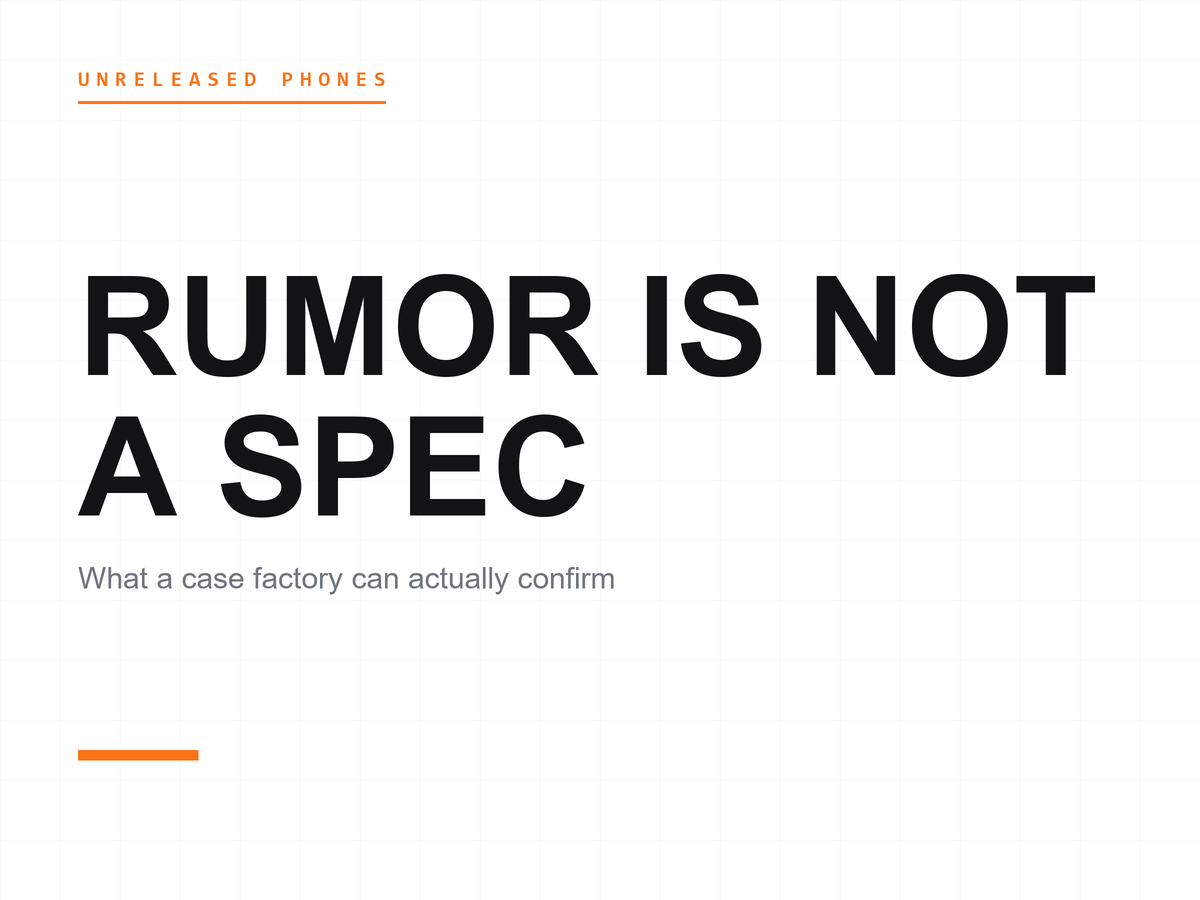
Buyers often arrive with a leak about a phone that has not shipped and ask iFunSmart to confirm it. We cannot. A case factory knows its own molds, not a manufacturer's launch plan, so the honest answer stays short: wait for the official specification.
Last updated: November 2, 2026.
Why Buyers Bring Rumors to a Supplier
A launch creates an information vacuum. Buyers must decide whether to commit stock before demand is visible, and their material is a stream of posts and forwarded screenshots. Bringing that material to a supplier is a reasonable procurement move. The buyer is not testing anyone's loyalty. The buyer wants a second opinion before money moves.
We understand the impulse. A buyer who waits for the official launch may lose the first weeks of demand. A buyer who commits too early may own stock for a phone that sells below plan. The rumor feels like a shortcut through that uncertainty. It is not. A rumor is a claim about a product that has no published source behind it, and repetition does not turn it into a measurement.
What a Case Factory Actually Knows
A factory knows its molds and the dimension chain behind them. We can answer which model a mold was cut for and which reference its dimensions came from. We can also name the stage it has reached. The manufacturer's product plan is not ours to know. A confirmed specification is a dimension or feature the manufacturer has published for a device that is actually on sale, not a detail repeated by people outside the company.
That distinction matters because a case is cut one to one to a device. A current-generation build follows the same rule, against one device and one set of numbers. The phrase "one to one" only means something when the dimensions can be checked. Before publication, the numbers behind a mold are references and estimates, held with margins, not the manufacturer's final drawings. We do not present them as final drawings.
We make no statement about the specifications of an unreleased model. The mold may exist. The specification does not, at least not in public.
Three Kinds of "I Heard Something"
An official publication is the strongest source, and it is the only one that should enter a mold as a fact. That means a specification page or a launch document from the manufacturer. It can be cited later if a fit dispute arises.
Forwarded claims are weaker. A screenshot from a social account or a message forwarded by another buyer may be accurate, outdated, or about a different variant. The original context is usually gone by the time it reaches you. A rumor is not a tooling reference, and it is not a purchase reference.
Indirect evidence from the accessory chain sits between the two. Measurements circulate before a launch, and other accessory makers move tooling ahead of the announcement. These are signs. A sign can narrow a guess. It cannot turn a guess into a specification, and it cannot tell you which variant will reach your market.
No single source settles a dimension on its own. What a factory can act on is agreement across sources, and what closes the question is publication.
Why a Factory Should Not Confirm for the Manufacturer
A mold is cut to one set of numbers. When those numbers are wrong, the steel is wrong, and the parts that come off it are wrong. A factory that cuts tooling from an unverified claim risks scrapping the mold and the buyer's launch order with it.
There is a second cost, and it lands on the buyer. When a supplier says the specification is confirmed, the buyer hears certainty and commits stock. If the case was built to a guess, the problem appears after the container arrives. The supplier may survive the conversation. The buyer owns the inventory.
So we keep the answer short. We do not confirm specifications that have not been published. The manufacturer has not published this one, so we have nothing to add. When the phone ships, our process checks the case against the actual device before production units leave. Until then, a rumor is not a tooling reference. We are not being evasive. We are refusing to invent.
The Questions a Buyer Can Actually Get Answered
A buyer weighing an early order can split the decision into three parts. Whether a mold already exists is something a factory can answer, because the mold is its own property. It can name the model and the reference behind it.
How fast a case can move once the dimensions are official is also a factory question, and we answer it for our own line. That answer covers our process, not the manufacturer's launch date.
The specification itself is the part no supplier can answer before publication. A supplier who answers with confidence has either seen an official document or is repeating a rumor in better language. Ask which one.
Put the answers in writing. There is a useful order to the questions: which model and version the mold serves, which reference the dimensions came from, when the mold was last checked against a physical unit, and what happens to your order if the retail unit differs. Ask for the model and version to appear in the order confirmation. Those questions produce an answer a factory can stand behind. The specification question produces a guess.
Before you plan stock around an unannounced model, ask the supplier to write down which reference the mold was cut to and what that reference can and cannot settle.
Common Questions From Buyers
Why Won't a Factory Confirm a Rumor That Sounds Credible?
Credibility is not a source. Several people can repeat the same claim and still be wrong, or right about a variant you will not sell. A factory that repeats the claim lends its name to a number it cannot verify. If the claim fails, the buyer carries the stock and the factory carries the blame. Neither outcome is worth the sentence.
How Can I Tell Whether a Supplier Is Guessing?
Ask for the source behind the statement. A supplier working from published data can name the document and the date. A supplier working from a rumor tends to cite "the market," a social account, or a contact who cannot be named. That answer is not evidence. It usually means the mold has no written basis, which is a separate problem for your order.
Does an Early Mold Mean the Factory Knows the Phone?
No. A mold cut before a launch is built from reference data and physical samples, with margins around the areas that carry the most uncertainty. It is checked against the retail unit when the phone ships. The mold's existence shows that a factory committed steel to a calculation. It does not show that the factory received the manufacturer's final drawings. An early mold is a business decision, not a disclosure from the manufacturer. A Duo build already on the line follows the same rule: a single device and a single hinge, cut to one set of dimensions.
What to Do Next
Treat a rumor as a lead, not a dimension. Ask the factory the questions it can answer: whether a mold exists, which reference it was cut from, what stage it has reached, and how a mismatch with the retail unit would be handled. Leave the specification question open until the manufacturer publishes. Then order against what is written, not against what is repeated.
A supplier who tells you the honest version early is giving you something useful. You can plan around an open question. You cannot plan around a false answer.
Send iFunSmart the model you are planning for, and we will tell you in writing whether a mold exists, which reference it was cut from, and what our process checks once the retail unit is available.
Apple and iPhone are trademarks of Apple Inc. iFunSmart is an independent manufacturer of phone cases and accessories and is not affiliated with, authorized, sponsored, or endorsed by Apple.