Business Solutions
Test Reports: What We Can and Cannot Hand Over
A buyer asking for test reports deserves a straight answer. What a factory can actually provide, what it cannot, and how to verify the rest.
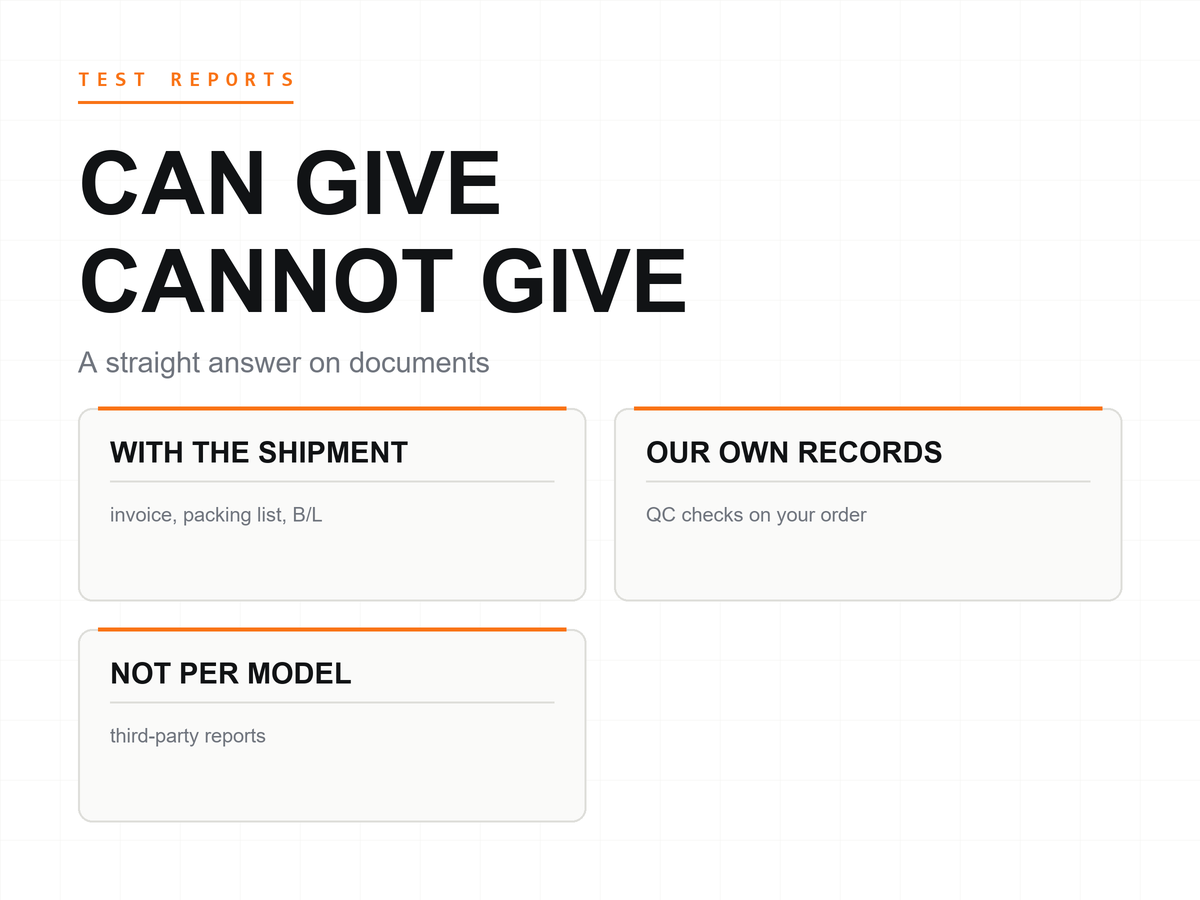
Buyers ask iFunSmart for test reports, and some expect one for every model in our catalog. We cannot send one per model. What we can hand over is narrower: shipping documents, our own inspection records, label files, and photos of styles we have shot.
Last updated: November 2, 2026.
What We Can Hand Over
When a buyer asks for a test report, the request usually bundles several documents under one word. Separating them is the first useful step, because a factory can answer some directly and cannot answer others at all.
The documents that travel with a shipment are the commercial invoice, the packing list, and the bill of lading. They are produced for every order, and they record what was sold and how the shipment moved. They say nothing about performance.
Then there is our own paperwork. Our QC team in Guangzhou keeps inspection records for each order. Those records are ours: notes and counts from our own checkpoints, not a certificate from an outside body. We can share the records we keep for your order, and because we print and apply labels in-house, label artwork can be checked against your confirmed file before production.
Packaging samples work the same way. A box or bag can be approved before the run, and the approved sample becomes the reference for the shipment. For photography, we provide free HD images for the styles we have photographed. That offer stops at the styles we have shot; we do not shoot a new style just because a listing needs a picture.
The physical sample is the most useful item on this side of the line. A case in your hand can be squeezed, mounted on the phone, and dropped on your own floor.
What We Do Not Hand Over
A plain no covers three requests that recur. We do not hand over third-party reports for every model. Magnet curves by model are not ours to publish, because a curve belongs to the unit that was measured. When a buyer asks for customer names, sales figures, or a case study file, the answer is that those belong to the buyer who shared them.
The report request deserves the clearest explanation. A third-party laboratory report is not a catalog document. It is issued for a sample, for a stated test item, under stated conditions, and it carries the name of the laboratory that ran it. A report usually covers one sample and one test item. It does not describe the rest of a catalog, and it cannot be rewritten to.
Customer references are a different kind of no. A buyer's name, volume, and case history belong to that buyer. We do not publish customer names or sales data, and we do not release customer case files. A supplier who offers them freely is trading someone else's information.
Why a Report Stops at the Sample
A test report records what a specific sample was tested for, by whom, and under what conditions.
That definition sets the scope, and the scope is narrow. The lab receives a sample, runs the agreed test item, and writes down what happened to that sample. The result travels with that sample and that test item. It does not travel with the model name, the mold, or the next production run.
This is why a report cannot be stretched over a range. A case that passed a test in one color and one material does not carry that result to a different build, and a sample pulled from a submission batch is not a unit from a production lot. A report covers the sample it was run on, not the range.
There is a second reason the paperwork is thin. A third-party report is not part of a standard shipment. It is arranged per project, usually because a buyer needs it for a particular market, and the arrangement includes who sends the sample, who pays for the test, and who waits for the result. A supplier who claims to hold a report for every model is describing an archive you should ask to see.
How to Verify What No Document Covers
The absence of a report does not leave a buyer with nothing. It changes the method from reading to checking, and those checks need no laboratory.
Start with the process. A factory visit or a video walk through the QC stations shows you where checks happen, who records them, and what the records look like. Ask to see the station, not a folder. A record you watch being written beats a file assembled for your visit.
Then use the sample. The coating, the fit, the magnet grip, and the way the case survives a fall are all things you can judge yourself. Our lines are open to it: ask for a sample of a hinge build under review and work the hinge through its full travel, or take a mainline design and mount it on the iPhone 18 Pro you sell for.
The third check is the order itself. If a test matters to your market, name it in the order confirmation: which test, on which model, who sends the sample, who carries the cost, and what result counts as acceptance. A requirement written into the order is enforceable. A requirement sent in a chat message is a hope.
The Questions Worth Asking in Writing
Four questions separate a supplier who can answer from one who is improvising, and none needs a technical background.
The first is which model and which test item the report covers. The second is whether the sample came from a submission batch or a production lot, because the two are not interchangeable. Then ask who holds the report and whether you may cite it to your own customer, since a report you cannot reference has little value in a retail conversation. Last, ask what acceptance check replaces the report if none exists for your model.
A supplier who answers those questions in specific terms is telling you how the factory works. One who answers with a brochure is telling you something else.
If you are already comparing suppliers, send the same four questions to each and put the answers side by side.
Common Questions From Buyers
Which Documents Should I Ask for Before an Order?
Ask for the trade documents that will travel with the shipment, the inspection records the factory keeps for your order, and a packaging sample approved against your artwork. Add the product sample itself. Those items cover what was sold, what was checked, and what the unit feels like.
Can You Send a Report for a Model You Have Not Tested?
No. A report is tied to the sample that was run, and we will not pass one model's result off as another's. If a report exists, it covers the test item named in it. If none exists, the answer is that none exists, and the next step is a sample or a written acceptance check.
Does a Missing Report Mean the Case Is Untested?
It means the case has no third-party report that we can hand over. It does not mean nobody looked at it. Our QC team inspects orders at our own checkpoints, and those records are available for your order. The distinction matters: an internal record is evidence of a process, while a third-party report is evidence about one sample. A buyer should know which one is being offered.
What to Do Next
A test report request is a fair request, and the fair answer separates what exists from what does not. Ask for the documents that travel with the order, watch the process, and test the sample yourself. Where a third-party report is missing, put the acceptance check in writing instead of assuming one.
Send us the model and the test item you need covered, and we will tell you in writing which documents we can provide for that order and which checks you should run on the sample.
Apple and iPhone are trademarks of Apple Inc. iFunSmart is an independent manufacturer of phone cases and accessories and is not affiliated with, authorized, sponsored, or endorsed by Apple.