Oct 8, 2026Business Solutions
3D Files, 2D Drawings, or a Sketch?
The file you send decides how much engineering happens before your sample is even cut. What a 3D file, a 2D drawing, and a sketch each cost in effort.
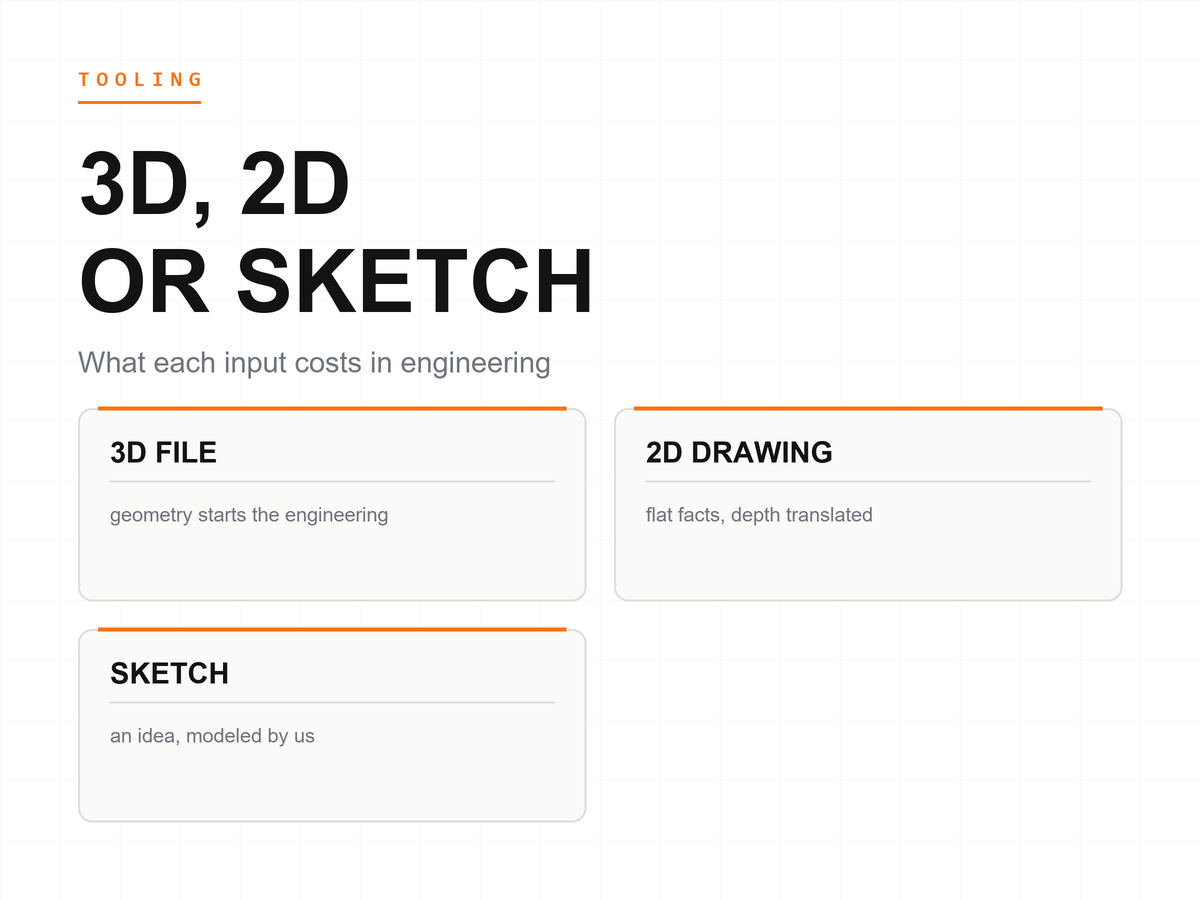
A 3D file starts the engineering from your geometry. A 2D drawing supplies the flat elements and leaves the depth to be translated. If all you hold is a sketch, the modeling lands on our side first. iFunSmart works from all three, and whichever file you send decides how much engineering sits between your inbox and the first sample.
Last updated: October 8, 2026.
The File Sets the Starting Line
An engineering-ready file is one that carries the case geometry — the back surface, the cutouts, the wall positions — in a form modeling software can read without reconstruction. That is the target every input is measured against. The three common inputs sit at different distances from it, and the distance shows up as engineering work before a sample is cut, not as a verdict on the project.
The file type does not decide whether a case can be made. Any of the three carries a project to production. What changes is how much of the shape arrives defined, how much gets translated, and how much gets built out of conversation. Buyers who absorb that split start packing the right information into whatever file they have. Format names matter less than geometry.
What a 3D File Carries
iFunSmart accepts STP, STEP, and IGS files — that is our intake list, stated as our own practice rather than a claim about the industry. A file in one of those formats carries the actual surfaces: the curvature of the back, the position of every cutout, the height of the camera frame lip. The engineering starts on your surfaces instead of from a blank screen, and it shifts to what a model cannot say by itself: whether the walls clear the phone they wrap, whether the buttons keep their travel, whether the frame sits where the lens actually is. A model drawn for one phone does not stretch onto another; the outline an iPhone 18 Pro Max needs is not the outline an iPhone Duo needs. When the geometry arrives defined and the checks pass, the mold is cut to match it at 1:1 precision, and the first sample reads as a confirmation rather than a reveal.
What a 2D Drawing Gives and What It Leaves Out
We also accept CAD, AI, and CDR drawings. A 2D file delivers the flat facts — the outline, the lens cutout and its position, the logo placement, the color callouts. What it cannot deliver is depth. How thick the wall sits off the phone, how the side profile rolls into the back, how far the camera frame rises above the surface: all of that has to be translated, and the translation is engineering work done before any sample can exist. The path we run most often is to build the 3D model from your drawing and send it back for your approval, so the depth you did not draw gets confirmed in 3D before anything is cut. A drawing with the key dimensions marked travels that path with fewer questions attached.
What a Sketch Asks of the Factory
A sketch or a photo means the project starts from intent. We model from it — building the 3D shape ourselves out of what your drawing shows and the conversation around it. That is ordinary work here, and plenty of private molds started as nothing more than a sketch. What a sketch adds is modeling rounds: the shape exists nowhere until someone proposes it, and your confirmation is what turns the proposal into geometry. A sketch usually asks for more engineering before the sample than a 3D file does, though how much more depends on the design and on how completely the sketch states its intent. We do not quote engineering effort in this article, because that workload is read per design rather than per format. Two things shrink the gap from your side. Pair the sketch with a reference photo of a case whose fit you already like, because it anchors the dimensions that words cannot. And name the phone it must fit, because fit is where most modeling decisions begin.
When the Shape Already Exists, the File Question Shrinks
Much of what arrives as a custom request describes something a mold already holds. Choosing an existing open mold design closes the geometry question before it opens: the magnetic build with its metal camera frame already exists in steel, so the brief starts from a molded sample rather than a model on a screen. The same shrink happens on the surface side. Point at a finished SKU with files on hand and the engineering narrows to the finish, because a cherry shade on a smoke-skin surface sits on a proven shape and asks no new steel. Before you draft any file, check whether the design you are describing is already a SKU. Nothing trims the workload like a shape that already exists.
The Version That Gets Approved Is the Version That Arrives
Sampling turns on versions. By the time a sample is confirmed, two files often exist: the one you first sent and the one the sample was built from, and the gap widens when modeling happened on our side while your team revised the drawing mid-round. The fix is a habit rather than a tool. When a revision supersedes an earlier file, send it and say so in writing before the next round starts. Then freeze the approved version, name it, and check the arriving sample against that file instead of against memory. A sample judged against a superseded drawing fails twice: once against the old intent and once against the new one.
Common Questions From Buyers
Do I need a 3D file to start?
No. A 2D drawing with the key dimensions marked starts the same project with one modeling step attached, and a sketch starts it with the modeling done on our side. Buyers send a representative file before their design is finished for exactly this reason: to learn which track the project is on while it is still on paper.
Which dimensions should a 2D drawing carry?
The ones depth cannot inherit. Mark the wall thickness, the positions of the camera cutout and the port openings, and the side profile you want where the case meets the phone. Logo position and color callouts ride along on the same sheet. A missing dimension is not a blocker; it is a question our side sends back, and every round trip you prevent is engineering your schedule keeps.
Does a sketch make the project slower or costlier?
Usually it means more modeling before a sample exists, because the geometry starts blank. What that becomes on a quote or a calendar is read per design, and it depends on how complete the sketch is and whether the shape already lives in a mold. This article does not quote engineering effort; the honest answer is the one your specific file gets when you send it.
What happens to my file after I send it?
It gets read first. We check that the geometry or drawing opens as intended, then check the fit against the phone it names, then model whatever the file left undefined and send the model back for your approval. Nothing is cut until the file on our side and the intent on yours describe the same case.
What to Do Next
Inventory what you hold before the next custom brief. A 3D model goes out as it is, a 2D drawing with the key dimensions marked, a sketch with a reference photo and the phone named. We have tooled cases in Guangzhou since 2010, and across 1,000+ molds the intake question has stayed the first one we ask, because every stage after it leans on the answer. Whichever file you hold is enough to start that conversation.
Send us whichever file you have, and we will read it, tell you what it covers, and flag what has to be modeled before a sample is cut.
Apple and iPhone are trademarks of Apple Inc. iFunSmart is an independent manufacturer of phone cases and accessories and is not affiliated with, authorized, sponsored, or endorsed by Apple.