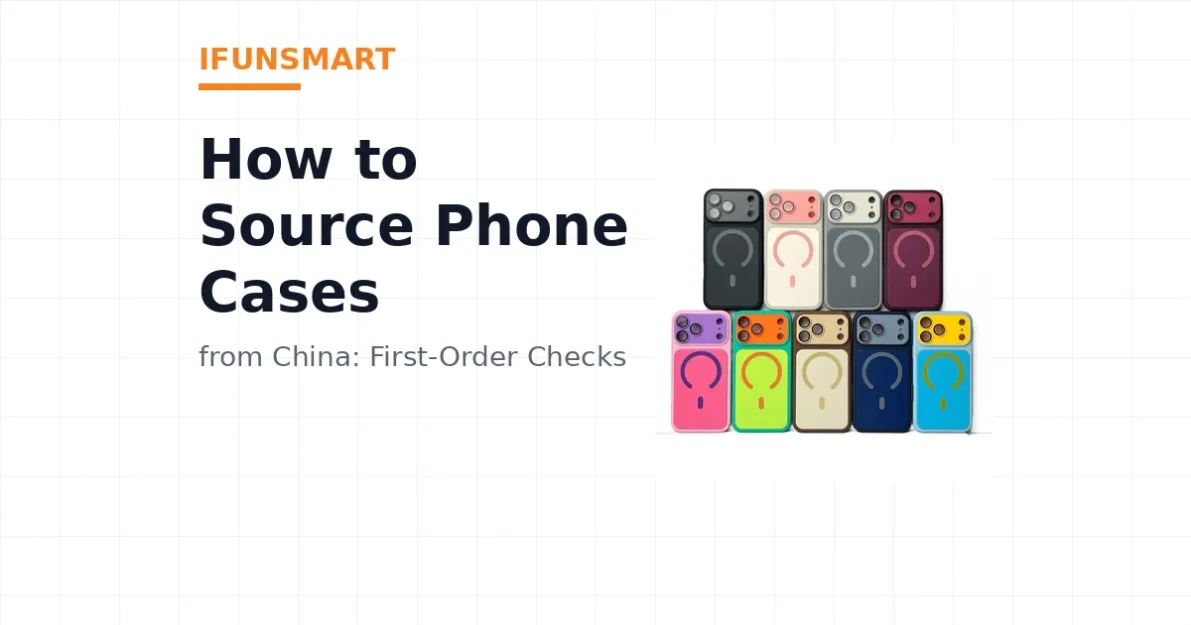
How to Source Phone Cases from China: First-Order Checks
A first-order sourcing workflow for distributors: write the brief, check the factory, compare quotes on identical specs, approve the sample, and clear the pre-shipment checks before the deposit.
BLUF
BLUF
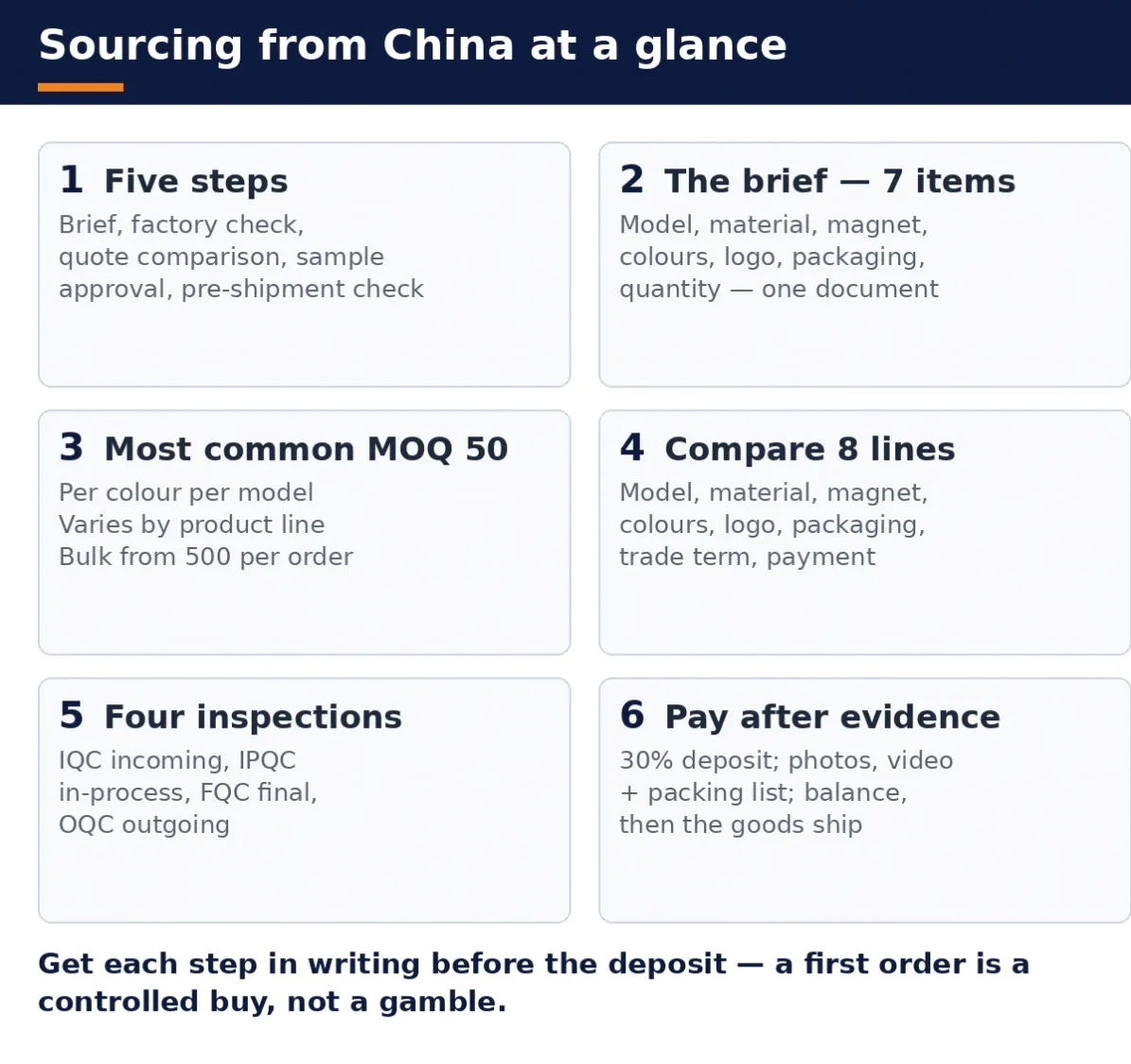
Sourcing phone cases from China is a five-step workflow: a written brief, a factory check, a like-for-like quote comparison, a sample approval and a pre-shipment check. Get each step in writing before the deposit, and the first order is a controlled buy, not a gamble.
Short answer
A first order fails for boring reasons, not dramatic ones. The brief named the wrong model. The quote compared a TPU case with a hybrid case. The sample was approved by photo, and the bulk run matched the photo, not the case. The deposit went out before the packaging was agreed. None of those failures needs a better factory — they need a better sequence, and the sequence is the same whether the order is 500 pieces or 50,000.
The workflow in this guide has five steps, in this order:
- Write the brief first. Model, material, magnet figure, colours, logo method, packaging, quantity — in one document, before any supplier is asked for a price.
- Check the factory, not the catalogue. Moulds, printing, assembly and a QC department are the evidence; a wide catalogue is not.
- Compare quotes on identical specs. Same model, same material, same magnet figure, same packaging, same trade term — or the comparison is meaningless.
- Approve a physical sample. The approved sample is the production standard, confirmed in writing; a photo approval is not an approval.
- Clear the pre-shipment checks. Inspection records, packing list, carton marks and the payment sequence — all before the balance is paid.
Each step names the document or the written confirmation to ask for. A distributor who runs the five steps has a phone case sourcing checklist that works for the second order too, because the brief, the approved sample and the inspection records carry over. A distributor who skips a step has to re-do it later, at the price of the bulk run.
Our most common MOQ is 50 pcs per colour per model, bulk distributor orders start at 500 pcs per order in total, and samples are free for distributors. Payment terms are T/T and Western Union only — the full terms are in the checklist in section 6.
Sourcing from China at a glance
| Step | What it is | What to ask for in writing |
|---|---|---|
| 1. The brief | Model, material, magnet, colours, logo, packaging, quantity — one document | The brief itself, confirmed back by the factory |
| 2. The factory check | Moulds, printing, assembly, QC department — evidence, not catalogue size | Mould list for the models in the order; QC department and inspection stages |
| 3. The quote comparison | Identical specs, identical trade term — or no comparison | A line-by-line quote showing material, magnet figure, packaging and trade term |
| 4. The sample approval | A physical sample, bench-checked, approved in writing | Written confirmation that the approved sample is the production standard |
| 5. The pre-shipment check | Inspection records, packing list, carton marks, documents | Final and outgoing inspection records, packing list, carton photos |
1. What should the brief say before you ask for a quote?
A quote is only as good as the brief behind it. A factory that is asked for “a magnetic case for iPhone 18 Pro Max, 500 pieces” will quote something — but the buyer does not know what. The material could be TPU or a TPU and PC hybrid. The magnet could be N52 at 2700 Gauss or a weaker magnet with no figure stated. The packaging could be a polybag or a printed retail box. The price that comes back is the price of one of those combinations, and the buyer has no way to tell which one. That is how a phone case supplier evaluation goes wrong before it starts: the buyer compares two quotes for two different products and picks the cheaper one.
The brief is one document, and it names seven things. Send the same table to every supplier you compare — a supplier who answers it line by line is a supplier who can be compared; a supplier who answers with a catalogue link and a single price has not answered the brief.
| Brief item | What to write | Why it controls the order |
|---|---|---|
| Exact model | The exact model, such as iPhone 18 Pro Max, and the exact quantity per model — not a series name | A case that fits the iPhone 18 Pro does not fit the iPhone 18 Pro Max; a brief that names a series instead of a model is a return waiting to happen |
| Material and construction | TPU, PC, liquid silicone, leather, or a hybrid — and whether the case is a single material or a layered build | The material decides the feel, the weight and the failure modes, so it is named in the brief, not discovered on the sample |
| Magnet figure | The magnet grade and pull figure per style, in writing — for example N52 at 2700 Gauss on our magnetic styles | Magnet figures differ by style across any factory’s range, so a figure from one style is never assumed for another |
| Colours | The exact colour names and the quantity per colour | The MOQ is per colour per model, so a brief that lists twelve colours for one model is already a 600-piece order — the per-line figures are in section 3 |
| Logo method and position | Laser engraving, print, debossing or embossing — and where on the case it sits | A 100-piece trial order can already carry a logo by laser engraving, which is permanent where silk-screen fades and needs a higher MOQ; confirm the method for the material in the order, in writing, before the trial |
| Packaging | Polybag, retail box, barcode, dieline — and whether the packaging is part of the quote or a separate line | A case in a plain polybag is a different product in the shop from the same case in a printed retail box |
| Quantity and split | The total pieces, the split by model and the split by colour | Bulk distributor orders start at 500 pcs per order in total, so the brief should show the split that reaches that total — depth in fewer colours, or breadth across styles, decided before the quote |
Our mould coverage guide lists which models we hold moulds for, and a model with no mould is a model to ask about in writing before quoting a customer. The brief is also the document the sample is checked against and the bulk run is checked against — so write it once, carefully, and keep it. It is the first item in the phone case sourcing checklist, and it is the item every later step refers back to.
2. Factory or trading company — what proves which one it is?
The factory question matters because it decides who controls the mould, the material and the re-order. A factory that owns its moulds can confirm a fit in writing, can re-run a style, and can tell a buyer which models have no mould yet. A trading company buys from a factory and adds a margin, and it cannot answer a mould question from its own floor. Article 15 of this series lists the tell-tale signs in detail; this section is the short version, used inside the sourcing workflow — the three checks to run before the first quote is compared.
The first check is the mould list. Ask for the moulds held for the models in the brief, in writing. A factory answers with a list — models, and which styles each model is available in. A trading company answers with a catalogue. The mould list is also where the gaps show: if the brief asks for a model with no mould, the factory says so, and the buyer decides whether to wait for a re-tool or to order a different model. A supplier who claims every model for every style, with no gaps, has not checked its own moulds.
The second check is the production floor: printing, assembly and a QC department. A phone case is not one process — it is moulding, printing, magnet fitting, assembly and packing, and each step has its own failure mode. Ask which of those steps the factory does in-house and which it outsources, and ask for the QC department by name: who inspects, at which stages, and what record they keep. The inspection stages are the subject of section 5, and a factory that cannot name them is a factory whose quality control is a claim, not a process.
The third check is the range itself. A factory with 1000+ designs and 500+ models, running 500K+ pieces a month since 2010, has a range because it has the moulds — the range is the evidence, not the sales pitch. But the range is also where a buyer should be careful: a wide catalogue does not prove that the style in the brief is in stock, or that its mould is current. The mould list for the models in the brief is the check; the catalogue is the menu.
Run these three checks before comparing quotes, not after. A quote from a supplier who has not passed the factory check is a price for a product the buyer has not verified, and a cheap quote from an unverified supplier is the most expensive quote in the order — it is the one that produces a bulk run the buyer cannot sell. The factory check is also the step that protects the re-order: a factory that holds the mould will still hold it when the buyer comes back for the second order, and the second order is where the margin is made.
3. How do you compare quotes on the same specs?
Two quotes can only be compared if they describe the same product. That sounds obvious, and it is the step most often skipped — because the quotes arrive in different formats, with different line items, and the buyer compares the bottom line. The bottom line is the last thing to compare. The first thing to compare is the spec sheet behind it.
A like-for-like comparison checks eight lines, and a quote that does not show a line is a quote that has not answered it:
- Model and fit. The exact model, confirmed against the mould list. A quote that says “iPhone 18 series” has not confirmed a fit.
- Material and construction. TPU, PC, silicone, leather, hybrid — and the layer structure. A TPU case and a TPU-plus-PC hybrid are different products at different prices, and a buyer who compares them on price alone is comparing two different buys.
- Magnet figure. Grade and pull figure per style, in writing. A magnetic case quoted without a magnet figure is a case whose magnet the buyer has not verified.
- Colours and quantities. The exact colours, the quantity per colour, and the MOQ per colour per model. Our most common MOQ is 50 pcs per colour per model and it varies by product line — IPDK Duo styles are 100, ISF Samsung styles are 50, IP leather styles are 30 or 50, IQ styles are mostly 30, IPD styles are 20, 30 or 50 by line — so the MOQ line in the quote must be read per style, not assumed from another style.
- Logo method and artwork. The method, the position and the artwork file. A quote that prices a logo without naming the method has not priced the logo.
- Packaging. Polybag or retail box, barcode, dieline — and whether the packaging is included in the unit price or charged separately.
- Trade term. EXW, FOB, CIF or DDP — the term decides who pays the freight, the insurance and the duty, and a quote on a different term is a quote for a different landed cost. The importing guide in this series explains the terms; the point here is that two quotes on different terms cannot be compared on the unit price alone.
- Payment terms. T/T and Western Union only, in our case; new customers may pay a 30% deposit first, and the balance after the goods are ready and the photos, video and packing list have been sent. A quote that adds a payment method the factory does not offer has not been read.
When the eight lines match, the prices can be compared — and the cheapest quote is still not automatically the right one. A lower price may hide a thinner material, a weaker magnet, a different packaging or a shorter inspection. Ask the cheaper supplier to confirm, line by line, that its spec matches the brief, in writing. A supplier who confirms in writing is a supplier who can be held to the spec; a supplier who answers “same as the others” has not confirmed anything.
A phone case wholesale price China search will return prices, but a price without a spec sheet is not a quote — it is a headline. The quote to compare is the one that shows its eight lines, and the supplier to choose is the one whose eight lines match the brief and whose sample proves it. That is the sample step, and it comes next.
4. What does the sample approval actually lock in?
The sample is the only part of the order the buyer can hold in the hand before the deposit, and it is the part most often approved too quickly. A sample approved by photo is not approved at all — a photo shows the shape and the colour, and it hides the parting lines, the coating adhesion, the magnet pull, the hinge friction and the carton integrity. Those are bench checks, and they are done on a physical sample, in the buyer’s hand, against the brief.
Samples are free for distributors, and the sample should be ordered in the exact model, colour and logo method of the planned bulk order. A sample in a different colour proves the fit and the construction; it does not prove the colour. A sample without the logo proves the case; it does not prove the logo method on that material. Order the sample as the bulk order in miniature, and check it the same way the bulk run will be checked.
The bench checks follow the brief, line by line. Fit first: the case seats on the exact model, the buttons align, the camera cut-out clears the lens, and the case comes off without forcing. Then the material: parting lines are clean, the coating adheres, the edges are smooth, and the colour matches the approved swatch rather than a screen thumbnail. Then the function: the magnet pulls and holds on a charger and on a magnetic mount, the hinge or stand holds its position, a slide cover cycles on the bench sample and sits flush, and a card slot grips the card after repeated use. Then the logo: the engraving or print is in the agreed position, it is legible at arm’s length, and it survives a thumb rub without lifting. None of these checks is a consumer anecdote — they are factory QC language, done on a bench sample, and they are the same checks the factory’s own QC department runs at the final inspection stage in section 5.
The approval is the written confirmation that the sample is the production standard. Ask the factory to confirm in writing that the bulk run will match the approved sample — same material, same magnet figure, same colours, same logo method, same packaging — and keep that confirmation with the brief. If the bulk run differs from the sample, the written confirmation is the document the buyer refers to, and the inspection records in section 5 are the evidence. A factory that will not confirm the sample as the production standard in writing has not approved the sample either — it has sent one.
One more check belongs here, because it is the one buyers forget: the packaging sample. Ask for a photo of the finished retail pack, and if the packaging is custom, ask for a physical packaging sample with the bulk sample. A case in a plain polybag is a different product in the shop from the same case in a printed retail box, and the packaging is agreed before the deposit, not discovered in the carton. The packaging guide in this series covers boxes, barcodes and the dieline; the point here is that the packaging is part of the sample approval, not an afterthought.
5. What are the four inspection stages, and what do you ask for at each?
Quality control in a factory is not one inspection at the end. It is four stages, in order, and each stage catches a different failure. The stages are standard factory practice — incoming QC, in-process QC, final QC and outgoing QC — and a buyer who knows them can ask for the right record at the right time, instead of asking for “a quality check” and receiving a single photo.
IQC — incoming quality control. Materials, components and packaging are inspected on arrival, before production starts. The TPU pellets, the PC sheets, the magnets, the leather, the retail boxes — each batch is checked against its specification before it enters the line. The failure this stage catches is the wrong material: a magnet batch with a lower pull figure, a leather batch in the wrong shade, a box batch printed with the wrong barcode. What to ask for: the incoming inspection record for the materials in the order, and the material certificates where they exist. A factory that inspects its incoming materials can tell a buyer which batch went into the order; a factory that does not is building on uninspected stock.
IPQC — in-process quality control. Production is monitored as it runs: first-article sign-off, patrol checks at intervals, and a stop rule when a defect repeats. The first article is the first finished piece off the line, checked against the approved sample before the run continues — if the first article fails, the run does not start. The failure this stage catches is drift: a mould that wears, a print that shifts, a magnet that seats a millimetre off, repeated across hundreds of pieces before anyone notices. What to ask for: the first-article approval and the in-process inspection records for the run. A buyer will rarely see these records on a first order, but asking for them tells the buyer whether the factory runs them — and a factory that runs IPQC will say so plainly.
FQC — final quality control. The finished product is inspected against the approved sample before it goes into the warehouse: fit, appearance, function, logo, colour, and the defect grading per SKU. The failure this stage catches is the finished piece that does not match the sample — a case with a visible parting line, a logo in the wrong position, a stand that does not hold, a colour that drifted from the approved swatch. What to ask for: the final inspection report with the defect grading for the SKUs in the order. This is the record to ask for on every first order, because it is the record that says the finished goods match the sample the buyer approved.
OQC — outgoing quality control. The last check, after packing and before shipment: quantity, SKU mix, labels, carton marks and the shipping documents. The failure this stage catches is the packed carton that is wrong — the right cases in the wrong colours, the right quantity in the wrong cartons, a missing barcode, a packing list that does not match the cartons. What to ask for: the pre-shipment inspection record, the packing-list check and photos of the packed cartons with their marks. This stage is the one the buyer verifies against the payment sequence in section 6: the photos, the video and the packing list the factory sends after the goods are ready are the OQC evidence, and the balance is paid after they arrive.
The four stages are a process reference, not a promise about any single factory’s internal paperwork — so ask for the records, and read what comes back. A factory that sends a final inspection report with defect grading per SKU is a factory that inspected; a factory that sends a single photo of a case on a table has not sent an inspection record. The buyer does not need to audit the factory in person on a first order — the records, the approved sample and the written confirmations are the audit, and they cost nothing to ask for.
| Stage | What is inspected | What to ask for |
|---|---|---|
| IQC — incoming | Materials, components and packaging on arrival, before production | Incoming inspection record; material certificates where they exist |
| IPQC — in-process | First-article sign-off and patrol checks while the run is going | First-article approval and in-process inspection records |
| FQC — final | Finished product against the approved sample, before warehousing | Final inspection report with defect grading per SKU |
| OQC — outgoing | Quantity, SKU mix, labels, carton marks and documents after packing | Pre-shipment inspection record, packing-list check and carton photos |
6. What do you check before the goods ship?
The last step is the shortest, and it is the one that decides whether the deposit becomes a delivery. Four checks, all before the balance is paid.
First, the payment sequence. Our terms are T/T and Western Union only. New customers may pay a 30% deposit first; after the goods are ready the factory sends photos, a video and the packing list; the customer pays the balance, then the goods ship. The sequence matters: the balance follows the evidence, not the other way round. A supplier who asks for the balance before the photos and the packing list has reversed the sequence, and the buyer should say so in writing before paying.
Second, the landed cost. The unit price is not the landed cost. Freight, insurance, duties, clearance, handling and local transport all sit between the factory gate and the buyer’s warehouse, and the trade term decides who pays which of them. A quote on EXW leaves the freight and the duty to the buyer; a quote on DDP includes them. The importing guide in this series explains the terms and the documents; the point here is to confirm the term and the documents in writing before the goods ship, and to confirm with a broker the duty treatment for the buyer’s country — no duty rate for phone cases specifically is stated in this guide, because it varies by country and by classification, and a broker’s confirmation is the document to rely on.
Third, the documents. The packing list, the commercial invoice, the certificate of origin where the buyer’s import needs one, and the carton marks — all checked against the order before the goods leave. A packing list that does not match the cartons is a customs delay, and a certificate of origin that arrives after the goods is a duty problem. Ask for the document list in writing with the quote, and confirm each document is sent with the shipment.
Fourth, the re-order. A first order that goes well is a supplier relationship; a first order that goes badly is a lesson. Before the goods ship, confirm in writing what the second order looks like: the mould is held for the models in the order, the approved sample stays the production standard, and the brief, the quote and the inspection records carry over. A factory that holds the mould and keeps the records is a factory the buyer can re-order from without repeating the whole workflow — and the second order is where the margin is made, because the brief is already written and the sample is already approved.
The first-order checklist
For a distributor sourcing phone cases from China for the first time, the eight checks below are the ones to clear before the deposit is paid, and each one names the document or the written confirmation to ask for.
- Write the brief. Model, material, magnet figure, colours, logo method, packaging, quantity — one document, sent identically to every supplier compared.
- Check the factory. Mould list for the models in the brief; printing, assembly and a QC department named; range as evidence, catalogue as menu.
- Compare quotes on identical specs. Eight lines — model, material, magnet figure, colours and quantities, logo, packaging, trade term, payment terms — or no comparison.
- Approve a physical sample. Ordered in the exact model, colour and logo method of the bulk order; bench-checked against the brief; confirmed in writing as the production standard.
- Ask for the inspection records. Incoming, in-process, final and outgoing — and at minimum the final inspection report with defect grading per SKU and the pre-shipment record with carton photos.
- Confirm the payment sequence in writing. T/T and Western Union only; 30% deposit for new customers; photos, video and packing list after the goods are ready; balance, then ship.
- Confirm the landed cost and the documents. Trade term, freight, insurance, duties, clearance — and the document list (packing list, invoice, certificate of origin where needed) sent with the shipment.
- Confirm the re-order. The mould is held, the approved sample stays the standard, and the brief, the quote and the inspection records carry over to the second order.
FAQs
Q1: How do I source phone cases from China for the first time?
Write the brief first — model, material, magnet figure, colours, logo method, packaging and quantity in one document — then check the factory’s mould list for the models in the brief, compare quotes on identical specs and the same trade term, approve a physical sample in the exact model and colour of the bulk order, and clear the pre-shipment checks before paying the balance. The full workflow, with the document to ask for at each step, is in sections 1 to 6 above.
Q2: How do I evaluate a phone case supplier in China?
Ask for the mould list for the models in your brief, ask which production steps are done in-house and who runs quality control, and ask for the inspection records — incoming, in-process, final and outgoing. A factory answers with a list and with records; a trading company answers with a catalogue. Check the range as evidence — 1000+ designs and 500+ models since 2010, at 500K+ pieces a month, is a range built on moulds — but verify the style in your brief against the mould list, because a wide catalogue does not prove that a specific style is in stock or that its mould is current. Never choose a supplier on the unit price alone; compare the eight lines in section 3 first.
Q3: What is the MOQ for phone cases from a China supplier?
Our most common MOQ is 50 pcs per colour per model, and it varies by product line — IPDK Duo styles are 100, ISF Samsung styles are 50, IP leather styles are 30 or 50, IQ styles are mostly 30, and IPD styles are 20, 30 or 50 by line. Bulk distributor orders start at 500 pcs per order in total, so a single style in its full colour range can already be a bulk order. A 100-piece trial order can already carry a logo by laser engraving. Confirm the MOQ for the exact style and model in writing before quoting a customer, because a MOQ from one style is never assumed for another.
Q4: What should a phone case quote from China show?
A quote worth comparing shows eight lines: the exact model and fit, the material and construction, the magnet grade and pull figure per style, the colours and quantities with the MOQ per colour per model, the logo method and position, the packaging and whether it is included in the unit price, the trade term, and the payment terms. A price without a spec sheet is a headline, not a quote — and a price for phone cases wholesale in China cannot be stated here, because it depends on the model, the material, the magnet, the colours, the logo and the packaging in the brief. Ask for the quote in writing on the eight lines in section 3, and ask us for a quote on your brief.
Q5: What quality checks should I ask for before a phone case shipment?
Ask for the four inspection stages: IQC (incoming materials inspected on arrival), IPQC (in-process checks with first-article sign-off), FQC (final inspection of the finished product against the approved sample, with defect grading per SKU) and OQC (outgoing check of quantity, SKU mix, labels, carton marks and documents after packing). At minimum, ask for the final inspection report and the pre-shipment record with carton photos — and pay the balance after the factory sends the photos, the video and the packing list, as our payment terms require. A single photo of a case on a table is not an inspection record.
About iFunSmart
iFunSmart — Ifun Electronics Technology Co., Ltd, Guangzhou, China — has made phone cases since 2010: 1000+ designs, 500+ models, 500K+ pieces a month, exported to 30+ countries. We reply within 24 hours. Send your brief — model, material, colours, logo and quantity — and we will quote it line by line, send a free sample for distributors, and confirm the fit, the MOQ and the inspection records in writing before your deposit.
WhatsApp: +86 13632248734 — or email contact@ifunsmart.com — or visit www.ifunsmart.com.
Read more
- Factory or Trading Company? How to Tell Before You Order Phone Cases
- What Distributors Look for in a Phone Case Supplier
- Bulk Phone Case Orders: How Volume Changes the Order
- Importing Phone Cases: Documents & Checks First
- How to Read a Phone Case Quotation
- Phone Case Sampling: How to Evaluate a Sample Before a Bulk Order
- Phone Case Payment Terms: What a First Order Looks Like
- Phone Case Quality Check Before Shipment: The Checklist