Oct 9, 2026Business Solutions
Payment Disputes: Fixing Document Discrepancies
Most payment disputes are document problems, not trust problems. The order to work a discrepancy: find it, name it, correct it, re-present it.
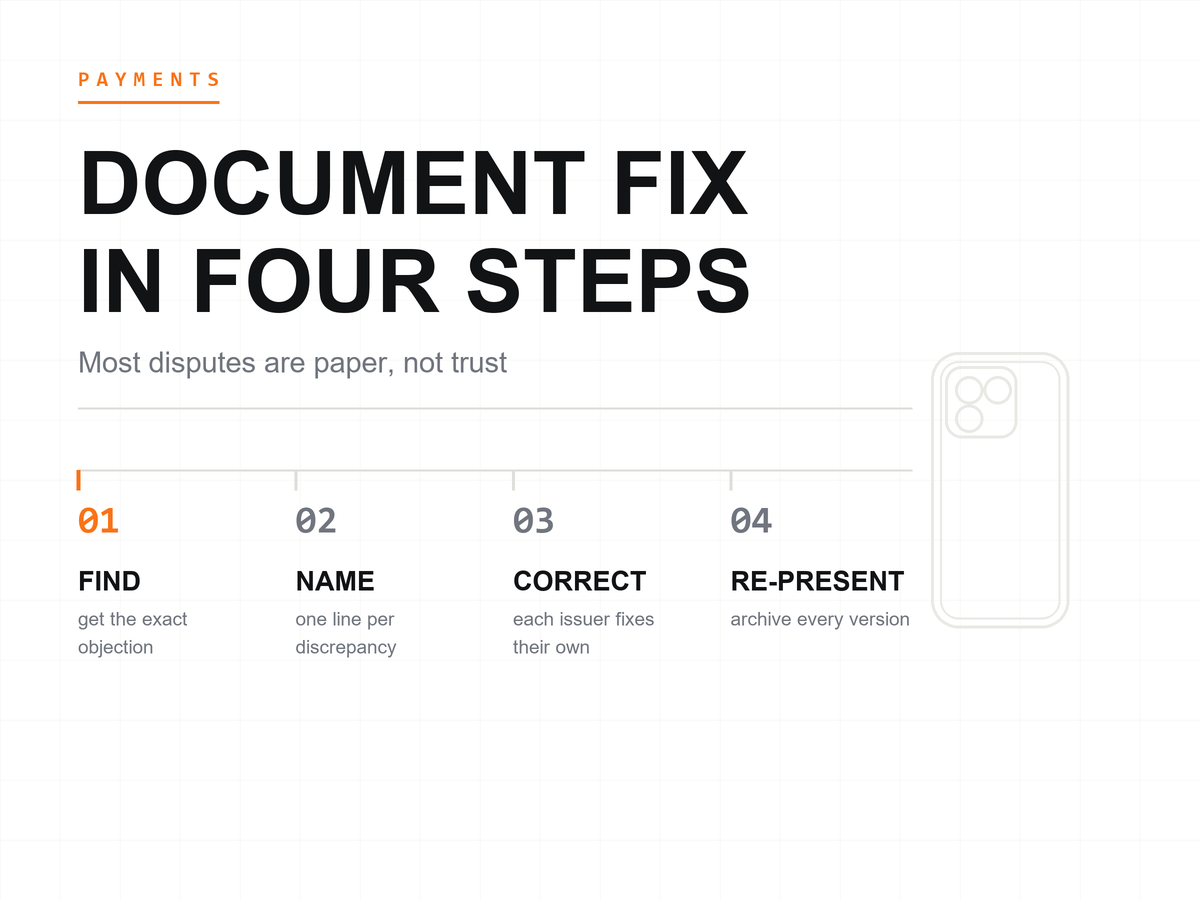
A payment that stalls mid-route is usually not a trust problem. It is a document problem, and document problems have an order to them: find the discrepancy, name it, correct it, re-present it. iFunSmart works shipping papers in that sequence, because the money follows the documents rather than the promises around them.
Last updated: October 9, 2026.
Why a Payment Stalls on Paper
When a payment moves against documents, someone on the paying side reads every paper twice: once against the payment instruction, and once against the other papers in the set. A discrepancy is a single point where one document contradicts the contract, another document, or the instruction the payment is working from. A buyer name that does not match the one registered at the bank, an invoice whose itemized lines disagree under its total, a transport document carrying details the contract does not carry — these are the ordinary shapes it takes.
The paper moves the money. That is worth saying plainly, because a held payment is easy to misread as a broken relationship, and it rarely is one. A payment held for review is a checker asking the papers to agree. Give the checker a set that agrees, and the hold loses its reason.
Find It: Get the Notice in Writing
A message that says only the documents were refused is not something anyone can work with. The first move is to ask the paying side, or the document checker behind them, for the specific point in writing, in the words the checker used. Documents not in order is a mood. A consignee name that does not match the invoice is a point.
If the notice carries several points, that is good news, because each one can be taken on its own line. What wastes a round is correcting against a guess. A fix aimed at the amount does nothing when the checker was reading the name.
Forward the notice to us exactly as it reads, and we will take up the points that sit on our documents from there.
Name It, Then Correct It
Write each point on its own line, keeping the checker's wording rather than your paraphrase, because the paraphrase is where the meaning drifts. The line-by-line list turns a rejection into a work sheet, and a work sheet says who owns each fix. The ownership rule is short: whoever issued a document corrects it. When the point sits on our invoice or our packing list, we correct it and return the corrected version. A transport document goes back to the carrier or the agent that issued it, and a certificate returns to the body that stamped it.
Corrections also have a sequence. Start with the papers you control, and put in the requests for the ones you do not, so the slowest document is not the last one requested. Treat every correction as a new version rather than an erasure: the corrected invoice sits in the file beside the original it replaces, and the file grows instead of resetting. That habit sounds like paperwork until the day a checker asks which version of a document a decision was made on.
Re-Present, and Keep Every Version
Once the named points are corrected, the set goes back together, as one complete presentation rather than a loose stack of replacements. What returns from the checker is a fresh reading, and honesty about that reading matters: a correction removes the point it names, and it does not oblige anyone to accept on sight. A fresh reading can surface a fresh point. The file is what lets you meet one quickly — the original set, the written notice, each corrected version, the covering message — because answering a new question depends on seeing the last answer in full.
Settling the Details Before Documents Move
The cheaper place to work a discrepancy is before any document exists. Make one pass against the order confirmation: check that the buyer name and the beneficiary name read exactly as each is registered at its bank, that the addresses agree, and that the itemized amounts on the invoice add back to the confirmed figures. The payment structure and the itemized lines of a quote each have their own article on this site, and both feed this single check.
The check reads the same on every shipment. Whether the papers cover a mainline reorder of a magnetic flagship case for the iPhone 18 Pro Max, or a premium shipment in an armor build for the same handset, the document set repeats, and so do the details worth locking down once, in writing.
Common Questions From Buyers
Does a correction settle the payment?
It settles the point it names, and that is all it settles. The corrected set comes back under a fresh reading, and the checker can still raise a point nobody has met yet, which is why every version stays in the file. A correction cannot put a date on the money, and it does not make the next reading less careful than the last one. What it gives you is a set with nothing left named against it.
Does this apply outside a letter of credit?
The discipline does. A transfer leans on fewer papers, and the papers it leans on matter just as much: a beneficiary name that does not match the account registration can hold a transfer at the receiving bank, and an invoice that disagrees with the confirmation invites questions from both sides. iFunSmart does not hold funds or issue bank guarantees. Where a payment runs through bank instruments, the instrument's own terms govern, and our side of the file is the documents we issue and correct.
What should be settled before the first invoice goes out?
Names come first: the payer and the beneficiary, spelled exactly as each is registered at its own bank, because a bank matches letters rather than intentions. Addresses travel with the names, and the itemized amounts come last, read against the confirmed figures line by line. Settled once, in writing, those details keep every later document honest, and they cost far less than a corrected set does.
What to Do Next
Work a discrepancy in the order it hands you: find the named point, write it down line by line, correct each document where its issuer sits, and re-present the set with every version kept. Before the next shipment, make one pass over the names, the addresses, and the itemized lines against the confirmation, so the checker receives a set that already agrees.
iFunSmart is a Guangzhou factory, founded in 2010, with 15+ years in phone case and accessory manufacturing and buyers in 30+ countries. We issue and correct our own shipping documents, and we work a discrepancy notice point by point with the buyer whose money is waiting.
Send us the discrepancy notice you have received, and we will work the corrections and the re-presentation with you, point by point.
Apple and iPhone are trademarks of Apple Inc. iFunSmart is an independent manufacturer of phone cases and accessories and is not affiliated with, authorized, sponsored, or endorsed by Apple.