Oct 9, 2026Business Solutions
A Supplier Contact Who Answers: What to Expect
A phone number is not a response structure. What a first answer should contain, who handles what comes next, and how to test it before you order.
A phone number is not a response structure. Before ordering, a buyer wants a contact who can name the next step, its owner, and the time the answer will come. iFunSmart, a Guangzhou phone case factory, states its response window on its contact page. This article shows how to read any first reply as evidence of the process behind it.
Last updated: October 9, 2026.
A Number Is Not a Structure
Buyers collect phone numbers and WhatsApp lines when they shortlist factories, and that habit answers only one question: how to reach someone. It says nothing about who owns the answer once the message lands, or what happens if the person reading it is on leave. A response structure is the fixed pattern by which a supplier receives a question, names who owns the answer, and closes it with a next step and a time.
A structure survives absence. When the contact who quoted you steps away, a structured desk hands the thread to a colleague with the question history attached, and the reply continues where it stopped. A lone contact cannot do that. The exchange resumes from the record instead of from your patience.
The difference shows in the first exchange. A supplier with a structure treats each question as a small job with an owner and a deadline. A supplier without one treats it as a message to react to.
What a Good First Reply Contains
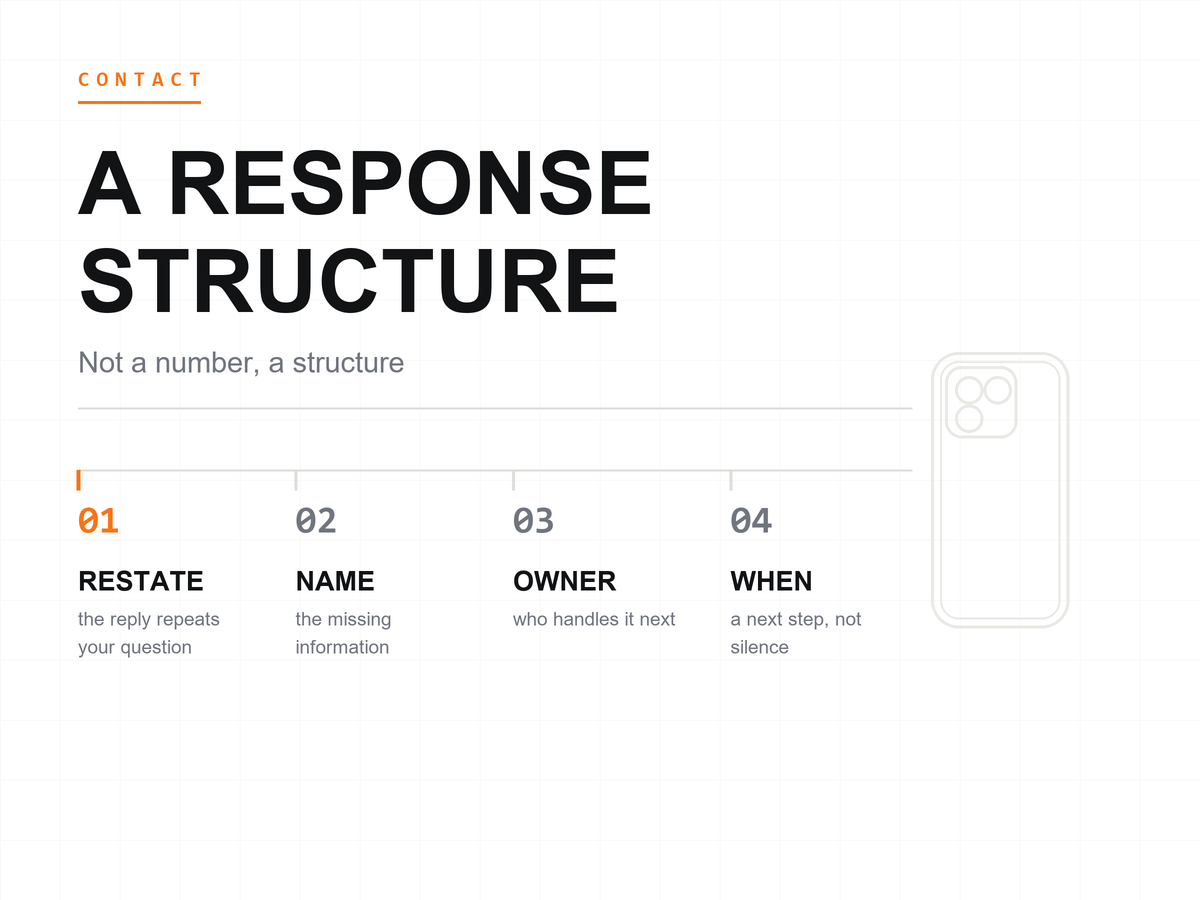
A good first reply does three jobs, and a buyer should check for each of them. The reply restates your question in the supplier's own words, which proves the reader understood it. It also points out what is still missing, because a case question is rarely fully specified in one line; the model, the finish, the packaging, and the volume all shape the answer. And it names the next step with the person who owns it.
A bare "OK" answers nothing. It may arrive in seconds, and it still tells you nothing about whether the question was read, whether anyone is working on it, or when you will hear back. Speed without content is noise.
Read a reply the way you read a quotation: line by line. Check which of your questions it answered and which it skipped, and look for the name that signs the next message. A reply that settles the easy part and leaves the hard part open is a warning, not an answer.
Structure Beats a Single Point of Contact
Buyers often ask for one person and one number, and that request misses the point. A single point of contact is useful, but it is not a structure. The question is what happens when that person changes jobs, takes leave, or hands the account to a teammate. In a structured setup the thread moves with its history attached, and the new owner can answer without making you repeat the spec.
Ask it directly: if your contact is away, who answers, and what does the next person know before you write? A supplier that can describe that handover is showing you a process. One that cannot is showing you a dependency.
Whether the same contact carries your account through a whole year is a separate question about the long run. This article stays inside the exchange itself: how one question moves from desk to desk, and what the record looks like when it passes between hands.
Test the Reply Before You Order
Every supplier looks responsive during the first chat. The test costs one message. Write a concrete question about a real style, the kind a buyer with an order behind it would ask. Ask about the card slots and the stand on an SKU to ask about, or about how a matte SKU on the question list reads in hand. Include the details a real order carries — the model, the finish you are weighing, the volume band you have in mind — then read the reply against the checks above.
The same habit that keeps sample rounds clean applies here: fix things in writing, the way sample terms get confirmed on an order confirmation, so both sides work from one document. Your question and the named owner belong in a record, not in two memories.
Do not judge by speed alone. A reply that takes longer and arrives with a spec check and a named owner beats an instant one that says nothing. The point of the test is not to catch a slow desk; it is to see whether the supplier has a desk at all.
What We State and What We Do Not
Our contact page states "Response within 24 hours." That line describes how our contact desk works. The hours stated on our contact page are our own statement, not an independent audit.
The reply you should expect from us does the jobs this article describes. It restates the question, asks for the spec that is still missing, and names who handles the next step. Behind the desk is a Guangzhou factory founded in 2010, molding cases with 1:1 precision and in-house CNC, serving brands and wholesalers in 30+ countries. A response structure is only worth as much as the work behind it, and a quick desk without a factory answers words, not production questions.
Tell us which style you would ask about first, and we will walk the question through the same structure this article describes.
Common Questions From Buyers
How fast should a supplier reply?
There is no magic number, and speed is the wrong test anyway. A reply that lands in minutes and says "OK" answers less than a later one that restates the question and names an owner with a time attached. Judge the content before you judge the clock. The response window we state sits on our contact page, and it is our own statement rather than an audit.
What should a first message contain?
A real question, not a greeting. Name the model you are buying for — an iPhone 18 Pro or an iPhone Duo — and the finish or the build you care about, the volume band you are weighing, and the deadline that matters to you. End with the question you actually need answered rather than a request for the catalog. A specific question returns specific information; a general one returns a catalog page.
Does the person who quotes also run the order?
It depends on the supplier, and the answer matters less than the process behind it. What you want is a named owner for each stage and a record that travels when the owner changes. Ask before you order: if the contact is away, who answers, and does the next person see the full thread? A supplier with a structure answers that question directly. A supplier without one changes the subject.
What to Do Next
Take one style you are weighing and write the question you actually need answered, with the model, the finish, the volume band, and your deadline in mind. Send it to each supplier on your shortlist and read the replies side by side against the checks from this article. The reply that restates your question and names both an owner and a time is the one worth trusting.
Send us one concrete question about a case you are considering, and read our reply against the checks in this article.
Apple and iPhone are trademarks of Apple Inc. iFunSmart is an independent manufacturer of phone cases and accessories and is not affiliated with, authorized, sponsored, or endorsed by Apple.