Oct 9, 2026Business Solutions
Which Items a Supplier Makes vs Buys
A supplier can make one category and buy another. The questions that reveal the split, so your quality and lead-time expectations sit on the right items.
One quote list can hide two supply chains. iFunSmart molds its phone cases in-house at its Guangzhou factory, yet an order that spans cases and accessories can mix lines we make with lines we buy in. Which lines are self-made and which are sourced decides how quality and lead times behave.
Last updated: October 9, 2026.
The Same Quote List, Two Different Promises
A quote arrives with every line looking equal: same layout, same supplier name at the top, same column of figures. The lines are not equal. A line the supplier produces itself carries one logic of quality, tooling, and scheduling. A line the supplier buys from a third party carries another, because the supplier's control over it stops where someone else's factory begins.
Two terms keep the split visible. A self-made item is one the supplier produces on its own tooling and lines; a sourced item is one the supplier buys from a third party and passes through to the buyer. Both can sit on the same order. A supplier who is open about which is which is telling the buyer something the quote format never shows.
Question One: Which Lines Are Yours, and Which Are Bought In?
Ask it per category, not once for the whole order. A phone case line has an origin a supplier can point to: which tool it comes from and which floor runs it. When the supplier names both, the line is theirs to control. When the answer routes through another factory, the line is bought in, and its quality and lead time live with a party the buyer has no contract with.
The question matters most on mixed lists. An inquiry that spans cases, straps, and charging accessories drops two kinds of goods into one basket, and treating every line as factory-made is how expectations break later. Each line fails in its own place.
The answer changes what a defect means. On a self-made line, a problem is the supplier's own process to fix. On a sourced line, the problem belongs to a third factory, and the supplier is a relay for it. A buyer should want that distinction spoken, not guessed.
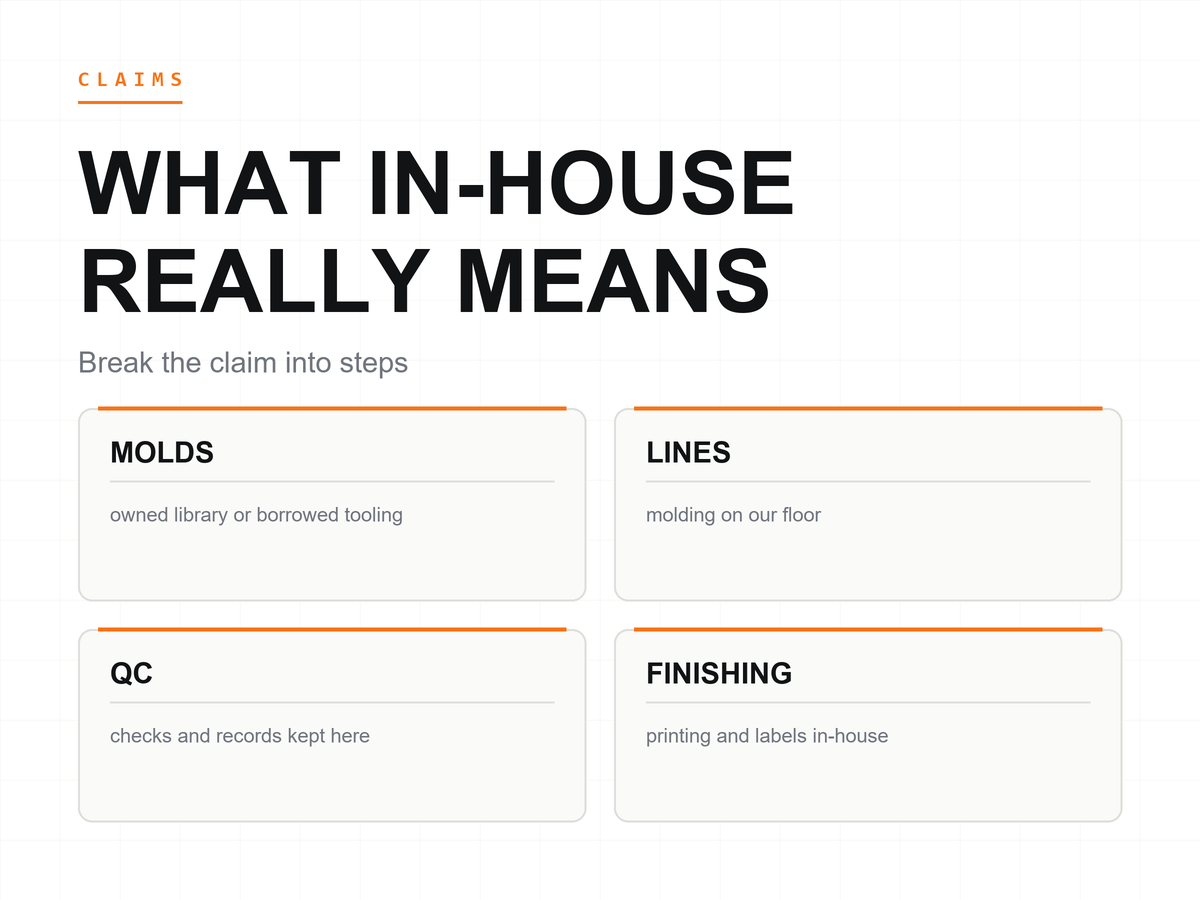
Our own answer is short because our case business rests on one claim we can show. We mold our phone cases in-house with our own tooling library, 1,000+ molds and in-house CNC behind it. That library carries a smoke-finished case we mold for the iPhone 18 Pro, and so does the rest of our case catalog.
Question Two: Who Inspects the Bought-In Lines?
A sourced item needs an owner for inspection, and the buyer should hear who that owner is before paying. The supplier may inspect third-party goods itself before they ship onward. Sometimes it leans on the original factory's check and passes the result along. Or it does neither and forwards the carton untouched. Each arrangement puts the risk in a different place, and the honest answer is a specific one: we inspect here, or the original factory inspects, or inspection is the buyer's own step.
The follow-up is who owns the fix. When a sourced line fails, does the supplier replace it on its own account, or does the buyer inherit a conversation with a factory they have never spoken to? That answer tells a buyer what they pay the supplier for on that line.
For the lines we mold, the origin is not a relay. The tool and the line sit in our Guangzhou factory. For sourced lines we make no equivalent claim. We do not promise sourced categories the in-house control our molded cases carry.
Question Three: Where Does the Lead Time Come From?
Lead time behaves differently on the two kinds of lines. A self-made line is scheduled: the supplier knows its mold, machine hours, and finishing steps, so the date it quotes is a date it owns. A sourced line is waited for. Its quoted date is the third party's date plus transport and handling, and every slip on that floor lands on the buyer's timeline unchanged.
The difference shows when a date moves. A slipped self-made line is the supplier's schedule to fix, and the supplier can answer with what it will do. A slipped sourced line is an upstream problem the supplier can only report. One answer lets a buyer replan; the other forwards news.
That is why one line on a quote can be firm while the line below it is soft. The buyer who asks where each date comes from learns which lines can be pulled forward and which cannot. One line in the first group is easy to name: a mainline molded design for the iPhone 18 Pro Max, a molded case on a schedule we control. A bought-in line sits in the second group by definition, however confident the supplier sounds.
Question Four: Put the Split in Writing
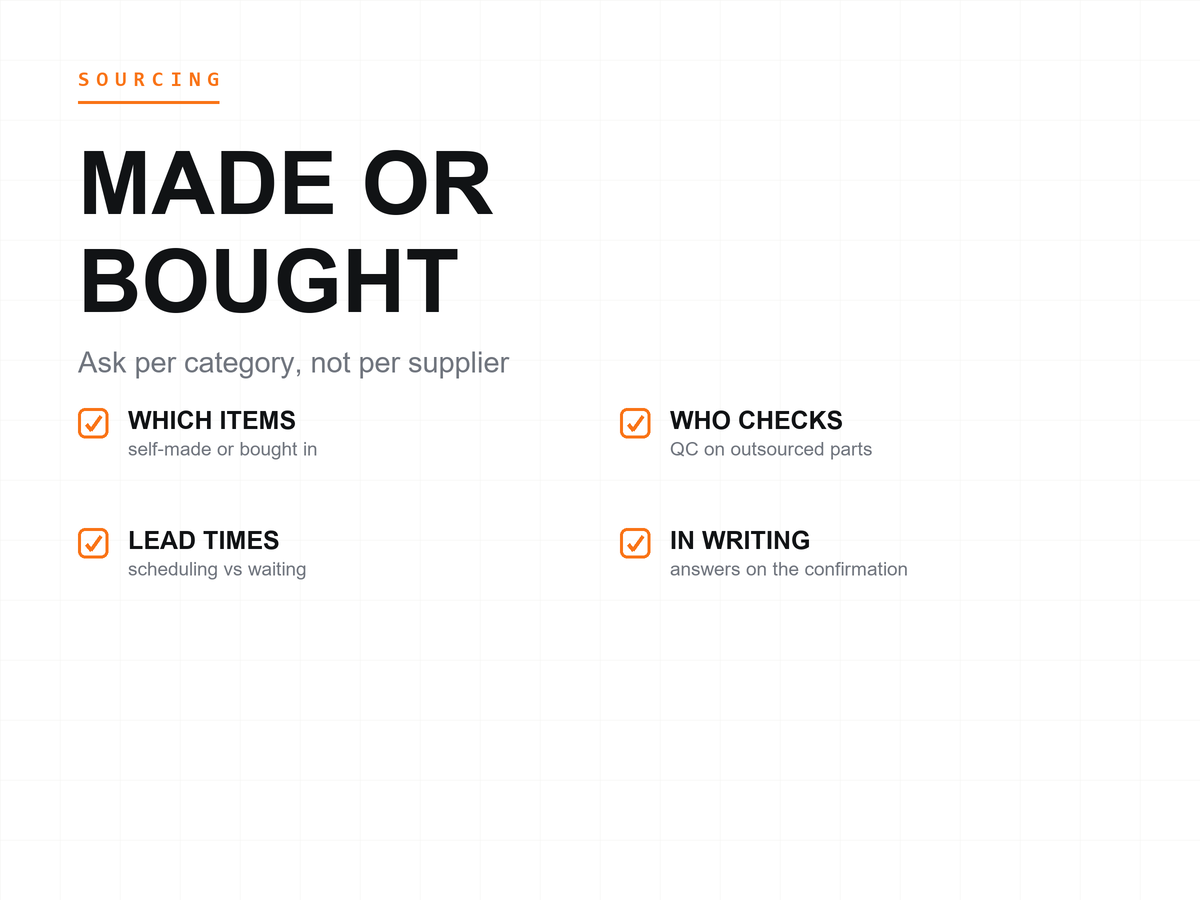
The four answers earn their value only when they survive into the order confirmation. A split that lives in a chat log protects neither side. Write it line by line: which categories are produced in-house, which are bought in, who inspects the bought-in ones, and whose date each line carries. Once the confirmation names these, a delay or a defect reads as a known fact of that line instead of a surprise.
Our side of that discipline is stated plainly. Terms for categories beyond case molding are agreed per order. The other half is honesty about what we do not make: categories we buy in are not presented as our own production.
Common Questions From Buyers
Does One-Stop Sourcing Mean Everything Is Made In-House?
No. One-stop describes how a buyer orders — one contact, one invoice, one shipment — not where every line is produced. A supplier can consolidate many categories while making some and buying others. The consolidation is real; the production split still has to be asked about line by line. Both facts can live on the same quote, and a buyer should hold both in view.
Is a Supplier That Sources Some Lines Less Reliable?
Not by itself. Buying in a category is a normal arrangement, and long-standing suppliers often mix molded lines with sourced ones. What signals reliability is the honesty of the map: a supplier who names the bought-in lines, the inspection owner, and the date each line carries gives a buyer a plan. The risk sits with the supplier who cannot answer, not with the sourcing itself.
How Can a Buyer Verify a Claim of In-House Production?
Ask for the concrete trail behind the claim: which tool a line comes from, and whether the supplier can show the floor where it runs. A factory that molds its own cases can point to its tooling library and CNC room. We answer that way ourselves — our case catalog comes off our own tooling library with in-house CNC at our Guangzhou factory. Ask before the order, not after. A supplier that answers in generalities is often relaying someone else's floor.
What to Do Next
Take the quote in front of you and mark it: made or bought, who inspects, whose date. Send the marked list back and ask the supplier to confirm it in writing, and keep it for reorders. Four answers cost one message, and they shape everything that follows: quality, lead time, and who to call when either moves.
Send iFunSmart your item list and we will mark, line by line, which items we mold in-house and which carry per-order terms.
Apple and iPhone are trademarks of Apple Inc. iFunSmart is an independent manufacturer of phone cases and accessories and is not affiliated with, authorized, sponsored, or endorsed by Apple.