Oct 9, 2026Business Solutions
What a Factory's "In-House" Claim Covers
"We have our own factory" means different things per capability. How to break the claim into molds, lines, and QC, and check each one in turn.
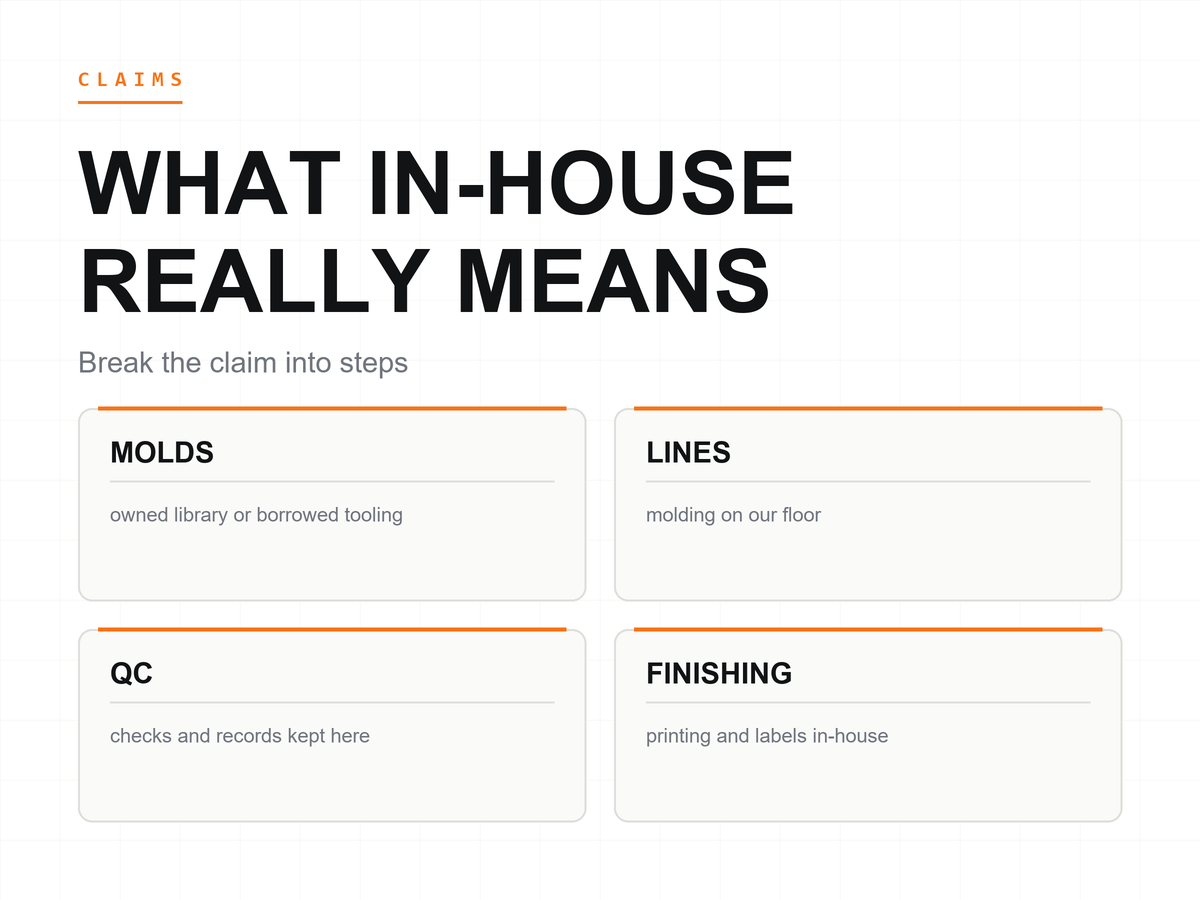
An "in-house" claim is not a single fact but a bundle of them. When a Guangzhou supplier like iFunSmart says the factory is its own, the words cover molds, production lines, quality control, and finishing work, and each step can be owned or outsourced separately. Check each in turn, and the claim becomes something you can verify.
Last updated: October 9, 2026.
What the Phrase Leaves Out
"Own factory" compresses several questions into a short phrase. A phone case passes through tooling, molding, inspection, and finishing before it reaches a carton. Every step has an owner: the supplier, a partner workshop, or a mix. A claim that does not say where each step happens tells you little about lead times, rework speed, or who to call when a batch fails inspection.
An in-house capability means a step performed on the supplier's own equipment, in the supplier's own space, by the supplier's own staff, with the records kept on the supplier's side. Ownership changes what you control.
A supplier can own some steps and outsource others. The useful answer is not a single yes, but a statement of which steps sit where, and the same supplier can answer differently for different product lines.
Molds: Who Owns the Tooling
A mold is the slowest asset in the chain and often the most valuable. Tooling can belong to the factory, to a customer who financed it, or to an outside tooling house that runs production on it. Each arrangement is normal somewhere in the industry, and each changes what a buyer can expect. Owned tooling usually means quicker changes, because a revision to a camera cutout happens on the factory's own machines. It also means exclusive shapes, because the factory can keep a design out of a rival's catalog. Tooling held elsewhere does not make a supplier dishonest, but revisions then move through a partner, and ownership questions surface if the relationship ends.
iFunSmart works from its own tooling library. We hold 1,000+ molds, and our CNC is in-house, so a change to a design from our own tooling library starts on our own machines. That is the practical difference between owning tooling and borrowing it.
When you hear an ownership claim, ask which molds the supplier owns and who pays when a mold wears out. The answer shows up later as revision speed.
Lines: Where the Parts Are Made
Molding is where the claim turns physical. A workshop that runs its own injection machines controls the daily schedule, the machine settings, and the material lots. A factory that sends molding to a partner controls a purchase order instead. Neither setup is a fault on its own; the problem appears when the setup differs from what the sales conversation implied. Buyers who stock shelves care, because the production location decides who answers for a delayed batch and who can squeeze an urgent rerun into a schedule.
Our claim is specific to case molding. Our cases are molded in our Guangzhou workshop with 1:1 precision molding, and the CNC work that builds and maintains the molds is in-house. a Duo hinge build comes off our molding machines, and a buyer can watch that step on a recorded tour rather than take the sentence on faith.
Ask where, not whether. A claim without a location is a claim without a check.
QC: Who Checks, Who Keeps the Records
Inspection splits into the act of checking and the record that outlives it. When the inspectors work for the supplier and the batch notes stay with the supplier, a rework discussion can reference the same numbers and photos the factory saw. When inspection is contracted out, results tend to arrive as certificates without the working notes behind them. Both setups exist in the industry. What changes is how fast a question gets answered after the goods land.
Checks differ by type. Visual and dimensional checks catch the flaws an eye or a caliper can find, and physical checks such as a drop test catch what happens on impact. We run the cases we mold through a 10 ft / 3 m drop test, and a buyer evaluating any supplier can ask the matching questions: who staffs the inspection station, whether records are kept per batch, and what happens to a failed batch. Rework, scrap, and re-inspection are all workable answers. The warning sign is a supplier with no answer.
Finishing: Printing and Labeling
Cases rarely ship bare. Patterns printed on the back, logos, and the barcode or model label on the packaging are finishing steps with equipment of their own, and that equipment is not the same machinery that molds the case. A factory can run finishing in its own workshop or hand it to a printing house. The finished case looks the same either way until something goes wrong, and then the repair path differs.
For iFunSmart this step is stated plainly: we print and apply labels in-house. A label carries the barcode a warehouse scans, so a delay in this step can strand a shipment at receiving. When a buyer asks a supplier about labels, a vague answer is an open question, not a small detail.
Common Questions From Buyers
How Do I Check a Claim Item by Item?
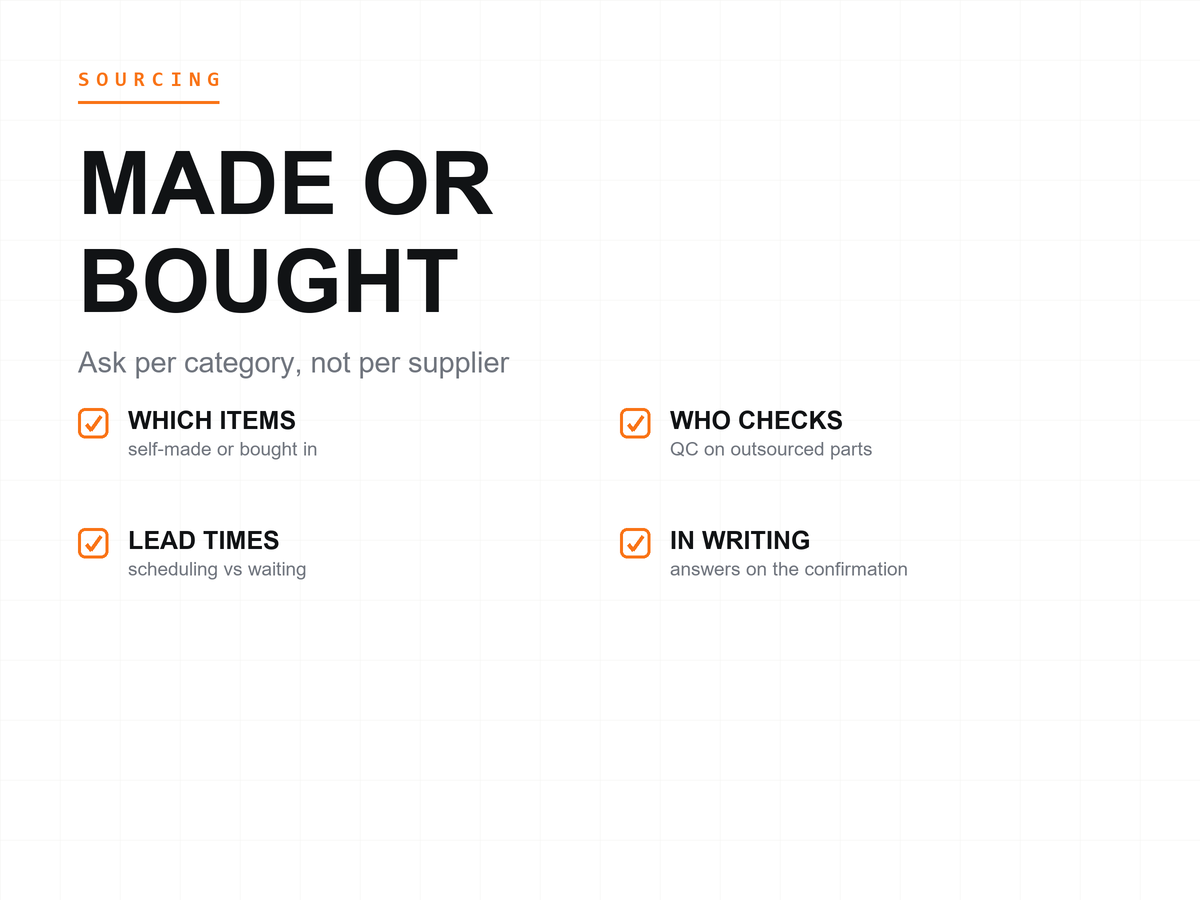
Walk the same short route each time. Name the step, then ask where it happens and who runs it, and look for evidence that matches the answer. A factory that says molding is in-house should be able to show the molding floor on a video call or in a recorded tour, and the tour should show the same area the answer named. If a step matters to you, ask to see it on camera. Put the answers in your confirmation notes, because a claim that only survives the sales conversation is not a claim you hold.
Which Step Is Most Often Outsourced?
There is no fixed answer, but a pattern shows up. Finishing steps such as printing on the case and label production change hands more often than molds do, because they run on machines different from the molding floor and need different skills. Packaging leaves the factory most easily, and that is routine rather than a warning. Tooling ownership is the steadiest signal: a factory that owns its molds can change them, and a factory that does not must ask someone else.
Does "In-House" Mean the Supplier Makes Everything?
No. The phrase is per step, not per company. A factory that molds its own cases still buys raw materials and can bring in components from outside. The claim we make is limited on purpose: we mold phone cases in-house, and we print and apply labels in-house. We do not describe every step of every product we ship as in-house, and we would rather a buyer ask per step than assume a blanket claim.
The right question is not whether the factory is yours but which steps are yours and which are not. An answer split by step is the useful kind; a blanket answer is the kind to test.
What to Do Next
Turn the slogan into a checklist you can hold a supplier to. For the steps that matter to you, get an answer for where each happens and who runs it, and write the answers next to the confirmation you keep. You do not need every step in-house. You need to know which steps are, before the timeline is committed and the cartons are on the water.
Tell us which step you want to confirm, and we will answer with where it happens and who runs it.
Apple and iPhone are trademarks of Apple Inc. iFunSmart is an independent manufacturer of phone cases and accessories and is not affiliated with, authorized, sponsored, or endorsed by Apple.