Oct 9, 2026Business Solutions
3PL Inbound Appointments: The Step Before Stock
A shipment can clear customs and still sit in a truck queue. How inbound appointments work, why they slip, and where they belong in the timeline.
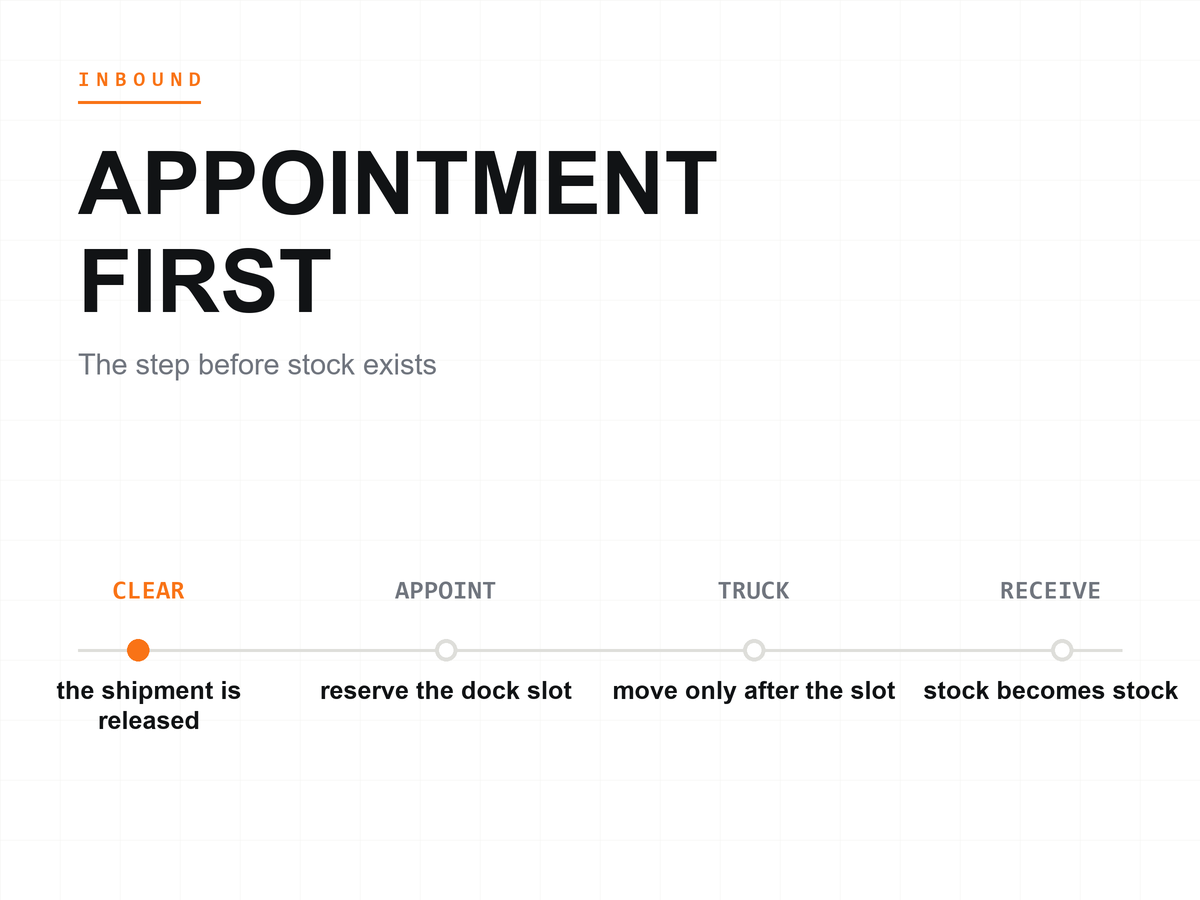
A shipment can clear customs and still sit in a truck queue, because unloading is gated by a 3PL slot that must be reserved before the truck moves. The appointment decides when stock becomes stock. Buyers importing iPhone cases from iFunSmart's Guangzhou factory meet this step on every container.
Last updated: October 9, 2026.
The Appointment Comes Before the Truck
An inbound appointment is a reserved dock slot that authorizes one truck to check in, park, and unload within an agreed window. A warehouse has a fixed set of receiving doors and a staffed yard, so it rations time instead of letting trucks show up at will. A dock crew can unload only so many trailers in a shift, and the 3PL would rather run a queue of reserved trucks than a line of surprised ones. That rationing is the whole point of the system, and it means the slot is settled before the truck moves, not after it arrives.
The planning direction is backward. The shelf date sets the appointment day, and the appointment day sets the pickup day, which in turn can only follow the customs release. A buyer who counts forward from the departure date ends at the gate with no slot, and that truck is early only in the calendar sense. The carrier should hold the appointment number before dispatch, because a truck sent without one arrives to wait. One slip passes down the chain, which is why the slot gets decided while the shipment is still in transit.
Why the Slot Slips
An appointment is a reservation, and reservations move. Peak windows fill first because most importers want the same dock times, and a buyer who books late gets whatever is left. The remedy for the peak is to book the moment the slot calendar opens, and to hold a second-choice window in reserve. A truck can also be turned away at the gate for incomplete documents, and one rejected check-in backs up the appointments behind it. Then there is volume: a shipment that shows up with more cartons than the appointment declared no longer matches the plan the warehouse staffed for, and the warehouse sends it back to the yard to rebook.
None of these failures is a customs problem. The goods are legally cleared and still not unloaded. What the three causes share is that they sit in different hands. Peak windows are market pressure. Rejected papers are a shipper-side failure, and an overage is a declaration failure. Two of the three are fixable before the truck rolls, which is why the checklist lives upstream of the gate.
Placing the Appointment in the Timeline
Book the slot behind the customs release, not ahead of it. A release that slips pulls the appointment with it, so leave a buffer between the release day and the appointment day, and confirm the slot only once the release looks firm. The buffer is not dead time; it is where a late release or a missed gate window gets absorbed, and it gives the carrier room to position a truck.
Before the booking call, gather the papers the gate will check: the commercial invoice, the packing list, and the delivery note, all stating the same quantity. A warehouse rejects what it cannot match against the documents, and a mismatch found at the dock means the slot was spent for nothing. Ask your forwarder for the appointment number before the truck is dispatched, and keep the release documents in one file.
Who Controls What
Split the appointment into the two sides that own it. The warehouse controls the slots: how many exist and what it takes to confirm one. We do not control warehouse appointment availability. What we control is the other half, the shipping documents and the declared quantities the gate checks against. The gate reads the papers before it reads the pallets.
Phone cases ship as light, bulky cartons, and the SKU mix changes the cube. A pallet of a bulky armor build stands taller than a pallet of slim clears, and a heavy-duty armor case for the iPhone 18 Pro Max needs a deeper carton. The dock plan runs on the counts we declare, so the packing list is what the warehouse staffs for. When our declared quantities and carton dimensions are accurate, the appointment's volume assumption holds, and that part of the gate is settled before the truck arrives.
What the Appointment Does Not Cover
The appointment is the gate, not the whole receiving step. It does not cover how fast the warehouse sorts and posts the inventory, or when the stock is shelf-ready. Putaway and the system posting are downstream work with their own schedule. A buyer who reads the appointment as a delivery promise sets the shelf plan too tight. The safer reading is narrow: the appointment buys the dock window and nothing downstream of it, which is one more reason the buffer belongs in the plan.
Common Questions From Buyers
When should the appointment be booked?
The slot should be confirmed before the truck is dispatched and after the customs release looks firm. Booking too early hands the warehouse a window the papers may not be ready for, and booking too late finds the peak windows taken. The rule of thumb is release first, appointment second, truck third. The practical test is simple: if the carrier does not yet hold the appointment number, the truck does not leave.
Why does a shipment still sit after customs clears?
Because clearance ends the customs step and the appointment opens the warehouse step, and the two do not overlap by default. A cleared container still needs a dock window, complete documents at the gate, and an arrival volume that matches the declaration. Miss any of them and the truck queues at the yard, not at customs.
Can a confirmed appointment still move?
It can. A dock window shifts when an earlier truck runs long or the warehouse reopens its slots, and that lever belongs to the warehouse, not to the seller and not to the carrier. The buyer's protection is the buffer left between release and appointment, plus documents that are ready before the truck rolls.
How should I respond when a slot slips?
Go through the carrier or your forwarder, because the warehouse owns the schedule and hears the carrier first. The documents and the declared quantities can be rechecked on our side while the carrier negotiates a new window. The split of control is the point: a warehouse-side slip runs through the carrier, and a paper slip runs through us.
What to Do Next
Treat the appointment as a step with an owner, not as a formality. The warehouse owns the slot, the shipper owns the papers and the declared quantities. The buffer between the two is the buyer's insurance. When the papers match the pallets and the buffer holds, the appointment becomes the quiet step it should be.
Send iFunSmart your warehouse's receiving requirements and shipment details, and we will prepare the documents and declared quantities your carrier needs at the appointment gate.
Apple and iPhone are trademarks of Apple Inc. iFunSmart is an independent manufacturer of phone cases and accessories and is not affiliated with, authorized, sponsored, or endorsed by Apple.