Business Solutions
Phone Case Quality Problems in Bulk Orders
Your bulk phone cases arrived with defects? Document the problem, grade it, decide rework vs return, and send a written claim your supplier can act on — before the next batch ships.
BLUF
Phone case quality issues in a bulk order are a documentation problem first and a negotiation second. Photograph and sort the affected units before anything moves, grade the fault, then send the factory a written claim with the evidence attached.
Short answer
Phone case quality problems in a bulk order feel like a disaster, and most of the damage is done in the first hour — not by the defect itself, but by what happens to the evidence. Cartons get opened and mixed, good units get sold, faulty units get thrown away, and by the time the supplier asks what went wrong there is nothing left to show. The order of work when a bulk delivery arrives with defects is therefore fixed: stop, document, grade, and only then decide what to ask for. Nothing is reworked, returned or resold until the record exists, because the record is what turns a complaint into a claim a factory can act on.
The first question to settle is whether the problem is real, and whether it is the factory's problem. A case that does not fit the phone it was made for, a coating that peels under a fingernail, a magnet ring that will not hold, a hinge that binds, a print that is off-centre, a carton that arrived crushed with the cases inside damaged — these are factory-side faults, and they belong in a written claim. A case ordered against the wrong model, a colour chosen from a screen rather than a physical sample, or a design the buyer approved in writing and then changed its mind about, are not. That distinction decides everything that follows, which is why the grading step comes before the claim step and never after it.
Our most common MOQ is 50 pcs per colour per model, and it varies by product line, so a bulk order is a real commercial quantity rather than a handful of samples. Bulk distributor orders start at 500 pcs per order in total, and free samples are available for distributors, so a distributor who has approved a physical sample has a production standard to hold the delivered batch against. If the delivered cases do not match the approved sample, the sample is the evidence, the claim writes itself, and the re-order decision is a question of what changes in the brief — not a question of whether to trust the supplier again on the same terms.
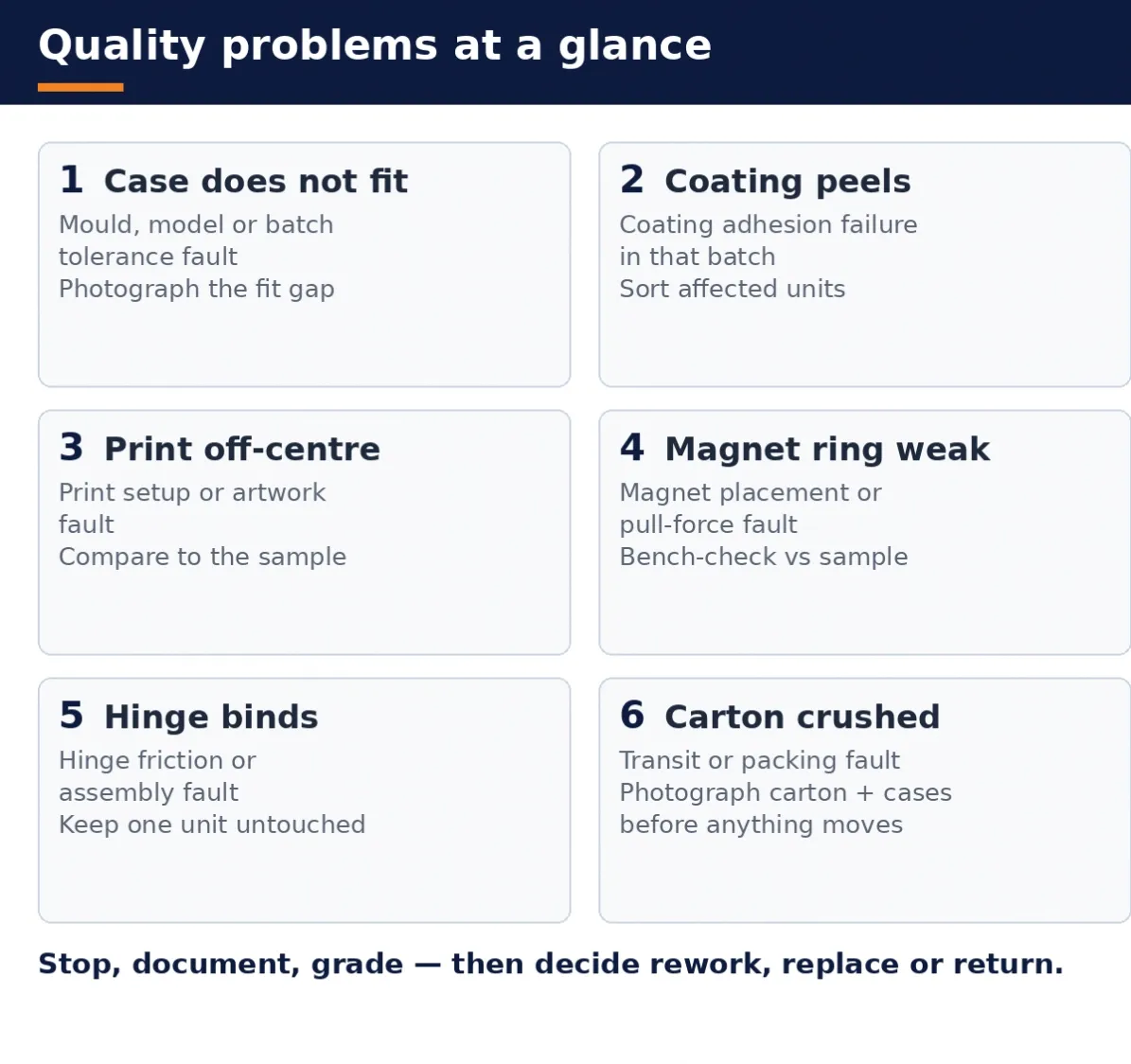
Quality problems at a glance
Problem | What it usually means | First step |
|---|---|---|
Case does not fit the phone | Mould, model or batch tolerance fault | Stop selling; photograph the fit gap against the approved sample |
Coating peels, flakes or bubbles | Coating adhesion failure in that batch | Sort affected units; keep one untouched as evidence |
Print off-centre, faded or wrong | Print setup or artwork fault | Compare against the approved artwork and the sample |
Magnet ring weak or misplaced | Magnet placement or pull-force fault | Bench-check against the sample; do not test by hanging weight |
Hinge stiff, loose or binding | Hinge friction outside the approved feel | Keep the unit whole; do not force it open or closed |
Cartons crushed or wet on arrival | Transit or packing failure | Photograph the cartons before opening; keep the packing |
Mixed colours or models in cartons | Packing or picking fault | Count and sort by carton before anything is shelved |
Logo wrong, missing or misplaced | Logo application fault | Check the approved artwork position against the delivered units |
1. How do you document phone case defects in a wholesale order before anything moves?
Phone case bulk order problems start with one rule: nothing moves until the record exists. The cartons stay where they are, the cases stay in the cartons they arrived in, and nobody sells, repacks, repairs or throws away a faulty unit before it has been photographed and counted. This feels slow when a retail customer is waiting, and it is the step that saves the claim: a factory can act on a photograph of a fault in its original carton, not on a description of a unit already binned. Treat the delivery as evidence first and stock second, for as long as the sorting takes.
Start with the outside. Photograph every carton as it arrived, including the labels, the tape, the corners and any crushing, wetting or puncture, before a single carton is opened. If a carton is damaged, photograph the damage from more than one angle and photograph the cases inside that carton before they are lifted out, so the link between the damaged carton and the damaged cases is visible in the pictures rather than asserted in words. Keep the packing material from any damaged carton: a crushed corner and a scuffed case inside it are two halves of one fact, and they need to stay together until the claim is settled.
Then open and sort, carton by carton, keeping a written count as you go. The count is the backbone of the claim: how many cartons arrived, how many units were in each carton, how many units show the fault, and how many are clean. Sort the faulty units by fault type, because a batch with one fault type is one problem with one cause, while a batch with several fault types may be several problems — and the factory needs to know which it is. Put the faulty units aside in their own cartons, labelled by fault type, and keep at least one faulty unit of each type completely untouched: no cleaning, no retrying the fit, no peeling at a loose edge. An untouched faulty unit is the reference piece the factory will ask for.
Photograph the fault itself the way a factory QC bench would see it, not the way a customer would. A fit problem needs a photograph of the case on the phone it was made for, showing the gap or the overlap, with the approved sample beside it where possible. A coating problem needs a close photograph of the peeling or bubbling area, and a photograph of a clean unit from the same batch beside it, so the difference is visible rather than described. A magnet problem needs a note of the bench check done — the magnet pull-force check against the sample — and the result in plain words, not a demonstration with improvised weights. A hinge problem needs a note of how the hinge feels against the approved sample — stiff, loose, binding — and the unit kept whole, because a forced hinge destroys the evidence of how it arrived.
Write the record down while the sorting is still happening, not from memory afterwards. The record names the order, the delivery date, the models and colours in the shipment, the carton count, the unit count per carton, the fault types found, and the count of faulty units per fault type. Attach the photographs to the record with the fault type and the carton number on each one, so that anyone reading the claim can match a picture to a carton without asking.
Two habits protect the claim at this stage. Keep the good units separate from the faulty units from the moment of sorting, and sell only from the clean stock — never from a mixed pile, because a faulty unit returned by a customer then cannot be traced to a carton. And tell the factory the same day the problem is found, with a short message saying what the problem appears to be and that a full written claim with photographs and counts is on its way. That message is not the claim; it is the notice that stops the clock, and it should go out before the sorting is finished, so the factory knows the shipment is being held and does not treat silence as acceptance.
2. How do you grade phone case defects wholesale buyers report: cosmetic, functional, or batch-wide?
Grading phone case defects in a wholesale order means sorting faults into three kinds — cosmetic, functional, and batch-wide — because each kind leads to a different remedy, and asking for the wrong remedy turns a reasonable claim into an argument. A cosmetic fault changes how the case looks. A functional fault changes how the case works. A batch-wide fault means the problem is not in a few units but in the run itself. The grade is decided by what the fault does to the case, not by how annoyed the buyer is, and it is decided against the approved sample, which is the production standard both sides agreed.
A cosmetic fault is a fault a customer can see but that does not stop the case from doing its job: a faint parting line that is more visible than on the sample, a small scuff on a surface that is not the display face, a print that is very slightly off-centre but still legible and in the right place, a colour that is a shade away from the sample without being a different colour. Cosmetic faults matter commercially — a distributor cannot sell a visibly marked case at full price through a retail channel that inspects stock — but they do not make the case unusable, and that matters for the remedy. Rework or replacement of the affected units are the remedies that fit. The test is simple: would a buyer who was told about the fault, plainly, still use the case? If yes, it is cosmetic.
A functional fault is a fault that stops the case from working as sold: a case that does not fit the phone, a button cover that does not press, a port cutout that blocks the cable, a magnet ring that will not hold the phone on a mount, a hinge that binds so the case will not open or close, a coating that peels off in use rather than sitting on the surface, a card slot that will not hold a card. Functional faults are not a matter of taste — a case that does not fit is not a case, and a distributor cannot sell it on the hope that the customer will not notice. The remedy is replacement or return of the affected units, or of the whole model where the fault affects it. The claim should name the function that fails and the bench check that shows it failing, because that is the evidence the factory needs to find the cause.
A batch-wide fault is different again: it is not a grade of one unit but a judgement about the run. The signs are that the same fault appears across cartons, across colours, or across the whole model — the same peeling on units from different cartons, the same fit gap on every unit of one model, the same misplaced print on unit after unit. When a fault is batch-wide, counting the faulty units matters less than establishing the pattern, because the pattern points at a mould, a coating run, a print setup or a material batch rather than at handling. The remedy for a batch-wide fault is a production-level one: a remake of the affected model, a return of the affected model, or a hold on the rest of the order while the cause is found. It is also the grade that most affects the re-order decision, because an unexplained batch-wide fault will repeat on the next order.
There is one more distinction the grading step has to make, and it is the one buyers most often miss: the difference between a fault and a characteristic of the material. Liquid silicone shows handling marks more readily than hard PC; a clear case shows a parting line more readily than an opaque one; a textured finish hides small marks that a gloss finish shows. The approved sample is the arbiter here: if the sample shows the same characteristic to the same degree, it is the product as agreed, and the claim should not be built on it. If the delivered batch shows it far beyond the sample, it is a fault, and the sample is the proof. That is why the sample is kept, and why the comparison photograph — delivered unit beside approved sample — is the most useful evidence in a quality claim.
Grade each fault type once, in writing, and let the grade decide the remedy asked for. A claim that grades every fault as batch-wide and demands a full return reads as a buyer who has not looked at the goods; a claim that grades honestly reads as a buyer the factory can work with, and it is the claim that gets a production answer rather than a defensive one.
3. Phone case rework vs return: how do you decide for a wholesale order?
The rework versus return decision for a wholesale phone case order is a commercial decision, best made with four questions in order: can the fault be fixed, who fixes it, what does the fix cost the buyer in time and reputation, and what happens to the units that cannot be fixed. A fault that can be reworked cleanly, at the factory, without touching the units that are already good, is usually worth reworking. A fault that cannot be fixed without remaking the unit is a replacement or a return. A fault that can be fixed only by the buyer, by hand, unit by unit, is almost never worth accepting — the labour, the inconsistency and the risk to the buyer's reputation are costs the claim should not absorb.
Rework fits a narrow set of faults. A misplaced print can sometimes be corrected where the print is applied, if the units can be stripped and reprinted without damaging the surface — but only the factory can judge that, and only on a trial unit first, never on the whole affected quantity at once. A logo that is wrong can sometimes be corrected by reapplying it, and for a small trial quantity a laser-engraving correction is one option the factory may offer — the 100-pc laser-engraving logo trial exists for exactly this kind of small-quantity logo work, and it is worth asking about where a logo is the fault. A carton that arrived crushed can be repacked, where the cases inside are undamaged. A mixed-colour packing fault can be re-sorted. What rework does not fit is a mould fault, a fit fault, a coating adhesion failure or a magnet fault: none can be fixed by handling the finished unit, and any attempt to fix them by hand makes the units unsaleable and destroys the evidence.
Return fits where rework does not. A case that does not fit, a coating that peels, a magnet ring that will not hold, a hinge that binds — these are remakes, not repairs, and the honest remedy is replacement units from a corrected run or a return of the affected units. A full return fits only where the fault is batch-wide and the order cannot be split into good and faulty stock. For a distributor, bulk phone case returns usually mean a partial return: the faulty model goes back, the clean models stay, and the claim covers the faulty model alone. The claim should say which it is, with the counts from the sorting step, so the factory is answering a specific proposal rather than a general complaint.
Three practical tests help decide between the two. The first is the trial test: ask the factory to rework a small number of faulty units first and send photographs of the result before anyone agrees to rework the rest. If the trial units come back clean, rework is real; if they come back marked or inconsistent, the claim moves to replacement. The second is the time test: a rework that takes the units out of the selling season is a delay, not a remedy. The third is the consistency test: a reworked batch has to be indistinguishable from a clean batch, because a distributor cannot sell two grades of the same model through one channel.
Who pays for the rework or the return is part of the decision, and it should be agreed in writing before any unit moves. The usual shape is that the factory bears the cost of fixing its own fault — the rework, the replacement units, and the freight on the returned or replacement shipment — but "usual" is not an agreement, and the claim should ask for the specific costs to be confirmed: who pays the return freight, who pays the replacement freight, and what happens to the faulty units once they are back at the factory. The buyer should also ask what happens to any units already sold from the clean stock before the fault was found, since a fault in sold units is a customer-service problem as well as a supplier problem.
Finally, record the decision in the same file as the sorting record and the photographs, with the date, the fault grades, the remedy agreed and the person at the factory who agreed it. A verbal promise is worth little once the units have shipped back; a written agreement with the counts, the grades and the freight responsibility named is the document the next order is built on. If the factory will not put the remedy in writing, that belongs in the re-order decision in section 6.
4. How do you write a phone case quality claim to a supplier?
A phone case quality claim to a supplier is a short business document with one job: to give the factory everything it needs to find the cause and agree a remedy, without a meeting and without a second round of questions. The tone is factual, the structure is fixed, and every sentence answers a question the factory will ask. A claim that does that gets a production answer; a claim that does not gets a request for more information, and the days lost are days the faulty stock sits unsold.
Open with the order facts, in the first lines: the order number, the order date, the models and colours, the quantities, the delivery date, and the date the fault was found. Then state the problem in one paragraph: what the fault is, which models it affects, and how many units are affected out of how many delivered. Use the counts from the sorting step, not estimates — an exact count is checkable against the factory's own packing records and an estimate is not.
Then give the evidence in order. Name the fault types, one at a time, with the grade for each — cosmetic, functional or batch-wide, as decided in section 2 — and attach the photographs for each type with the carton numbers on them. Describe the bench check that shows the fault: fit against the phone, coating adhesion, magnet pull-force and hinge friction against the sample, and carton integrity on arrival. Keep the description to what was done and what was seen, not to what the buyer thinks caused it — the cause is the factory's job to find. Include the comparison with the approved sample wherever the sample is the standard: delivered unit beside sample, difference visible.
Then state the remedy asked for, specifically and per fault type: replacement units for the functional fault, rework on a trial basis for the print fault, return of the affected model, and the freight responsibility for each movement. Name a date by which the factory's answer is needed, and the person at the buyer's end who will handle the return or the replacement. Close by asking for three things in writing: the cause as the factory understands it, the corrective action it will take on the next run, and the remedy it agrees, with the freight and the timing named. Those three answers are what turn a claim into a prevention plan, and a factory that gives all three is a factory worth re-ordering from.
Keep the claim to one message with attachments, not a chain of short messages spread over days. A single written claim, sent by email, with the photographs and the counts attached and the order number in the subject line, is a document both sides can file, forward to a production manager, and refer back to when the replacement units arrive.
One more point on tone, because it decides the outcome more often than buyers expect. A claim that is factual, specific and graded reads as a professional buyer who will be a customer again, and it is answered by a production manager. A claim that is angry, vague or exaggerated is answered by a sales representative. Keep a copy, with the factory's written reply, in the order file, because that file is the record the re-order decision in section 6 is made from.
5. How do you stop phone case quality problems in the next batch?
Preventing the next batch of phone case quality problems starts with the brief, because most repeat faults are brief faults: a model named by series rather than by exact model, a colour named from a screen rather than a physical swatch, a logo position described in words rather than marked on artwork. The brief for the next order should name the exact models, the exact colours, the exact artwork with its position, and the approved sample as the production standard, naming the sample by its approval date, so there is no doubt which sample the run is held to. A brief that leaves any of those to assumption will produce a batch that matches the assumption rather than the order.
Sample approval is the second control, and it is the one that most often gets skipped when an order is urgent. A physical sample, approved in writing before production, is the standard the delivered batch is judged against. The approval should record what was approved: the model and the fit, the colour, the coating feel, the print position, the magnet hold, the hinge feel, the carton and the packing. If the sample was approved with a condition — a colour to deepen, a print to move, a hinge to ease — the condition should be written on the approval, not carried in memory, because production will follow the written approval and not the conversation around it. No sample approval in writing, no production, however urgent the order feels.
Pre-shipment inspection is the third control, and it is where the phone case quality control checklist wholesale buyers ask for earns its keep. The checklist is the one in our pre-shipment guide: fit, parting lines, coating adhesion, print position and legibility, magnet pull-force, hinge friction, carton integrity, counts per carton, and the packing as it will travel. The buyer should ask, before the goods ship, which of those checks were done, on how many units, and with what result — and should ask for the result in writing with photographs of the checked units. A factory that can show a completed checklist with photographs is a factory whose next batch is worth ordering; one that cannot show one needs a third-party inspection or a smaller first order until the checklist is shown. The inspection is not a sign of distrust — it is the normal step between sample approval and shipment.
Two more changes are worth making after a faulty batch, and both are cheap. The first is to add the fault that actually happened to the checklist for the next order by name: if the fault was coating adhesion, the next order's checklist names coating adhesion explicitly, with the bench check that shows it; if the fault was a misplaced print, the next checklist names the print position with its measurement against the artwork. A generic checklist catches generic faults; a checklist that names the last fault catches the fault that is most likely to repeat. The second is to change the packing where the fault was a packing fault: stronger cartons, dividers between finishes, a count sheet and a contents label in each carton — small changes, agreed in writing, that stop a transit fault from becoming a batch fault.
Finally, the prevention step should include a conversation, not just a document. Ask the factory what it found when it investigated the claim, what it changed, and what it will check on the next run that it did not check on the last one. A factory that can name the cause and the change has fixed the problem; one that cannot will produce the same fault again. Write the answer down, attach it to the claim file, and let it decide the re-order.
6. Should you re-order after phone case quality problems — and what does a first order need?
The re-order decision after phone case quality problems in a bulk order is a decision about the supplier, not about the fault. A fault on one order does not end a supplier relationship; a fault that is unexplained, unremedied or repeated does. The buyer should ask three questions, in order. Did the factory answer the written claim with a cause, a corrective action and a remedy, in writing? Did the remedy arrive as agreed? And did the next sample, or the next small order, show the fault fixed? A supplier that answers all three is a supplier to keep, on a smaller next order first if the buyer prefers. A supplier that answers none of the three is a supplier to replace, however good the first orders were.
There is a middle case, and it is the common one: the factory answered the claim, agreed a remedy, but the cause it named is thin, or the remedy arrived late, or the fault is fixed on one model but not on another. In that case the re-order should be smaller, narrower and more tightly controlled: fewer models, the models that were clean, a fresh sample approval in writing, and a pre-shipment inspection with photographs. A smaller, controlled re-order tests whether the fix is real without putting the buyer's season at risk. What a buyer should not do in the middle case is place the same order again on the same terms and hope — hope is not a quality control.
The first-order checklist below applies the same discipline from the start, so a first-time buyer does not have to learn it from a faulty batch. Each item names the document or written confirmation to ask for before the deposit is paid.
- Write a brief the factory can produce from. Exact models, exact colours, artwork with its position marked, material as agreed, and the quantities per model and colour. Ask the factory to confirm the brief in writing, line by line, before quoting.
- Confirm the MOQ and the bulk terms per product line. Our most common MOQ is 50 pcs per colour per model, and it varies by product line — IPDK Duo 100, ISF Samsung 50, IP leather 30 to 50, IQ mostly 30, IPD 20, 30 or 50 by line — so confirm the MOQ for the lines in your order rather than assuming one figure.
- Approve a physical sample in writing as the production standard. Record the model and fit, colour, coating feel, print position, magnet hold, hinge feel, carton and packing. Note any condition on the approval itself, not in conversation.
- Ask for the pre-shipment quality control checklist, in writing, with photographs. Fit, parting lines, coating adhesion, print position, magnet pull-force, hinge friction, carton integrity, counts per carton. If the factory cannot show a completed checklist, ask for an inspection or a smaller first order.
- Agree the packing in writing. Carton strength, dividers between finishes, a count sheet in each carton, a label on each carton naming its contents — and who pays if the packing fails in transit.
- Confirm the payment sequence in writing. T/T and Western Union only; new customers may pay 30% deposit first; after the goods are ready the factory sends photos, video and the packing list; the customer pays the balance, then the goods ship.
- Agree the claim route before the goods ship. Who to contact, what evidence to send, and what the remedy is for a functional fault, a cosmetic fault and a batch-wide fault. A claim route agreed before shipment is answered faster than one negotiated after a fault is found.
- Keep the order file. Brief, quote, sample approval, inspection record, claim and reply, in one place. The order file is what the re-order decision is made from, and what turns one order's lesson into the next order's brief.
FAQs
Q1: How to handle defective phone cases in a bulk order?
Stop, document, grade, then decide. Photograph the cartons before opening them, sort the faulty units by fault type with a written count, keep one untouched faulty unit of each type as evidence, and tell the factory the same day that a problem has been found. Then grade each fault — cosmetic, functional or batch-wide — against the approved sample, and send a single written claim with the photographs, the counts and the remedy you are asking for.
Q2: What does a phone case quality claim supplier need?
The order number and date, models, colours, quantities, delivery date and the date the fault was found; the fault types with the count of affected units out of the delivered quantity; photographs of each fault type with carton numbers, including a comparison against the approved sample; the bench check that shows the fault; and the remedy asked for per fault type, with the freight responsibility and the date by which an answer is needed. Close by asking for the cause, the corrective action and the agreed remedy in writing.
Q3: Should I ask for rework or a return on defective bulk phone cases?
Ask for rework only where the fault can be fixed cleanly at the factory without touching the good units — a misplaced print corrected on a trial basis, a logo reapplied, a packing fault re-sorted. Ask for replacement or return where the fault cannot be fixed by handling the finished unit: a case that does not fit, a coating that peels, a magnet ring that will not hold, a hinge that binds. Ask the factory to rework a small trial number first and send photographs before agreeing to rework the rest, and agree in writing who pays the freight before any unit moves.
Q4: Phone case inspection failed — what to do before the goods ship?
Treat a failed pre-shipment inspection as the system working. Ask the factory for the completed quality control checklist with photographs, name the fault types and the grades, and hold the shipment until the cause and the corrective action are agreed in writing. The options are a corrected remake of the affected units, a re-inspection with photographs, or a smaller shipment of the clean units only — with the faulty units held back. Never accept a failed batch on a promise that the fault will be fixed after delivery, and never let the goods ship while the inspection result is still disputed.
Q5: How do I avoid phone case supplier quality issues on the next order?
Judge the supplier on how it handled the last claim, not how it sold the first order. A supplier worth re-ordering from answers a written claim with a cause, a corrective action and a remedy, in writing; delivers the remedy as agreed; and shows the fix on the next sample or the next small order. Before the next order, check the brief, the written sample approval, the pre-shipment checklist with photographs, and the claim route agreed in advance. If the supplier cannot show those four, order smaller, order fewer models, or order from a supplier that can — and ask us for a quote on your brief, naming the fault from the last batch.
About iFunSmart
iFunSmart — Ifun Electronics Technology Co., Ltd, Guangzhou, China — has made phone cases since 2010: 1000+ designs, 500+ models, 500K+ pieces a month, exported to 30+ countries. We reply within 24 hours. Send your brief — model, material, colours, logo and quantity — and we will quote it line by line, send a free sample for distributors, and confirm the fit, the MOQ and the inspection records in writing before your deposit.
Read more
- Phone Case Quality Check Before Shipment: A Checklist for Wholesale Buyers — https://www.ifunsmart.com/posts/phone-case-quality-check-before-shipment-checklist
- Phone Case Sampling: How to Evaluate a Sample Before a Bulk Order — https://www.ifunsmart.com/posts/phone-case-sampling-how-to-evaluate-a-sample-before-bulk
- How to Source Phone Cases from China: First-Order Checks — https://www.ifunsmart.com/posts/how-to-source-phone-cases-from-china-first-order-checks
- Phone Case Warranty & Returns: What to Ask Before Ordering — https://www.ifunsmart.com/posts/phone-case-warranty-returns-what-to-ask-before-ordering
- How to Read a Phone Case Quotation — https://www.ifunsmart.com/posts/phone-case-quotation-guide
- Phone Case Payment Terms: First Order — https://www.ifunsmart.com/posts/phone-case-payment-terms-first-order
- Bulk Phone Case Orders: How Volume Changes the Order — https://www.ifunsmart.com/posts/bulk-phone-case-orders-volume-guide
- What Distributors Look for in a Phone Case Supplier — https://www.ifunsmart.com/posts/phone-case-supplier-for-distributors