Business Solutions
E-Ink & Smart Display Phone Cases: What Buyers Order First
One E-ink style, iPhone 11–16, NFC battery-free display, metal ring stand. What to check on a sample, what the MOQ is, and what to confirm in writing before a bulk order.
BLUF
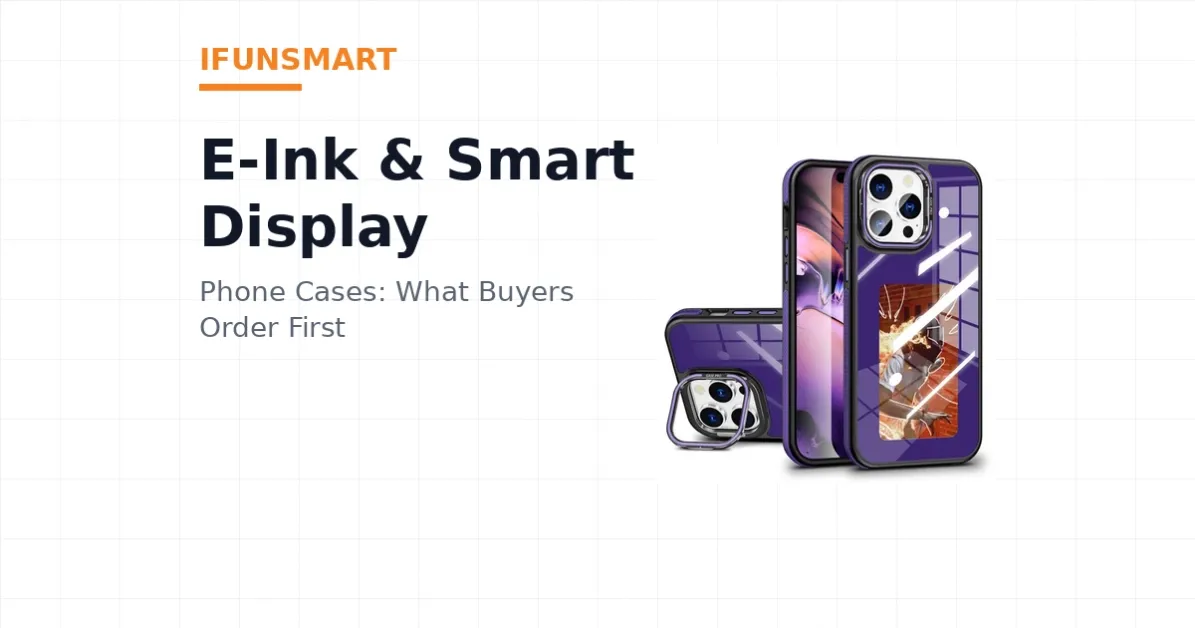
iFunSmart lists one E-ink phone case: a TPU + PC shell for iPhone 11–16, a four-colour E Ink display that updates over NFC with no battery, and a folding metal ring stand. Order it as a specialty line — check the sample first, confirm the full model list in writing.
Short answer
An E-ink phone case turns the back of the phone into a picture display that changes on demand and then stays put. The picture is sent to the case over NFC from a companion app, the display needs no battery and no charging, and the image keeps showing even after the phone is taken out of the case. That is the whole product idea in one sentence, and it is also the reason a distributor should treat this line differently from a clear case or a rugged case: it is a specialty product with one style on the site, for one phone family, and its value is the display, not the protection.
The range, as it stands, is a single style. The Smart E Ink Screen Phone Case with NFC and Metal Ring Stand is the only E-ink case on ifunsmart.com, listed for the iPhone 11–16 series, in TPU + PC, in three colours — Black, Purple and Gray — at our most common MOQ of 50 pcs per colour per model, with logo customisation and custom packaging supported. There is no second E-ink style to compare it with, no Samsung version on the site, and no page for iPhone 17 or 18. A buyer who wants this product orders this style, for these models, and confirms anything beyond that in writing before paying a deposit.
That narrow range is not a reason to skip the line. It is a reason to order it deliberately. An E-ink case sells as a gift, a promotional item and a retail novelty — the buyer is paying for a back that changes, not for another clear shell. The first order should therefore be small and exact: one model, the colours that suit the channel, a physical sample approved in writing, and the full model list confirmed before the bulk quantity is agreed. The sections below work through how the display works, which phones it fits, what the ring stand does, how colour, logo and packaging are ordered, who buys these cases and in what quantity, and the bench checks to run on the sample before a bulk order.
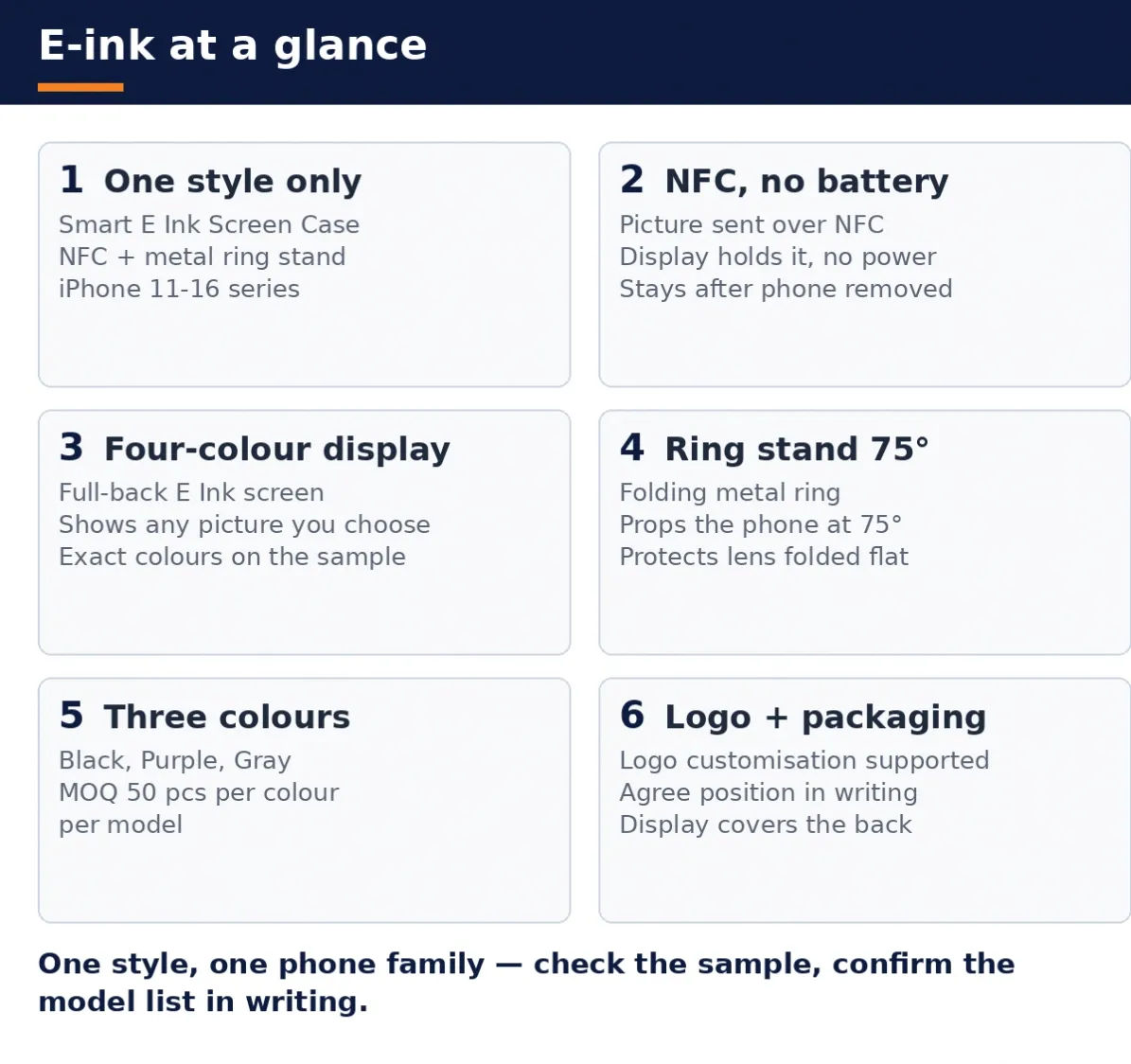
E-ink at a glance
Item | What the product page confirms | Confirm in writing |
|---|---|---|
Style | One style: Smart E Ink Screen Phone Case with NFC and Metal Ring Stand | — |
Models | iPhone 11–16 series | Full model list for your order |
Material | TPU + PC | — |
Display | Four-colour E Ink screen, NFC battery-free | Exact four colours on the sample |
Stand | Folding metal ring, opens at 75 degrees | — |
Colours | Black, Purple, Gray | — |
MOQ | 50 pcs per colour per model | MOQ for the lines in your order |
Logo & packaging | Logo customisation and custom packaging supported | Logo position — the display covers the back |
1. How does an E-ink phone case work, and what does NFC actually do?
An E-ink phone case works in two parts that a buyer should keep separate: the display and the transfer. The display is a four-colour E Ink screen that covers the back of the case. The transfer is NFC — the picture moves from the phone to the case wirelessly, and the display then holds the picture with no power at all. Nothing about the case needs charging, and there is no battery inside it. That is the fact the product page states plainly, and it is the fact that decides whether this product fits a buyer's channel: the case is a passive display, not a second screen that needs power, software updates or a cable.
The sequence on the sample is simple enough to check in a minute. Open the companion app, pick a theme, upload a picture of your own, or create one with the app's AI tool, then hold the phone to the case and send the picture over NFC. The display changes, and the new picture stays on the back when the phone is taken out of the case, when the phone is switched off, and when the case is sitting on a shelf. A distributor can demonstrate that on a counter with a customer watching: send a picture, lift the phone out, and the picture is still there. That demonstration is the product's selling point, and it is also the first sample check — if the picture does not transfer, or does not stay, the sample has failed before any other check matters.
Four points about the display need to be understood before ordering, because each one limits what the case can show. First, the display shows four colours. The page does not name which four, so do not assume a palette from another brand's E-ink case — the exact four colours are a question for the sample, and the sample is where a buyer sees them. Second, the display is an E Ink panel, not a phone screen: it holds a still image, it does not play video, and it does not refresh continuously. A buyer who orders it expecting a moving display will be disappointed, and a distributor who sells it as one will get returns. Third, the picture is sent over NFC, which means the phone and the case have to be held together for the transfer — there is no remote update, no Bluetooth pairing and no cloud push. Fourth, the display covers the full back of the case, which means the back is not available for a printed logo or a printed design in the usual way. Logo placement has to be agreed around the display, and section 4 covers how.
The companion app is part of the product, and it deserves a question in the first enquiry, not after the order is placed. The page describes what the app does — themes, uploads, AI creation, NFC sending — but it does not name the app, and it does not state which phones or app stores carry it. A distributor ordering for a retail channel should ask for the app name, confirm it is available in the market the cases will be sold in, and try it on the sample before approving the bulk order. If the app is not available where the buyer's customers are, the display cannot be changed, and the case becomes a fixed-picture product. That is a fact worth knowing before the deposit, not after the cartons arrive.
One more distinction matters for a wholesale buyer. The E-ink case is a display product first and a protective case second. Its shell is TPU + PC, and it sits in the site's Rugged Armor category, but the page makes no drop-test claim and no protection rating claim, and this article repeats none. A buyer who needs a protection-first case should order from the rugged range and judge it on the rugged checks in our armor guide. A buyer who orders the E-ink case is ordering the display, and the protection is the shell that carries it. Keep the two jobs separate when the sample is checked, and the order will be judged on the right standard.
2. Which phones does the E-ink case fit — and which does it not?
The E-ink case fits the iPhone 11–16 series. That is the compatibility the product page states, and it is the only model range stated anywhere for this style. The page also says to ask for the full model list, which means the series range is the headline and the exact models inside it are confirmed per order. A buyer should therefore treat "iPhone 11–16 series" as the starting point and the written model list as the order: name the exact models in the brief, get the list confirmed in writing, and approve the sample against the exact model it will be sold for. A case that fits the series in general but not the model on the shelf is a return, not a sale.
Three gaps in the range need to be stated plainly, because a buyer who assumes them will order wrong. There is no E-ink page for iPhone 17 or iPhone 18, and no E-ink page for any Samsung model. There is no second E-ink style for a different phone family. And there is no E-ink page for any other model family at all. If a buyer's channel needs an E-ink case for a newer iPhone or for a Samsung model, the answer is to ask us in writing — not to assume the iPhone 11–16 shell fits a newer phone, and not to assume a style exists because the technology exists. Phone fit is exact: a mould cut for one model does not fit another, and a case ordered against the wrong model is the most common avoidable fault in a bulk order.
The single-style range also changes how a first order should be shaped. With a broad range, a distributor spreads a first order across styles and learns which one sells. With one style, the learning is in the models and the colours, not in the styles. Order the models the channel actually sells — the iPhone models that move in that market — and order the colours that suit the channel, rather than ordering every model the page might cover. A first order of one model in three colours at 50 pcs per colour is 150 pcs, which is a sensible trial size for a specialty line; a first order spread thinly across six models the buyer has not checked is six chances to hold dead stock. The model list, confirmed in writing, is what turns the series range into an order.
One practical point on fit. The display sits on the back of the case and the ring sits around the camera, so the fit check on the sample has three parts, not one: the case must seat on the phone without a gap, the camera cutout must clear the lenses, and the ring must fold flat without touching the lens glass. All three are checked on the sample in section 6. If any of the three fails on the sample, the model is not approved, however good the display looks.
3. What does the ring stand do, and what protection does the case give?
The ring on the E-ink case is a folding metal ring around the camera. It opens as a stand at 75 degrees, and it protects the lens when it is folded flat. Those are the two jobs the page states, and they are both worth checking on the sample, because the ring is the only moving part on the case and moving parts are where a sample either passes or fails.
As a stand, the ring props the phone at a fixed 75-degree angle. That is a single angle, not an adjustable range, and a buyer should check it on the sample the way a customer would use it: set the phone on a flat surface, open the ring, and see whether the phone sits steady in both orientations the channel's customers will use. A stand that holds on a desk and slips on a shop counter is a stand that has not been checked properly. The ring is metal, so it will also take the wear of repeated opening and closing — the sample check in section 6 cycles it and looks at whether it still sits flat afterwards.
As lens protection, the ring does its work folded flat. When it is closed, it sits around the camera and stands above the lens glass, so the lenses do not touch the surface the phone is laid on. That is a simple, mechanical form of protection, and it is the only lens-protection claim the page makes. It is not a claim about drop protection, and it should not be sold as one. A distributor who needs a drop-protection story for this case should ask for the test report in writing, as our rugged guide advises for every armor style — and should not repeat any drop figure the page does not state.
The shell itself is TPU + PC: a soft TPU frame with a hard PC back, the same two-material construction used across much of the range. The display is set into that back, so the back is not a plain PC panel — it carries the E Ink screen, the NFC transfer area and the ring mount. That construction is why the sample checks in section 6 look at the back as a whole: the parting line where the frame meets the back, the seating of the display in the back, and the fixing of the ring around the camera. A shell fault and a display fault can look alike from the front; the bench checks separate them.
What the case does not claim matters as much as what it does. The product text does not use the word MagSafe, and it gives no magnet figure of any kind. The ring is a metal ring stand, not a magnetic ring, and the case should not be sold as MagSafe compatible on the strength of the ring. If a buyer's channel needs MagSafe compatibility, the question to ask in writing is whether this style holds a magnetic charger and accessories — and the answer to accept is the one that comes back in writing, tested on the sample, not an assumption from the word "ring". Our MagSafe guide covers what a magnet claim needs to show, and this style has not shown it on its page.
4. Colours, logo and packaging: what does a distributor order?
The E-ink case comes in three colours: Black, Purple and Gray. That is the full colour range on the page, and it is a short range for a reason — the display does most of the visual work, so the shell colour is a frame for the picture rather than the picture itself. A distributor ordering for retail should think about the three colours the way a frame shop thinks about frames: black suits a channel that sells the picture, purple suits a channel that sells the case as a fashion item, and gray sits between them. The purple is the colour shown on the product page's main image, with the display showing a photograph, and it is the colour a buyer should ask for on the sample if the channel has not chosen yet — it shows the display and the shell together.
The MOQ is 50 pcs per colour per model, which is our most common MOQ, and it varies by product line, so confirm the MOQ for the lines in your order rather than assuming one figure. For this style the arithmetic is simple: one model in three colours is 150 pcs at minimum, and one model in one colour is 50 pcs. A distributor ordering for a bulk threshold should remember that bulk distributor orders start at 500 pcs per order in total — across models and colours, not per model — so a 500-pc order on this style means several models, several colours, or a repeat of the models that sell. The colour split is a decision to make with the channel in mind, not a guess: order deep on the colour the channel sells, and order the other colours as a trial, rather than ordering equal quantities of all three and holding two of them.
Logo customisation and custom packaging are both supported for this style, and both need a conversation before the order, because the display changes where a logo can go. The display covers the full back of the case, so a logo printed across the back would sit on the display, not beside it. A buyer who wants a logo on this case should ask in writing where the logo goes — on the frame, on the ring, or on the packaging — and approve the position on the sample, with the display showing a picture, so the result can be seen as a customer would see it. The 100-pc laser-engraving logo trial is available for a small trial order, and it is worth asking about where the logo is the question: laser engraving is permanent, while silk-screen fades and needs a higher MOQ. But the trial does not solve the placement question — the placement has to be agreed first, on the sample, in writing.
Custom packaging is the other half of the order, and it is where a distributor selling this case as a gift or a promotional item gets the most value. The packaging should name the product plainly — an E-ink display case, NFC, no battery — and it should show the display with a picture on it, because a box that shows a plain back does not sell the product inside. The dieline, the barcode and the retail pegboard details are covered in our packaging guide, and the same rules apply here: confirm the packaging in writing, with the artwork position marked, before the deposit is paid. A gift-channel buyer should also ask whether the packaging can carry the buyer's own brand and the instructions for changing the picture, since the customer who receives the case as a gift will need to know how to change the display.
5. Who buys E-ink cases, and in what quantity?
E-ink cases sell to three kinds of buyer, and each one orders differently. The first is the gift and promotional buyer: a company that wants a phone case with its own picture on the back, for staff, for clients, or for an event. For that buyer the display is the product — the picture is the brand, the case is the carrier — and the order is usually one model, one or two colours, and a logo or a picture agreed in advance. The second is the retail novelty buyer: a shop or a chain that sells the case as a conversation piece, where the customer changes the picture at the counter and buys the case because the back changes. For that buyer the demonstration matters more than the colour range, and the order is usually spread across the models the shop sells, in all three colours, so the counter always has a case to demonstrate with. The third is the distributor who already sells phone cases and wants a specialty line that a competitor's shelf does not carry. For that buyer the E-ink case is a differentiator, and the order is a trial first — one model, three colours, 150 pcs — with a reorder when the first batch sells through.
The quantity question follows from the buyer, not from the product. The minimum for one model in one colour is 50 pcs, and the minimum for one model in all three colours is 150 pcs. A bulk distributor order starts at 500 pcs per order in total, so a distributor who wants bulk terms on this style needs to reach 500 pcs across models and colours — for example, three models in three colours is 450 pcs at minimum quantities, and a fourth model, or a deeper order on the best-selling model, takes it past 500. That arithmetic is worth doing before the enquiry, because it decides whether the first order is a trial or a bulk order, and the two are negotiated differently. A trial order is judged on the sample; a bulk order is judged on the sample and on the colour and model split.
Free samples are available for distributors, and a sample is the right first step for this style more than for most, because the display is the product and a photograph of it is not the same as seeing it. A distributor should ask for a sample in the model and colour the channel will sell, change the picture on it through the app, take the phone out and confirm the picture stays, open the ring to 75 degrees and set the phone down, and fold the ring flat and check the lenses. Those five checks are the sample, and they are the reason the sample exists. A sample approved on the strength of a photograph alone is not approved at all.
Reordering an E-ink case follows the same discipline as any other style, with one extra question: has the app changed? A reorder should confirm that the companion app is still available, still works with the phones the channel sells, and still sends pictures the same way. An app that has changed its name, its store listing or its transfer method since the first order is a fact the reorder needs to know about, and it is a question to ask in writing with the reorder, not a surprise to find on the customer's phone. Our reordering guide covers the model phase-out and colour continuity questions that apply to every style; the app question is the one that belongs to this style alone.
6. What should you check on a sample before a bulk E-ink order?
A sample check for an E-ink case has two halves: the display checks and the case checks. The display checks come first, because the display is the product. The case checks come second, because the case is what carries the display. Both halves are bench checks, done on the sample itself, with the results written down — not impressions, and not a demonstration for a customer, but a record the bulk order is judged against.
Start with the display. Send a picture to the case over NFC from the companion app, and confirm the transfer completes. Check the picture on the display for legibility: text should be readable, a photograph should be recognisable, and the four colours should be visible as four colours, not as a muddy single tone. Take the phone out of the case and confirm the picture stays on the display. Switch the phone off and confirm the picture is still there. Then send a second, different picture and confirm the display changes cleanly, with no trace of the first picture left behind. If any of those five steps fails, the sample has failed, and the bulk order should not be approved until the factory has answered in writing.
Then check the ring. Open the ring to its stand position and set the phone on a flat surface, checking that it sits steady at 75 degrees without slipping. Close the ring and check that it folds flat against the back, without rocking and without touching the lens glass. Cycle the ring open and shut on the bench sample and check that it still sits flush when closed and still holds its angle when open. A ring that is loose after a few cycles on the bench will be looser after a month in a customer's pocket, and the sample is where that is found.
Then check the case the way every case sample is checked: fit on the exact model, with no gap at the corners and no overlap at the edges; the camera cutout clearing the lenses; the button covers pressing cleanly; the parting lines where the TPU frame meets the PC back, with no raised edge and no gap; the coating adhesion on the frame, checked by hand on the bench sample rather than by scraping; the seating of the display in the back, with no lift at the edges and no gap around the screen; and the carton and the packing as they arrived, with the count per carton checked against the packing list. Our pre-shipment checklist covers these checks in full, and the same checks apply here — the display does not replace them, it adds to them.
Finally, get the answers that only come in writing, before the deposit is paid. The full model list for the order, confirmed line by line. The exact four display colours, confirmed on the sample. The app name and where it is available. Whether the style holds a magnetic charger and accessories, if the channel needs that. The MOQ for the lines in the order, the logo position, and the packaging artwork — all confirmed in writing. And the payment sequence: T/T and Western Union only; new customers may pay 30% deposit first; after the goods are ready the factory sends photos, video and the packing list; the customer pays the balance, then the goods ship. A sample that passes the bench checks and an order file that holds those written confirmations is a bulk order worth placing. A sample that has not been checked, or an order placed on assumptions, is a claim waiting to be written.
FAQs
Q1: How does an NFC E-ink phone case work — does it need charging?
No. The picture is sent to the case over NFC from a companion app, and the four-colour E Ink display then holds the picture with no power at all. The case has no battery and needs no charging, and the image keeps showing even after the phone is taken out of the case or switched off. To change the picture, hold the phone to the case and send a new one over NFC.
Q2: What iPhone models does the E-ink case fit?
The product page lists the iPhone 11–16 series, and the full model list is confirmed per order — ask us for the list in writing and name the exact models in your brief. There is no E-ink page for iPhone 17 or 18 and no E-ink page for any Samsung model. Do not assume the iPhone 11–16 shell fits a newer phone; fit is exact, and the sample should be approved against the exact model it will be sold for.
Q3: What is the MOQ for E-ink phone cases wholesale?
Our most common MOQ is 50 pcs per colour per model, and it varies by product line, so confirm the MOQ for the lines in your order. For this style that means 50 pcs for one model in one colour, or 150 pcs for one model in all three colours — Black, Purple and Gray. Bulk distributor orders start at 500 pcs per order in total, across models and colours, so a bulk order on this style combines models and colours to reach 500.
Q4: Can I put my logo on an E-ink phone case?
Yes — logo customisation and custom packaging are supported for this style. Because the display covers the full back, the logo position has to be agreed around the display: ask in writing where the logo goes, and approve the position on the sample with a picture showing on the display. A 100-pc trial order can already carry a logo by laser engraving, which is permanent; silk-screen fades and needs a higher MOQ.
Q5: Is the E-ink case MagSafe compatible?
The product page does not state MagSafe compatibility, and it gives no magnet figure, so do not assume it. The ring on this case is a folding metal ring stand, not a magnetic ring. If your channel needs MagSafe compatibility, ask us in writing whether this style holds a magnetic charger and accessories, and accept only an answer confirmed in writing and tested on the sample.
About iFunSmart
iFunSmart — Ifun Electronics Technology Co., Ltd, Guangzhou, China — has made phone cases since 2010: 1000+ designs, 500+ models, 500K+ pieces a month, exported to 30+ countries. We reply within 24 hours. Send your brief — model, material, colours, logo and quantity — and we will quote it line by line, send a free sample for distributors, and confirm the fit, the MOQ and the inspection records in writing before your deposit.
Read more
- Phone Case Quality Check Before Shipment: A Checklist for Wholesale Buyers — https://www.ifunsmart.com/posts/phone-case-quality-check-before-shipment-checklist
- Phone Case Sampling: How to Evaluate a Sample Before a Bulk Order — https://www.ifunsmart.com/posts/phone-case-sampling-how-to-evaluate-a-sample-before-bulk
- How to Source Phone Cases from China: First-Order Checks — https://www.ifunsmart.com/posts/how-to-source-phone-cases-from-china-first-order-checks
- Phone Case Warranty & Returns: What to Ask Before Ordering — https://www.ifunsmart.com/posts/phone-case-warranty-returns-what-to-ask-before-ordering
- Phone Case Quality Problems in Bulk Orders: What to Do When They Arrive — https://www.ifunsmart.com/posts/phone-case-quality-problems-bulk-orders
- How to Read a Phone Case Quotation — https://www.ifunsmart.com/posts/phone-case-quotation-guide
- Phone Case Payment Terms: First Order — https://www.ifunsmart.com/posts/phone-case-payment-terms-first-order
- Clear Phone Cases: What Distributors Order First — https://www.ifunsmart.com/posts/clear-phone-cases-what-distributors-order-first