Sep 24, 2026Business Solutions
Air vs Sea Freight: When Launch Week Pays More
A launch concentrates case sales into a few weeks, and every day on the water is a day out of the peak. When air freight earns its premium, and when sea wins.
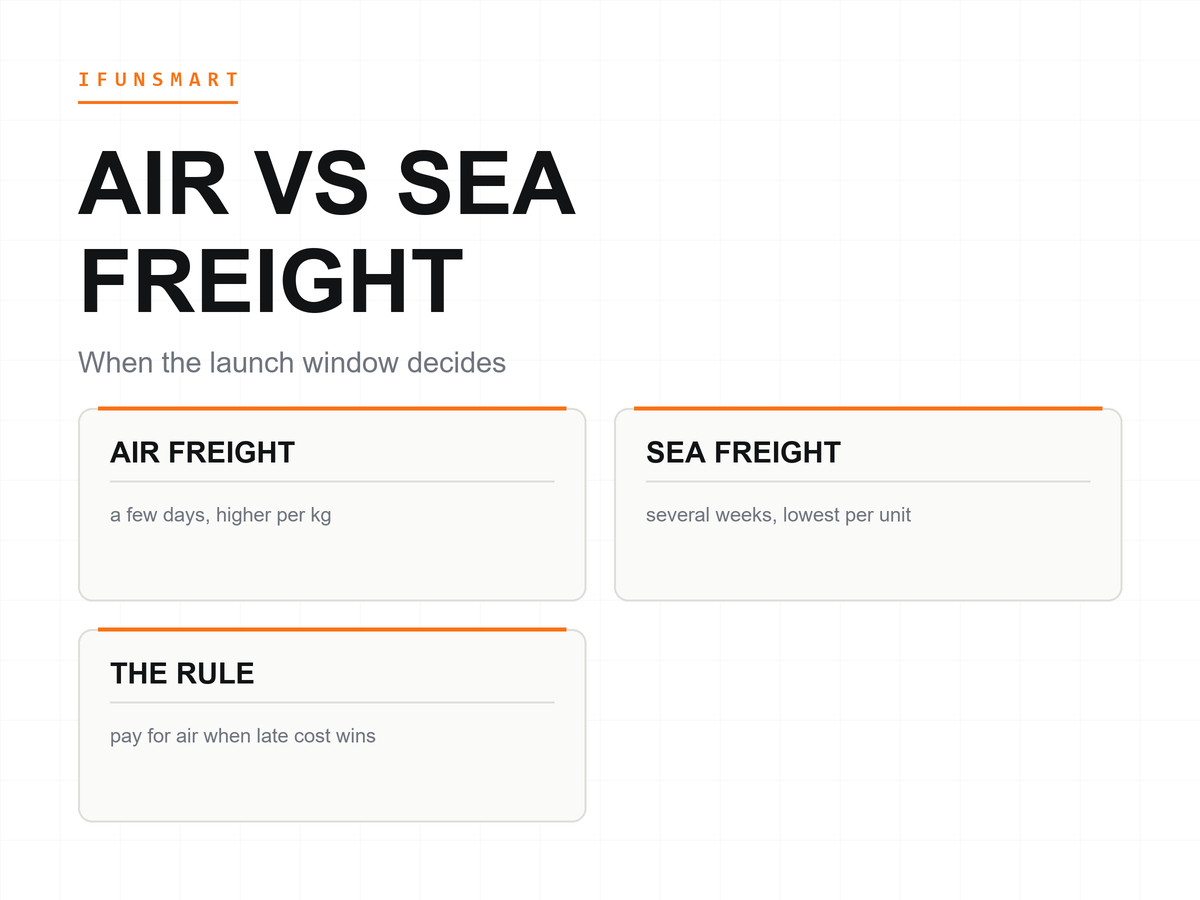
A new iPhone Duo or iPhone 18 Pro launch concentrates most of its case sales into a few weeks, and every day your stock sits in a container is a day you are not selling into the peak. Air freight wins when the late cost is bigger than the freight premium, and that calculation is one most buyers never run.
Last updated: September 24, 2026.
Why a Launch Is a Different Shipping Problem
An iPhone launch is not a normal restock. The first few weeks carry most of the volume, and the buyer who has cases on the shelf that week captures it at full margin. A reorder that arrives a month later lands after the peak and has to compete on price instead of availability.
Lead time is the gap between placing an order and the cases reaching your warehouse. In a steady month that gap is an inconvenience. In a launch week it is the difference between a full-price sale and a markdown, which is why the shipping mode deserves a real calculation rather than a habit.
Sea freight and air freight move that lead time by weeks, not days. Choosing between them for a launch is not the same decision as choosing between them for a routine reorder, and treating the two as interchangeable is the mistake that quietly costs buyers the peak.
What Air Freight Buys You
Air freight compresses the trip from our Guangzhou factory to most overseas markets into a few days instead of several weeks. The speed is the product, and the cost is the price of that product.
That speed buys three separate things. It lets you order closer to the launch, when you have real pre-order and early-sell data instead of a guess. It lets you top up a SKU that is selling faster than forecast — a MagSafe case for the iPhone 18 Pro Max, for example — without missing the rest of the window. And it puts your first batch on the shelf in time for the week demand peaks.
The tradeoff is cost per kilogram, and it is not small. Air freight costs several times sea freight, and the gap widens further when cargo space tightens during a launch season. Whether that premium is wasted or earned depends entirely on the other side of the ledger, which is what the next section measures.
What Sea Freight Saves You
Sea freight wins on cost per unit, and for a steady reorder that is the number that matters. A container moves thousands of cases for a fraction of the air price, which is why nearly every order outside a launch window should go by sea.
What sea freight costs you is time. Transit from Guangzhou to a US or European port runs several weeks, and that is before customs clearance and the final truck leg to your warehouse. Add production time and a first order stretches to two months or more from placement to shelf.
Sea freight is not a mistake. It is the wrong tool for a short, front-loaded window, in the same way that air freight is the wrong tool for a bulk reorder with no deadline. The decision is about the window, not the mode, and the window is what the launch creates.
When Paying More Actually Pays Off
Air freight earns its premium when the cost of arriving late is bigger than the extra freight, and that comparison has three parts.
The first part is the margin you miss. A case that sells at full price during the peak is money you keep, while the same case marked down after the peak returns far less. If the missed margin on your launch stock is larger than the air freight bill, the air freight has already paid for itself.
The second part is the cash tied up. Sea freight that takes six weeks to arrive means six more weeks your capital sits on the water, unavailable for the next order. Air freight returns that capital sooner, and on a small first order the carrying cost can matter as much as the freight itself.
The third part is the information you gain. Early sell-through data lets the second order be sized on fact rather than hope, and the second order is usually the larger one. That value is real even though it appears on no freight invoice.
The Late Cost Nobody Puts in the Quote
A freight quote shows two prices, one for air and one for sea. It does not show the late cost, because the late cost is not the forwarder's to calculate.
The late cost sits on your side of the table. It is the missed peak sales, the markdown on stock that arrives after demand has moved on, and the storage while that stock waits for the next cycle. In a launch window those three together routinely exceed the air freight premium on a first order, which is why the cheaper-looking quote can still be the dearer order.
We do not publish a per-kilogram freight rate, because it moves with the route, the season, and the volume. What we can do is put the two modes side by side for your specific order and tell you which one lands before your launch date.
Common Questions From Buyers
How do I know if my stock will arrive before the launch?
Work backward from the launch date using real transit times, not the shortest figure a forwarder quotes. If sea freight cannot clear your destination before the peak, air freight is not an upgrade; it is the only way to be in the market at all.
Does air freight ever cost more than the extra sales are worth?
It does when your margin is thin and your volume is large enough that the air premium becomes a real number. That is the situation where you split the order: ship enough by air to cover the launch week, and the rest by sea to arrive just after the peak, when the deadline pressure has passed.
What should I ship by air for an iPhone Duo launch?
Ship the launch-week quantity by air, and only the SKUs a buyer can see and name. For a foldable, that means the hinge cases for the launch and hinge protection case for the Duo that early adopters ask about first, rather than a full range spread thin.
What to Do Next
The freight decision should be made against your own launch date and your own margin, which is why we do not hand you a one-size answer. Send us the models and the destination market, and we will lay out the air and sea options and confirm which one arrives before your launch.
Send us your launch models and destination market, and we will confirm the freight mode and an arrival window before launch day.
Apple, iPhone, and Samsung are trademarks of their respective owners, used solely to indicate compatibility. iFunSmart is an independent manufacturer of phone cases and accessories.