Sep 23, 2026Business Solutions
After Your First Order: Deepen or Widen?
Your first batch's sell-through decides the second order. How to read velocity per design, model, and color, and when a new design beats a reorder.
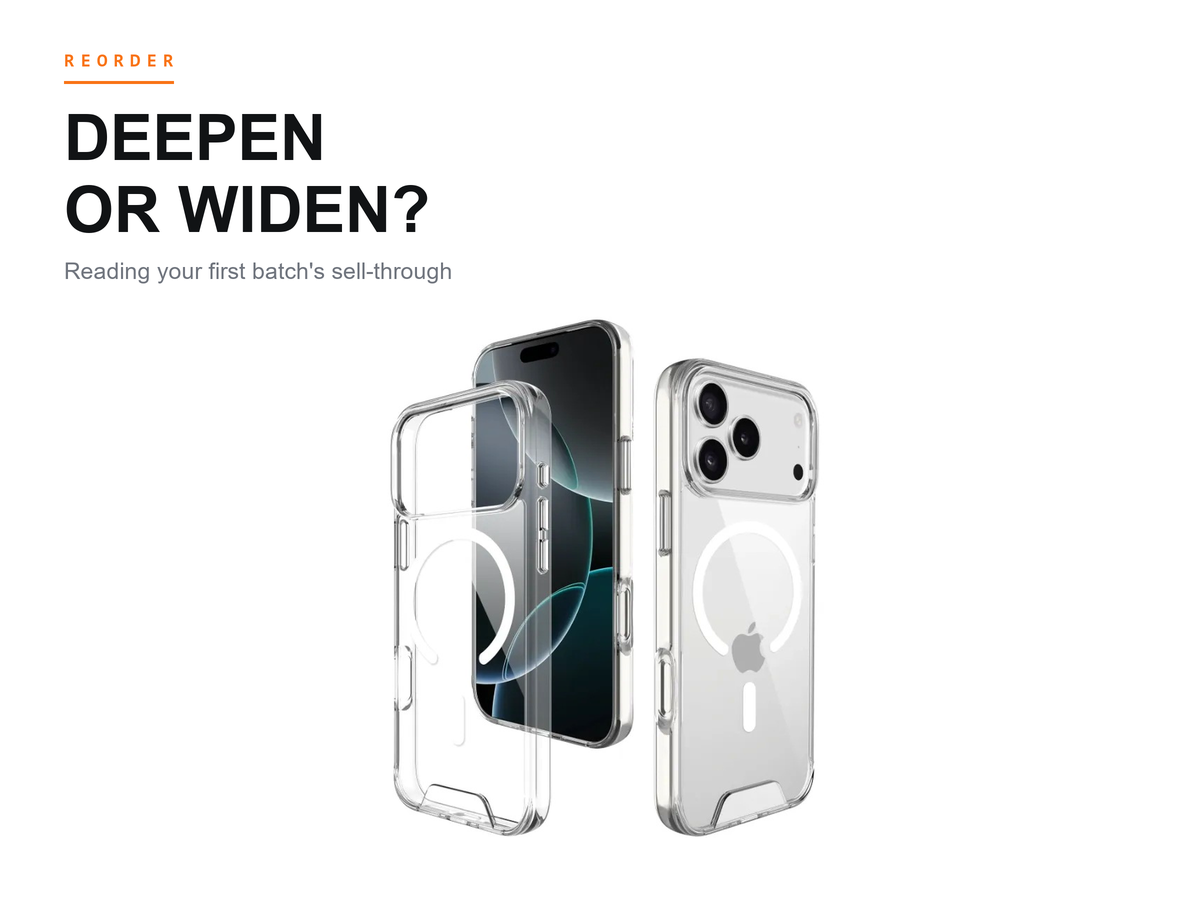
Your first order of iPhone and Samsung cases shipped, and the sell-through data is now in front of you. Every buyer reaches this moment and most guess. There are only two moves available — reorder the designs that sold, or add designs you did not carry — and the numbers from the first batch decide which one is right.
Last updated: September 23, 2026.
What Your First Batch Is Actually Telling You
Your first order was designed to produce information, and the information arrives as sell-through: how many units of each design, model, and color left the shelf in a given period.
Sell-through is the share of a delivered quantity that has sold in a period, and it is more useful than total revenue because it separates demand from inventory. A design that sold forty of fifty units has a high sell-through and a real signal. A design that sold forty of two hundred has the same revenue and a very different story.
Read the data at three levels: per design, per model, and per color. The pattern across those three is what tells you whether to deepen or widen, and most buyers only look at the first level.
The Two Moves You Can Make
Deepening means ordering more units of the designs that sold. Widening means adding new designs to the range.
Deepening is the cheaper move on almost every axis. It runs on tooling that already exists, it carries no new design risk, and it is a shorter production cycle than a new position because nothing has to be set up. When a design has proven demand, deepening is how a buyer converts a proven winner into profit.
Widening is the more expensive move, and it is the right one in a specific situation: when your leading design has a sell-through ceiling you cannot break with more units. That happens when the constraint is the design itself — a matte finish that only appeals to part of your market, for example — rather than the quantity you stocked.
The mistake is treating the two as alternatives. Most strong ranges do both: deepen the proven position, and widen by one or two designs to test the next generation of demand.
How to Read Which Designs Earn More Units
A design earns a reorder when its sell-through is high and its velocity is steady, and the second condition is the one buyers skip.
Velocity is the rate at which a unit sells, expressed as units per week rather than a total. A design that sold out in two weeks and one that took two months can have the same total, and only one of them is telling you to reorder now. Selling out fast is a stockout signal; selling out slowly is a range signal.
The useful comparison is against your own baseline rather than an industry figure, because your market decides what normal looks like. Rank your first batch by velocity, look at which designs held their pace through the whole period, and treat the top of that ranking as your reorder list.
One practical note: the color and model split inside a winning design often carries the real signal. A design that sold well in one color and stalled in the other should be reordered in the color that moved, not in both.
When Adding a Design Beats Reordering One
Add a new design when three conditions line up, and be strict about all three.
The first condition is that your proven designs are already well stocked relative to their velocity. If a winner is still selling faster than you can supply it, the money belongs in depth, not in a new test.
The second is that the new design answers a gap you can name — a finish your customers keep asking for, a build your current range does not cover. Adding a design because a catalogue showed it is how ranges get bloated.
The third is that the new position is small enough that a miss does not block your next reorder. A test that consumes your whole budget is not a test. We wrote about structuring a first order around that same principle, and it applies equally to the second move.
The Cost of Getting Either Move Wrong
Both moves have a failure mode, and they are not symmetrical.
Over-deepening on a design that was merely lucky leaves you holding stock that does not move, and the cost shows up as warehouse space and cash that cannot go into the next test. The tell is a design whose sell-through looked strong on a small quantity but weakens as your quantities grow.
Over-widening spreads a limited budget across too many shallow positions, and the cost shows up as stockouts on your actual winner while money sits in designs that never proved out. The tell is a range where nothing is stocked deep enough to survive a busy week.
The asymmetry matters: a stockout costs you a sale you had already earned, while dead stock costs you the capital for the next test. Buyers who protect the proven position first tend to grow the range faster over a year than buyers who chase new designs each cycle.
Common Questions From Buyers
How long should I wait before deciding?
One full selling period, long enough for velocity to be meaningful and short enough to act before your winner runs out. If you are launching into a peak season, shorten that window, because the season itself will move the numbers and waiting past it costs you the peak.
Should I reorder the same colors or add new ones?
When the winner is a micro-matte finish or a clear build, reorder the colors that moved and treat new colors as a widening decision, not a reordering one. A color is its own position with its own minimum, so a new color carries the same test cost as a new design and should be judged the same way.
What if nothing in my first order sold well?
Then the issue is usually the range rather than the individual designs, and the fix is to widen once with a genuinely different build rather than to reorder any of the current ones. That is a hard call to make, and it is better made from velocity data than from the hope that a slow seller will turn.
What to Do Next
Reorder decisions are cheaper and faster when the tooling already exists, which is the case for every design in our range — a reorder runs on an existing mold rather than a new one.
Send us the models and designs you want to take deeper, and we will confirm the production window and a ship date for a second order.
Send us your sell-through winners and we will confirm the reorder window for those designs.
Apple, iPhone, and Samsung are trademarks of their respective owners, used solely to indicate compatibility. iFunSmart is an independent manufacturer of phone cases and accessories.