Sep 23, 2026Business Solutions
Mixed-Model Small Orders: The Container Math Nobody Quotes
Mixing models and designs lowers your risk per position and raises your freight per case. How carton fill, LCL and FCL decide whether a mixed order pays.
A phone shop buyer sourcing iPhone and Samsung cases asked whether mixed models were possible, and the answer is yes — with a freight consequence that few suppliers explain up front. Splitting an order across many models and designs lowers your risk per position and raises your shipping cost per case. Here is how that math works before you commit to a wide, shallow order.
Last updated: September 23, 2026.
What Changes When You Mix Models
A mixed-model order is one purchase order containing several device models, designs, or colors, each in a smaller quantity than a single-model order would carry.
The benefit is obvious: you cover more of your customers with less risk on any one position, and buyers in four separate markets have asked us for exactly this. The cost is less obvious and lives in the carton, because freight on light bulky goods is billed on space rather than weight.
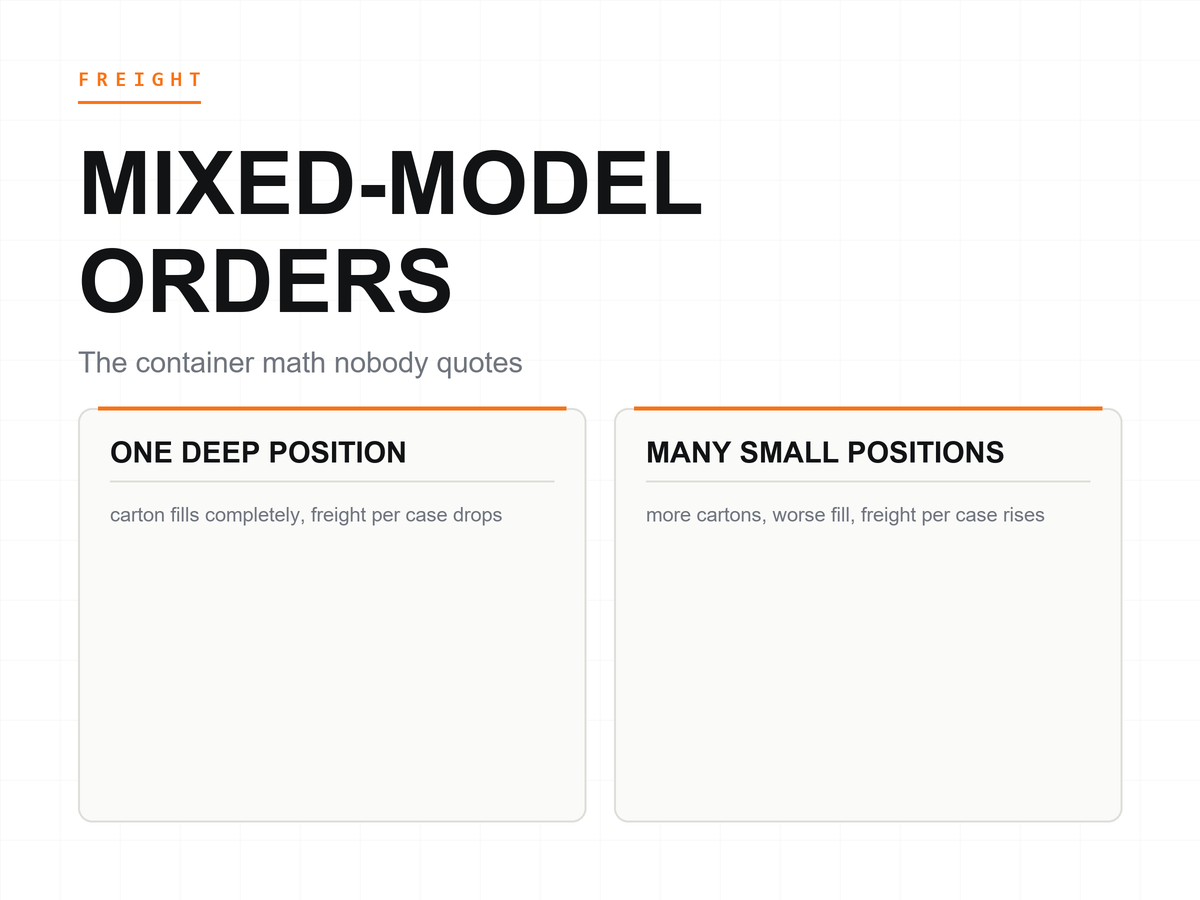
Every additional position in your order is a separate bundle that has to be produced, packed, labeled, and identified. Each one takes up carton space that a single deep position would have filled more efficiently. That is the whole trade, and it shows up on the freight invoice rather than on the product page.
Why Carton Count Rises Faster Than Piece Count
The carton is where mixed orders lose their efficiency, and it happens for a structural reason rather than a procedural one.
A carton of one design fills completely: the units are identical, so they tessellate and the empty space is close to zero. A carton of mixed positions is harder to fill because the bundles cannot be combined in every case — different models and colors often need to stay separately identifiable for your warehouse and your marketplace labels.
The result is a carton that holds fewer units than its volume suggests, and more cartons for the same total quantity. Since the freight bill for light goods follows carton dimensions and chargeable volume, the same number of cases can cost more to ship when they are spread across many positions. We have written about how volume weight is calculated, and a mixed order is the case where that calculation hurts most.
Container Fill: LCL Versus FCL for Mixed Loads
The container decision changes with the number of positions in the order, and this is where mixed orders need a plan rather than a default.
LCL, or less than container load, means your goods share a container with other shippers. It removes the need to fill a container yourself, and it charges you for the space you use. It suits orders that cannot fill a container and cannot wait to consolidate.
FCL, or full container load, means the container is yours. It becomes cheaper per unit once your volume is large enough to use most of the container's capacity, and it gives you control over how the cartons are stacked — which matters for a mixed order, because stacking is where unused space can be recovered.
For a mixed, shallow order the honest position is that LCL usually fits better at first, and the goal is to grow into FCL by deepening the positions that prove out rather than by adding more. Which one is right depends on your total volume, your destination, and how urgently the goods are needed, so it is a calculation per order, not a rule.
Planning a Mixed Order So Freight Stays Sane
Four habits keep a mixed order from quietly becoming an expensive one.
The first is to group positions that can share a carton. Models in the same family and finish often pack together, the way a clear MagSafe build and a translucent matte build sit in similar carton profiles. Telling your supplier which positions may be combined lets them pack the way your own warehouse prefers.
The second is to size the order around whole cartons rather than round piece numbers. A quantity that fills cartons exactly wastes no space, while a quantity that leaves every carton part-empty pays for the gap.
The third is to confirm the carton plan before production rather than after. Ask for pieces per carton, carton dimensions, and gross weight for your actual mix, then check those figures against the volume your own warehouse or marketplace charges you on.
The fourth is to keep the number of positions deliberate. Each position you add is a small bet, and a range with twenty shallow positions and no deep one has spread its risk so far that nothing can win a busy week.
Common Questions From Buyers
Is a mixed-model order more expensive to ship?
Usually yes, per case, and the reason is carton fill rather than weight. Mixed positions pack less efficiently than a single deep position, so the same quantity can occupy more cartons and more chargeable volume. The gap is manageable with a deliberate carton plan and grows when the mix is left unplanned.
Can I mix models and still get one shipment?
Yes, and consolidation into one shipment is the point of mixing rather than ordering separately. The practical requirement is a carton plan that keeps each position identifiable for your labeling while still filling the cartons, which is agreed before production rather than improvised at the warehouse.
How do I know if my order should be LCL or FCL?
It depends on total volume, destination, and urgency, and the deciding question is how much of a container your order actually uses. Ask your supplier for the carton plan and total volume, then compare that against LCL rates and a full container, because the crossover point is different for every lane and season.
What to Do Next
We build mixed orders regularly for buyers who carry more than one model, and we quote the carton plan alongside the case so the freight is visible before you commit.
Send us the models and designs you want in one order, with the quantities you have in mind, and we will return a packing plan with pieces per carton and total volume for your destination.
Send us your mixed-model list and we will return the carton plan with your freight estimate.
Apple, iPhone, Samsung, and Galaxy are trademarks of their respective owners, used solely to indicate compatibility. iFunSmart is an independent manufacturer of phone cases and accessories.