Oct 2, 2026Business Solutions
Your Buyer's Agent: How a Factory Cooperates
Many buyers purchase through their own agent. How a factory cooperates with that structure: specifications, samples, QC records, and shipping documents.
iFunSmart is a factory in Guangzhou, and many of the orders we ship arrive through a buyer's own agent rather than directly from the buyer. That structure works when both sides know where each piece of information goes. This page describes the operating flow: specifications, samples, QC records, and shipping documents.
Last updated: October 2, 2026.
We Work With the Agent You Already Use
iFunSmart is a factory, and we work with the agent a buyer already uses. A buying agent is the party a buyer appoints to place orders, coordinate suppliers, and carry documents between the factory and the buyer. On most runs that party shortens the loop to a decision, because the agent already knows the buyer's market, the shelf, and who signs off at home.
The arrangement behind the appointment belongs to the buyer. Our side is production and documents, so what follows is the operating channel only: who confirms what, where samples and documents go, and which desk gives the final acceptance.
One scope note sits in front of the flow. Our cooperation covers the products we manufacture ourselves. For categories we do not produce, we do not take on a purchasing role; we say so and leave those lines to the buyer's other suppliers.
Buyers also ask how to tell a factory from a trading company, and that test comes earlier in the process. By this point the agent is chosen, and the question is how a run moves between three desks: the buyer's, the agent's, and ours.
Where Specifications Get Confirmed
Every run starts with a specification both sides can read the same way. The model list comes first: iPhone 18 Pro, Galaxy S26, or whichever handsets the order covers, named exactly, with no shorthand that can drift between two parties. A case tooled for one chassis does not seat on another, so the model list settles the tooling before anything else moves.
Finish and hardware follow, line by line. A buyer ordering a clear case with an invisible metal stand and a buyer ordering a cherry color with a smoke skin finish are choosing two production routes, and the sheet has to record which one is approved. Surface treatment, magnet placement, button feel, and packaging artwork each get their own line.
Then comes the name that decides how everything else moves: the approver. An agent may hold full authority to confirm the specification, or the buyer may keep sign-off in house. Both arrangements work, as long as we know which one applies. A factory cannot treat a friendly message as an approval when the sender is not the named approver. Changes after acceptance go back into writing, on the same sheet, with the revision visible, and production starts only after the current revision is fixed.
Tell us which models you sell and where they sell, and we will point you to the specification sheet we hold for them.
Samples, QC Records, and Shipping Documents
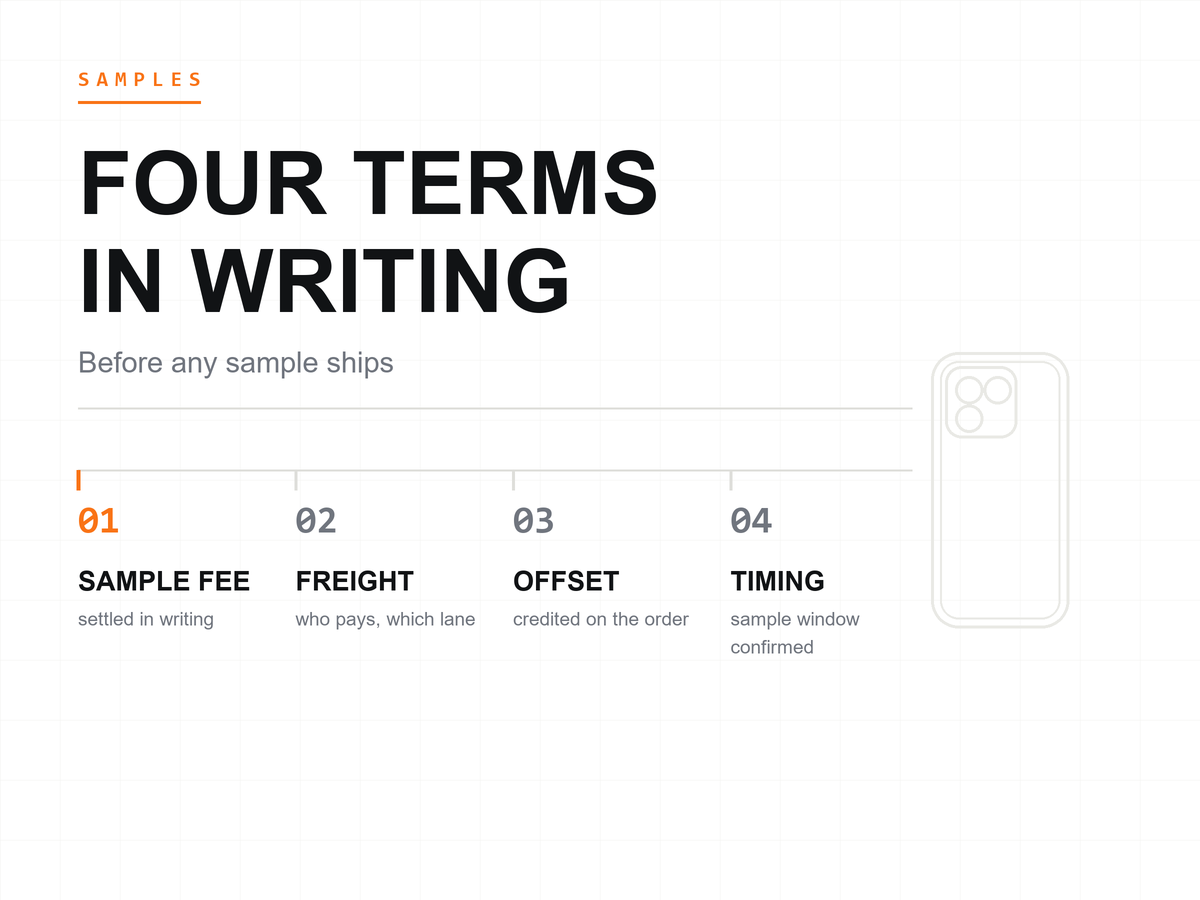
A sample request should name a receiver. Ship to the agent, ship to the buyer, or split the set between both; we use the address on the request. What we do not do is guess. A sample set that reaches the wrong desk loses time, and nobody can tell which version was approved.
The approved sample becomes the reference unit. QC then compares the run against the same standard the sample set, and the batch record travels with the order. Photographs and short video from the QC station can go to the party the buyer names, whether that is the agent, the buyer's inspector, or both.
Shipping documents follow the same routing rule. We prepare the document set the order calls for, and the consignee and notify party appear exactly as the buyer or the agent instructs for that shipment. One field, one instruction, one source. When two versions of the same field arrive, we hold the file and ask for a single confirmed version, because a document set with two owners is a delay at the port.
Packaging artwork is approved on the specification sheet before the run. Barcode labels, model labels, and shipping marks follow that approved file, and we print and apply labels in-house.
Final acceptance confirmation belongs to the buyer's side. The buyer or the agent the buyer designates signs off after inspection, and that acceptance is recorded against the order. We do not accept a run on the buyer's behalf.
What a Factory Needs From an Agent
Four items keep a run moving, and all four belong in the first exchange. Start with the target market, which decides packaging language, compliance file, and retail format. The specification then defines what we make, down to finish and hardware. A named approver settles who can sign. Receiving and clearance details close the set, telling us where the goods go and which documents the destination asks for.
An agent who sends those four items in one message gives a factory what it needs to plan tooling, samples, and documents. An agent who sends a model number and waits leaves both sides guessing, and guessing is how a carton ends up with the wrong label or a document set that misses a required form.
The commercial side stays off this page. Commercial terms are agreed privately between the parties and are not part of this article.
Common Questions From Buyers
Does the agent have to be the sample approver?
Not necessarily. It depends on what the buyer writes into the order file. Some buyers hand the agent full approval authority so decisions move in one time zone; others keep approval at head office and use the agent for communication and logistics. We follow the approver named in the file either way. If that name changes mid-project, one written note resets the channel.
How do QC records and shipping documents reach the buyer?
Through the channel the buyer names. QC photographs and the batch record can go to the agent, to the buyer's own team, or to a third-party inspector, and the shipping set follows the same instruction. When the buyer wants copies and the agent wants originals, both can be served from one file. The thing to avoid is two versions of the same record, because a file that lives in two versions stops being a record.
What happens when the buyer and the agent give different instructions?
We stop and ask for one confirmed instruction. A factory that follows whichever message arrived last builds a trail that matches neither party's understanding, and the mismatch tends to surface late, at the port or in the warehouse. Keep one source for each field, and the shipment stays clean.
What to Do Next
If you work through an agent, introduce the agent early, name the approver, and settle document routing before the first sample request. The opening exchange should carry the model list, the target market, the approver, and the receiving details. Everything downstream moves faster when those four items sit on the table from the start.
iFunSmart is a Guangzhou factory, founded in 2010, molding with 1:1 precision and in-house CNC. The flow above is how a run moves when a buyer's agent sits in the middle of it.
Send us your model list and the agent you work with, and we will route specifications, samples, and documents through the channel you name.
Apple, iPhone, Samsung, and Galaxy are trademarks of their respective owners. iFunSmart is an independent manufacturer of phone cases and accessories and is not affiliated with, authorized, sponsored, or endorsed by Apple or Samsung.