Oct 3, 2026Business Solutions
Magsafe Wallets and Stands: A Compatibility Checklist
A wallet or stand works only if the magnet ring, the thickness, and the hinge align. A checklist to check accessories against a case before you commit.
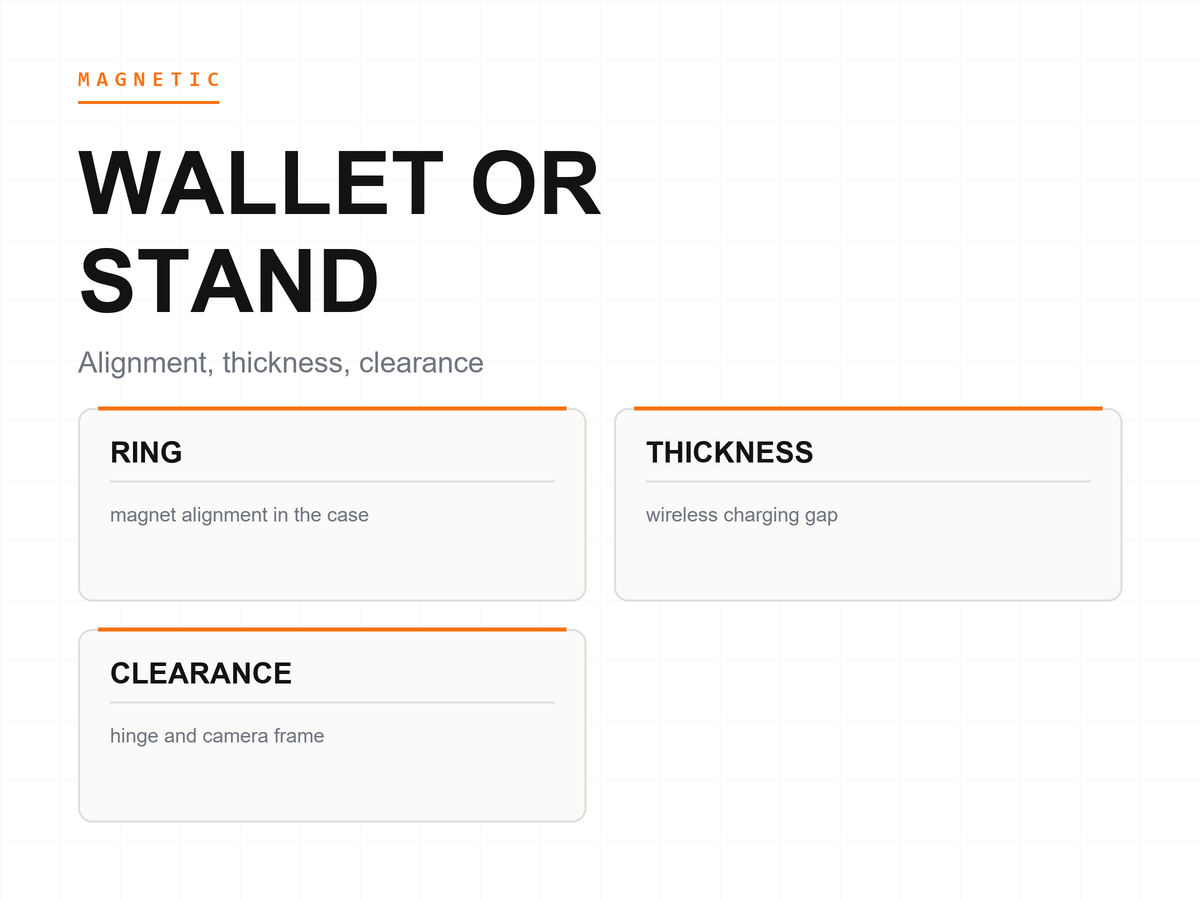
A MagSafe wallet that lifts off in a pocket is not a magnet problem; it is a fit problem. iPhone buyers pair cases with wallets and stands from many brands, and most failures trace to ring position, thickness, and hinge travel. Check all three before you commit to stock.
Last updated: October 3, 2026.
Compatibility Is a Three-Point Check
Accessory compatibility means the wallet or stand meets the case at every contact point without losing hold, without blocking the charge, and without forcing a hinge. That is a narrower test than the word "universal" suggests.
A wallet attaches through one magnet ring and detaches through a customer's fingers. If the ring inside the case sits off-center, the wallet can hold at rest and slide under load. A stand adds a second question: can its hinge open fully next to the camera frame? And thickness decides whether a charger on the back can still reach the phone through both layers. A wallet that survives a shake test but falls off when the phone comes out of a coat pocket has passed only part of the test. Three points, one verdict.
The Magnet Ring Has to Land on the Ring
MagSafe accessories locate themselves by the ring, not by eye. A wallet centered on the glass may still be offset from the magnets below it, and an offset ring means a weaker hold and slower self-alignment.
Alignment matters before the first day of use. A ring that is off by a small distance still holds at rest, because the magnets are strong; the failure shows under motion, when the wallet starts to rotate and lets go. MagSafe accessories are built to self-center, and self-centering only corrects what the layout allows it to correct. Two factories can both build a ring into a case and land it in different places, so the accessory's ring drawing is the first document to compare against the case's magnet layout. At our Guangzhou factory, cases are built with 1:1 precision molding, and the magnet layout is set in the mold, so the accessory either matches that layout or it does not. Fit is a design question.
Before you commit, ask the supplier for the accessory's ring drawing and the case's magnet layout, and put the two drawings side by side.
Thickness Sits Between the Accessory and the Charge
Wireless charging works through a case only as far as the case lets it. Every layer a case adds sits between the charger and the phone, and a wallet or a stand adds more distance on top. A thick shell plus a thick wallet can push the phone past the gap a charger tolerates, and the charge weakens or drops.
A wallet stuffed with cards does not change its magnet, but it changes its stack. Every card adds a layer between the charger and the phone, which is why the same wallet can charge fine empty and charge poorly full. Test the accessory the way a customer fills it, not the way a showroom displays it. A stand with a battery inside brings its own thickness along too, so a power stand is really a thickness decision with a hinge attached. A thin case keeps the gap small and leaves room for the accessory's own thickness, and a buyer who plans to bundle wallets should specify the case thickness and the accessory thickness in the same sentence, not as two separate SKU decisions.
Hinges and Kickstands Need Room to Move
A kickstand fails at one point in its arc. Its hinge swings through that arc, and whatever sits in the way blocks it: the camera frame on a slab phone, or the hinge and its cover on a foldable like the iPhone Duo. A stand that opens cleanly on a bare phone can knock against a raised camera rim once a case goes on, and a stand that hinges around the camera ring is sized for a specific ring height; a case that raises that ring changes the fit.
On the iPhone Duo the hinge is the phone's own moving part, and a case adds a cover around it. A stand that clears a slab phone's camera meets a different neighbor there, which is one more reason the pairing test belongs before the order. When a case already carries its own stand, that arc was designed with the case. That is the point of a case with its own kickstand: the hinge and the shell share one design, so nothing fights for the same space. The same logic applies to wallets with fold-out stands; the buyer still needs to see the accessory opened flat against the exact case.
Common Questions From Buyers
Does a wallet accessory work with every MagSafe case?
No. A claim of universal fit depends on the case design behind it, and that is the boundary to keep in view. A wallet that holds firmly on one thin case can slip on a thick textured one, and a stand that clears one camera frame can clash with another. The claim is a starting point, not a promise.
How do I check compatibility before I commit to stock?
Put the check on paper before the order. Ask the supplier for the accessory's ring drawing and the case's magnet layout. Get the wallet's magnet grade in writing, and ask whether the case was tested with that grade. Confirm whether the set was verified as a pair, not as two items that happen to share a logo. Then, when samples arrive, run the pair test on a counter: snap the wallet on, shake it lightly, and open the stand over the case. If the pair passes in hand but the buyer reports complaints a month later, re-check the same three points first. Fewer disputes come from the check than from the claim.
When should I pick a case with the wallet or stand built in?
When the accessory is the SKU and the pairing is the risk, merge the two. a card-holder build that carries its own stand removes the pairing question for your customer and the return question for you. The trade is variety: a built-in wallet is one design, while a separate accessory pairs with many cases. Decide which one your shelf needs before you order.
What to Do Next
The checklist needs no lab. It needs the accessory's ring drawing, the case's magnet layout, the thickness of both, and one open-and-shake test on a real sample. If a supplier cannot produce the first three, that answer is itself the verdict.
Send iFunSmart the accessory models you plan to pair, and we will check ring position, thickness, and hinge clearance against our cases before you commit.
Apple and iPhone are trademarks of Apple Inc. iFunSmart is an independent manufacturer of phone cases and accessories and is not affiliated with, authorized, sponsored, or endorsed by Apple.