Oct 2, 2026Business Solutions
The Cheap Case Trap: Returns, Reviews, and Freight
The lowest quote is rarely the lowest cost. How returns, refunds, reviews, and replacement freight turn a cheap case into the most expensive unit you sell.
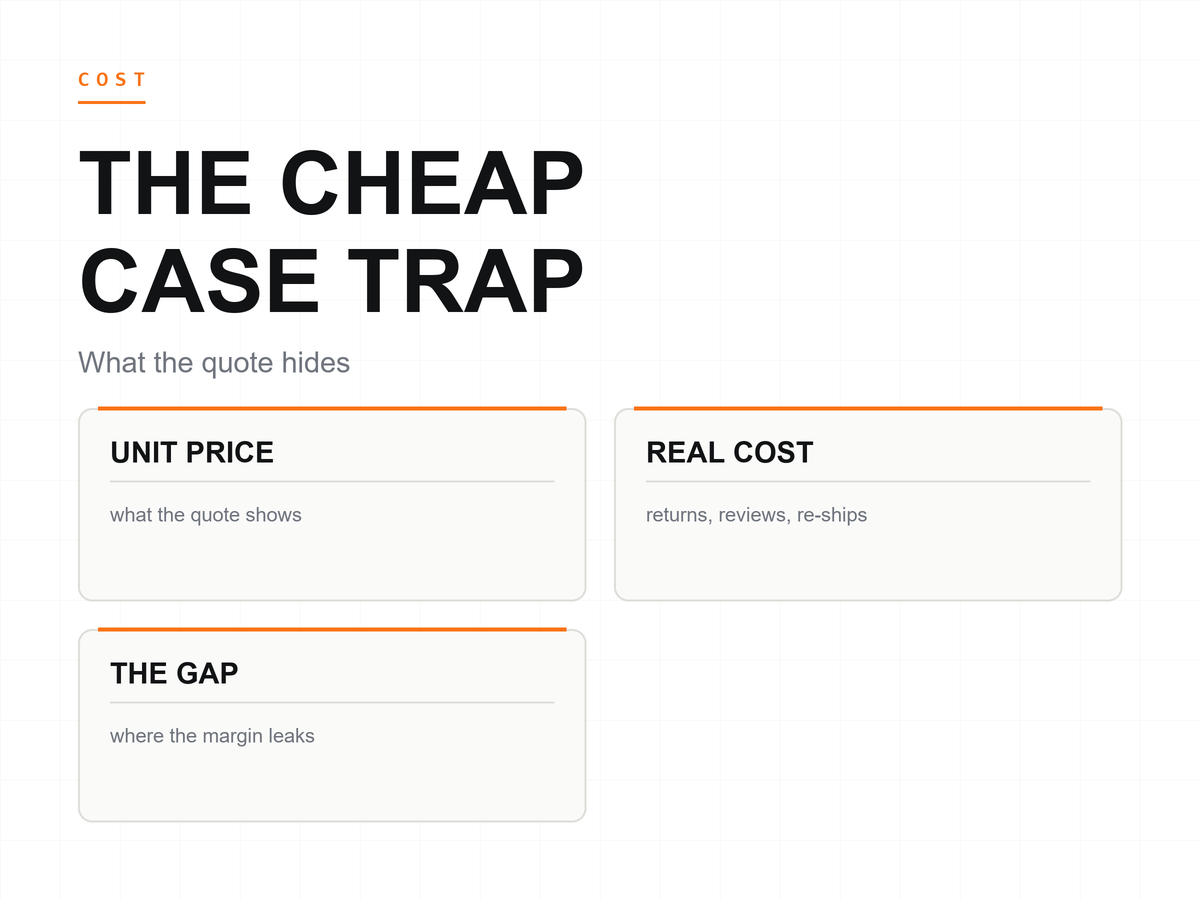
A cheap iPhone case is rarely cheap once it reaches your customers. The lowest quote does not remove cost; it moves that cost downstream, into refunds you absorb, reviews you cannot take back, replacements you ship a second time, and the staff hours that handle both. iFunSmart runs a Guangzhou factory, and this is the arithmetic buyers skip.
Last updated: October 2, 2026.
What the Quote Leaves Out
A unit price is easy to compare and easy to believe. It is also the number a supplier controls most directly, which is why it cannot carry the decision alone.
Net cost per unit sold is what one case costs your business once failed units, the refunds they trigger, and the labor around both are counted, rather than what the supplier charged at the factory door. A low row on the quote becomes a high row in that second figure.
Buyers meet this in different ways. A distributor finds scratches across part of a shipment and issues credits to keep a retail account happy. A marketplace seller lets the refund through rather than argue, and the return still counts against the listing. In a phone shop, the swap happens across the counter, and the customer who bought last month does not come back.
The quote was low in each case. The bill arrived later.
The Four Fields of Net Cost
A proper comparison takes four fields, and only the first one appears on the quote you were sent.
The first field is the quoted unit price. Write it down, because it is real; it is simply not the whole number. A gap between two prices usually reflects a different build rather than a hidden trick. Our own range shows the point: a mid-range micro-matte build and a mainline magnetic design serve different shelf positions, and neither becomes the right choice until the other fields are costed.
The second field is what a defective unit costs after it has landed, when the ocean freight and the duty are already paid and the unit sits in your warehouse or in a customer's hands. A refund sends the customer's money back without returning the freight spent to bring that unit in, or the picking, packing, and shipping labor spent on it. Someone must process the return, inspect the unit, and decide what happens next. That someone is on your payroll.
Replacement freight is the third field, and the next section explains why it shocks buyers who compared only product costs.
Time is the field buyers forget to count. Returns consume staff hours. Replacement cycles consume weeks. A defect wave found after a launch consumes attention that should be going into the next season, and the shelf gap does not close while replacements travel; the customer who found a bare shelf has bought elsewhere.
Where the Second Freight Comes From
Freight on an original case order is efficient because a container spreads its cost across every unit inside it. A replacement shipment has no such advantage.
Small parcels ride at higher rates per unit than a consolidated load, and volume weight works against a product that fills space long before it fills a scale. The failed unit's original freight and duty are sunk as well, because nobody refunds the cost of bringing a bad case across the ocean. Your destination may charge duty again on the replacement; whether it does is a question for your broker, not a factory in Guangzhou.
Whether a supplier replaces failed units at all depends on the terms agreed before production begins. When those terms are silent, the second freight bill becomes one more cost of the cheap case, and it arrives months after the decision that caused it.
Reviews Outlive the Unit
A refunded unit leaves your inventory. The review it earned can stay on your listing for years.
Shoppers read the rating before they read much else, and a rating moves slowly in both directions. A listing that keeps absorbing returns also keeps signaling the platform about how well it serves buyers, and traffic follows those signals. The refund is a cash event you can measure this month; the rating is an asset that moved once, and moving it back takes far longer than losing it.
We do not publish defect rates, and we would not expect you to trust a rate measured on another buyer's market, packing, and handling. Your returns data is the only data that describes your business.
When a Low Quote Becomes a Negative Return
The decision rule is arithmetic you can run with figures only you hold.
Write out the batch cost for each supplier. Estimate the share of units likely to fail from your own history with that supplier, or from a sample and an inspection plan rather than from a slogan. Multiply the expected failures by what one failure costs you: the refund, the disposal decision, the labor, the review risk. Add the freight to replace them. If the price gap between the two suppliers, spread across the whole batch, is smaller than the extra downstream cost attached to the cheaper one, the cheaper quote is a negative return. The discount was a loan, and you are paying it back.
Notice what the rule does not say: a low price is not wrong. A buyer selling into a market where returns are impractical, or running a promotional line where the case is nearly disposable, carries a lower failure cost, and for that buyer the low price is a real advantage. The problem is not the low price, but paying for the same case twice.
Buyers who want the upstream half of this arithmetic can read our earlier walkthrough of the itemized delivered-cost breakdown.
Common Questions From Buyers
How do I calculate the true cost of a cheap case?
Take the batch quantity and both unit prices, so the gap becomes a real amount rather than a feeling. Estimate failures from your own returns history and cost each one at the refund plus the handling time plus the disposal. Add the replacement freight and the weeks of shelf gap. The supplier with the smaller total is the cheaper one, whatever the quote rows suggest. With no history yet, a sample order and a written inspection plan are how you build one.
Does a lower unit price ever make sense?
Yes, when the downstream fields are genuinely low for your business. A seller whose customers rarely return cases, or whose market absorbs slightly flawed units at a discount, carries less risk per failure and can profit at a price a returns-heavy seller cannot touch. The mistake is assuming your returns profile matches the one the low price assumes.
Why do replacements cost more to ship than the original order?
Because the original order bought space in a container and the replacement buys space in a small parcel. The rate per unit is higher, the volume weight penalty is worse, and the freight already spent on the failed unit does not come back. A replacement sent alone is an expensive way to move one case, which is why this arithmetic belongs before the first shipment, not after it.
What to Do Next
iFunSmart has built cases in Guangzhou since 2010, and we can itemize the factory-side lines on any style we quote, so the first field in your comparison is clean. The other three fields belong to your market and your handling, and no supplier can fill them in for you.
Bring us the two quotes you are weighing and what you know about your own returns and replacement history. We will set the factory-side data beside your numbers, so you can see whether the gap is a saving or a debt.
Send us the two quotes you are weighing, and we will help you cost the gap across returns, replacements, and freight.
Apple, iPhone, Samsung, and Galaxy are trademarks of their respective owners. iFunSmart is an independent manufacturer of phone cases and accessories and is not affiliated with, authorized, sponsored, or endorsed by Apple or Samsung.