Sep 17, 2026Business Solutions
One Supplier or Five? Consolidating Cases and Accessories
Consolidating suppliers cuts coordination and freight, but only if they make the items rather than resell them. How to tell factory-made from sourced.
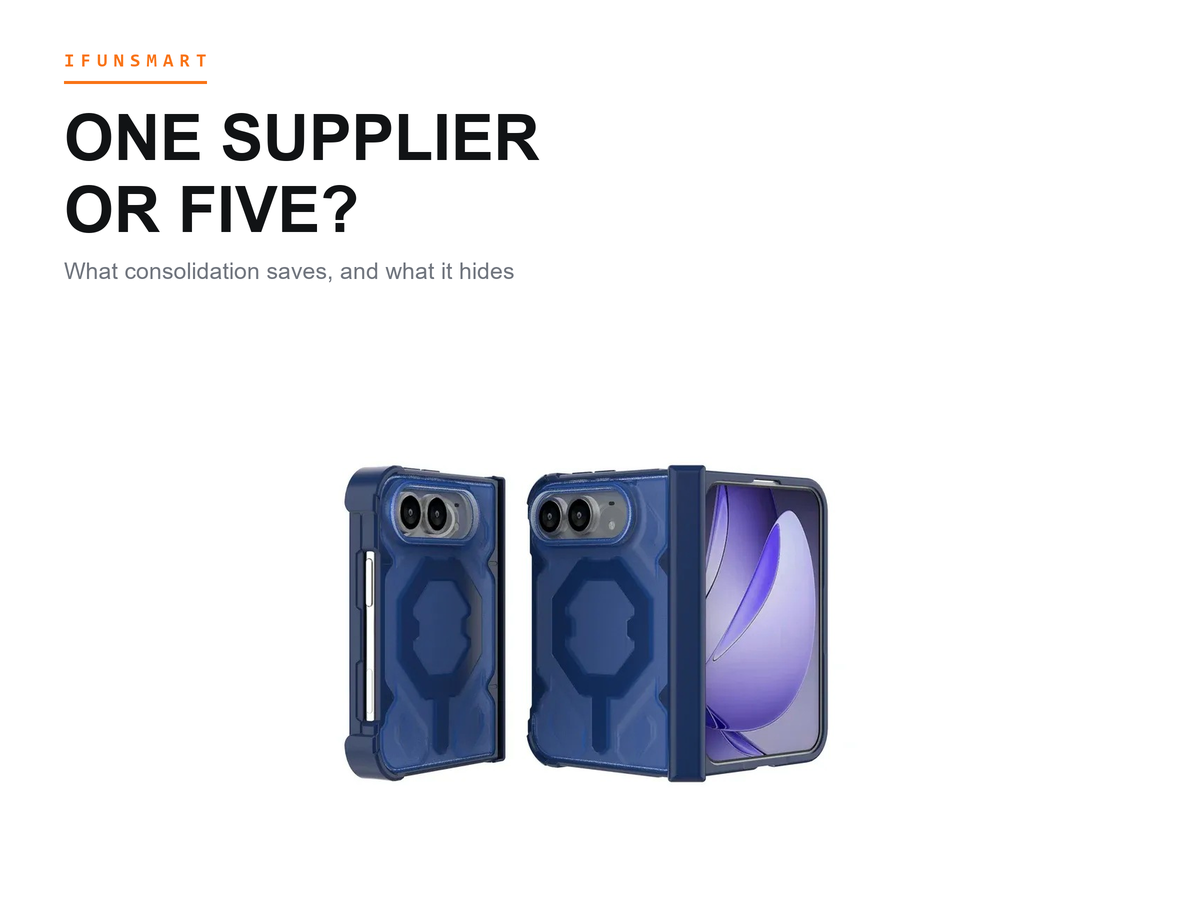
An iPhone case brand owner asked us to cover cases, AirPods cases, magnetic accessories, straps, and grips under one roof. That is a sensible goal and a common trap. Consolidating suppliers cuts coordination work and freight, but only if the supplier actually makes the adjacent items rather than reselling them. Here is how to tell the difference before you commit.
Last updated: September 17, 2026.
Why Brands Want to Consolidate
Consolidation means buying several product categories from one supplier instead of one supplier per category. The motive is practical: fewer purchase orders, fewer payment trails, one freight plan, and one party to chase when something is late.
For a young brand the arithmetic is easy to see. Every additional supplier adds a purchase order, a payment, a quality conversation, and a shipment that has to be coordinated with the others. On a first order across cases and accessories, that overhead can exceed the value of the goods. We have written before about structuring a small first order, and consolidation is the other half of the same decision.
Factory-Made and Sourced Are Different Promises
The distinction that matters is whether a supplier manufactures a category or buys it in.
A factory-made item is produced on the supplier's own tooling and lines. Quality control, tolerances, and lead times are theirs to control, and a problem is theirs to fix. A sourced item is bought from a third party and forwarded to you. The supplier may still add value, in consolidation and in one invoice, but they are not the manufacturer of that item, and their control over it is limited.
Both models can work. What does not work is a quote that blurs the two, because the risk sits in different places. On a factory-made case, a defect is a production question. On a sourced accessory, a defect is a third-party question, and your supplier is relaying it.
How to Tell Which One You Are Buying
Three questions answer it, and all three should get a direct reply.
The first is where the tooling sits. If the item is molded on their own tool, they made it, the way our magnetic kickstand case comes off our own mold. If they cannot say which tool, they bought it. The second is what they control. Ask who inspects the batch and who owns the fix if it fails; the answer names the party that actually carries risk. The third is how the price is built. A sourced item carries the original supplier's margin plus the consolidator's, and a supplier who will not discuss that structure is usually not adding much to it.
Our own position is worth stating plainly because it is the honest version. We manufacture cases and the accessory pieces that attach to them, including magnetic holders and stands like our 3-in-1 magnetic phone holder and the lanyard-compatible case range. Where a category sits outside our own production, we say so rather than quoting it as if it were ours.
What Consolidation Actually Saves
The saving is mostly in coordination and freight, not in unit price.
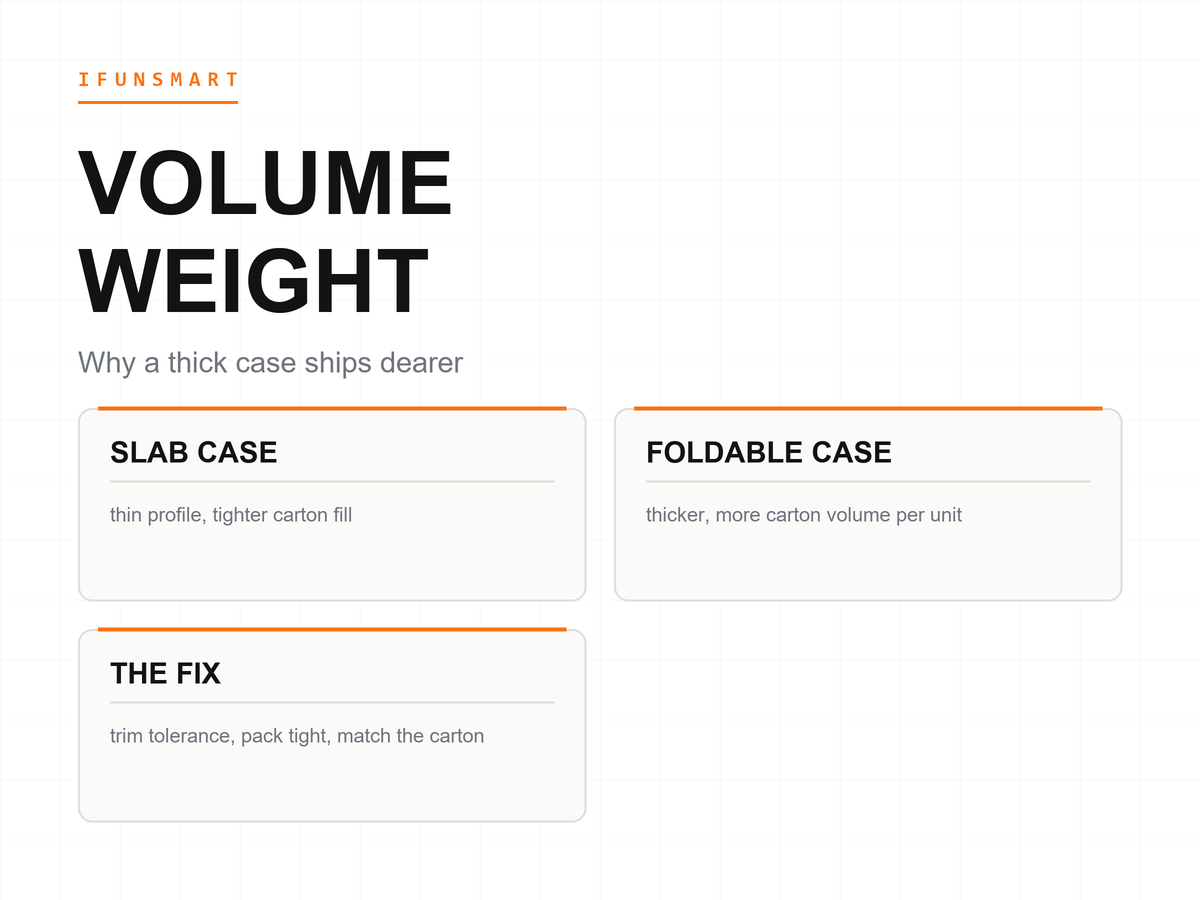
Consolidation removes purchase orders, payments, and status chasing, which is real time recovered. It also lets the whole order ship together, usually in one carton plan, which is where the freight saving comes from. We have written separately about how volume weight is calculated, and a consolidated order is easier to pack efficiently than three small ones.
What consolidation does not reliably do is lower the unit price of the consolidated items. A supplier who makes cases well and buys accessories in has no cost advantage on the accessories, so a package price that beats the market usually means either volume discounts you could get anyway, or a lower specification somewhere you have not looked.
Where Consolidation Becomes a Risk
Three failure modes are common enough to plan for.
The first is a category quality mismatch. Your brand standard was set by the case, and a sourced accessory that does not match it damages the brand more than the saving helps. The second is a lead-time illusion: the supplier's own production is predictable, but a sourced item is exposed to a third party's schedule, so a single ship date can slip on the item you cannot see. The third is accountability drift. When something goes wrong on a sourced item, the fix depends on a party you have no contract with.
The practical guard is to split your consolidation into what is factory-made and what is sourced, and to hold the sourced portion to an explicit standard rather than assuming it inherits the case's.
Common Questions From Buyers
Should I buy everything from one supplier on a first order?
Consolidate where the supplier genuinely manufactures, and treat sourced categories as a separate decision. On a first order the safer shape is to consolidate the categories that carry your brand standard, and buy the rest where the control is clear, even if that means one extra supplier.
How do I check whether an accessory is factory-made?
Ask for the tooling and the inspection owner, and ask for a sample of that specific item rather than of the case. A supplier who can send the accessory sample and describe how it was checked is telling you something. One who redirects the conversation back to the case is telling you something else.
Does consolidating raise or lower my freight?
It usually lowers it, because the whole order ships together and the carton plan can be built once. The saving shows up as fewer shipments and better container fill rather than as a lower rate.
What to Do Next
The useful first step is a category list rather than a price list: name the items you want, and ask your supplier to mark which ones they manufacture and which ones they would source. That single answer tells you where your brand standard is protected and where it is exposed.
Send us the categories you are planning for your first collection, and we will tell you plainly which ones we produce, which ones sit outside our own production, and what that means for your quality and lead-time risk.
Send us your category list and we will mark what we make, what we source, and where the risk sits.
Apple, iPhone, Samsung, and Galaxy are trademarks of their respective owners, used solely to indicate compatibility. iFunSmart is an independent manufacturer of phone cases and accessories.