Sep 18, 2026Business Solutions
Custom Logo on Phone Cases: Four Ways
"Custom logo" is four different processes. Where each method puts the mark, what that does to wear and cost, and the three details to confirm before production.
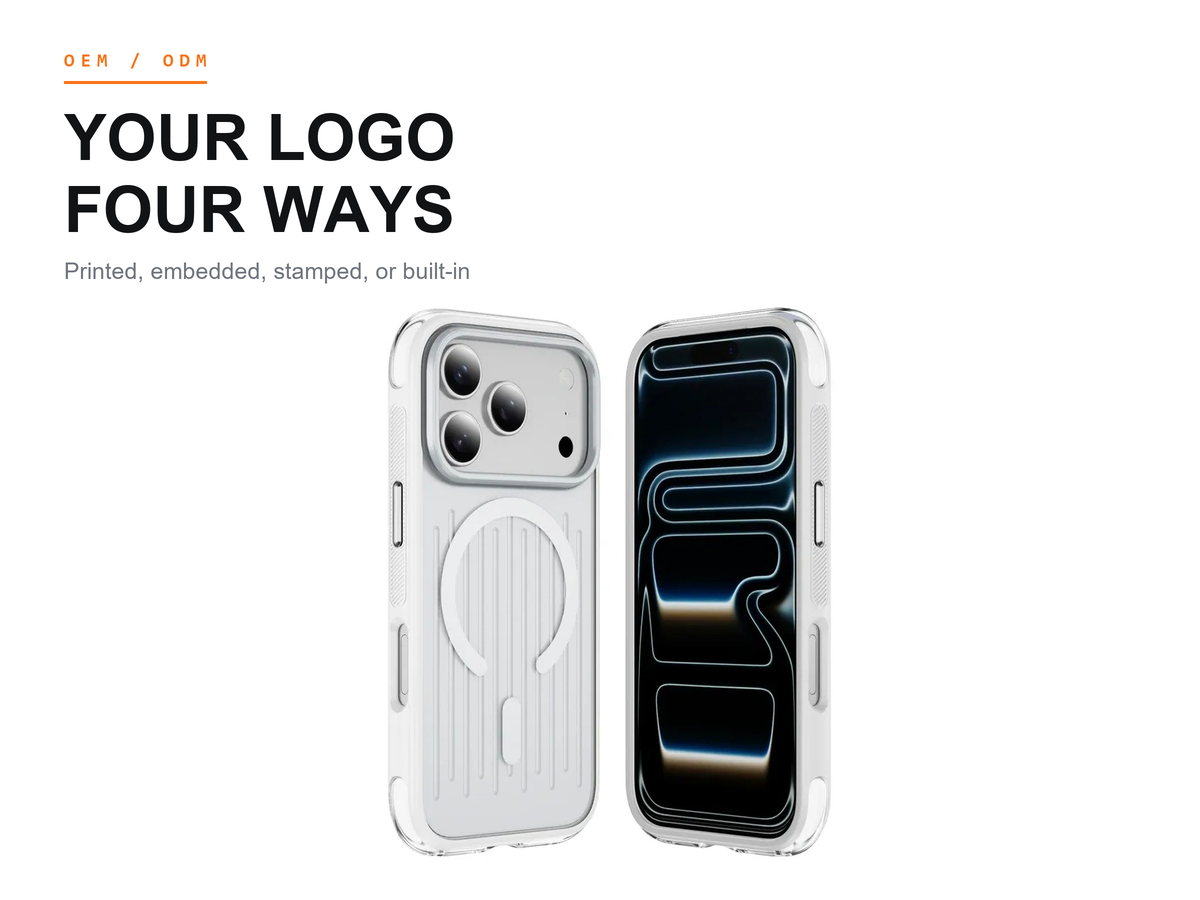
Brands keep asking for custom logos on iPhone and Samsung cases, and the request sounds like one question. It is four. The mark can be printed on the surface, embedded under it, stamped in metal foil, or built into the hardware itself, and each route changes the look, the durability, and the cost. The right choice depends on how your brand is read, not on which method the factory prefers.
Last updated: September 18, 2026.
Why "Custom Logo" Is Not One Process
A custom logo method is the technique used to place a brand mark on a case, and each technique puts the mark in a physically different place. That placement decides everything a buyer actually cares about: how it looks, how it wears, and what it costs.
The reason the choice matters is physical, not commercial. A mark on the outer surface lives where fingers, pockets, and keys are. A mark embedded under a clear layer lives behind protection. A metal badge lives on a separate part. Same logo, three different lifespans.
Buyers who do not specify a method usually get whichever one the factory defaults to, and they discover the difference when their customers start wearing the logo off. Asking for the method by name is the cheapest quality decision on the whole order.
The Four Routes, and Where Each One Wins
The four routes differ in how the mark is applied and what that does to it.
The first route is surface printing, which puts ink directly on the case exterior. It is the fastest and the most flexible for multi-color designs, and it is the route where wear shows up first, because the print is exposed. If your logo carries fine color detail, this is the route that reproduces it most faithfully, and a clear topcoat is what protects it.
The second route is embedded film, where the graphic sits under a transparent outer layer inside the case body. Because daily abrasion hits the protective layer instead of the artwork, wear is far slower. The trade-off is design freedom: the artwork reads cleanly as flat color shapes rather than fine gradient detail, the way our glitter pattern build carries its graphic under the surface.
The third route is foil stamping, which transfers a metallic film with heat and pressure. A metallic logo on a dark case reads as premium, and the effect cannot be reproduced by ink. The limits are the flip side: it suits simpler marks, and the metallic look either fits your brand language or it does not.
The fourth route is hardware, where the logo becomes a physical part, such as a metal badge or a shaped button set. This is the most durable and the most premium presentation, and it is also the most involved, because the mark becomes a manufactured component rather than a decoration. Our detachable metal-button build shows how far the hardware lever can go.
One boundary worth stating: a factory can describe these routes and show samples, but how long a mark lasts on a specific case is a physical test on that case, not a claim. Ask to see the finished sample and judge with your hands.
Matching the Route to Your Brand
The useful question is not which method is generally better, but where your logo would suffer most.
If your logo is colorful and detailed, surface printing reproduces it most faithfully, and the protection conversation becomes about the topcoat. If your mark is a simple shape that reads well in one metallic color, foil stamping turns a plain case into a branded one at low complexity. If your brand lives on premium hardware, a metal badge is the version customers keep after the case is gone.
Buyers across three markets have told us the same thing in different words: they want the brand on the product with no factory marking anywhere else. That requirement has nothing to do with the method, but it decides one thing for you: confirm before ordering that the only marks on the case are yours.
How to Choose Between Them
The practical sequence is to decide what your logo must survive, then work backwards to the method.
Decide first where the case will live, in a pocket or on a display shelf, because that sets how much wear the mark must take. Then decide how many colors the mark needs, because that narrows the routes quickly. Then decide whether the mark should read as ink, as metal, or as a built part, which is a brand-language decision more than a technical one.
Once those three answers exist, the method usually picks itself, and the conversation with a supplier becomes specific instead of general. If you want to compare the four routes on real cases rather than in a description, ask for samples of each route in your logo and judge them side by side. The cost difference is easier to accept when the difference in look is in your hand. A printed color build shows what the print route does with multi-color artwork.
Common Questions From Buyers
Which logo method lasts longest?
The methods place the mark in different positions, so they wear differently: embedded film and hardware marks are protected by position, while a surface print wears first and relies on its topcoat. Longevity on your specific case is a sample test, not a catalogue claim, so ask for a finished sample and handle it before you commit.
Can I mix methods on one case?
Yes, and mixing is common: a metallic mark on the back with a printed detail elsewhere, or hardware at the edges with a printed logo inside. Mixing adds setup steps, so confirm what each addition contributes before you stack them.
What details should I confirm before production?
Three: the method, the placement, and the protection over the mark. Confirm those in writing with the sample approved, because changes after production starts are the expensive kind.
What to Do Next
All four routes are available across our case range, and the fastest way to choose is to see them on a real case in your own logo rather than in a description.
Send us your logo and the models you plan to cover, and we will prepare samples of the routes that fit your mark and quote each option.
Send your logo and target models and we will prepare logo-method samples for you to compare.
Apple, iPhone, Samsung, and Galaxy are trademarks of their respective owners, used solely to indicate compatibility. iFunSmart is an independent manufacturer of phone cases and accessories.