Sep 17, 2026Industry Insights
iPhone Duo Cases: The Features Buyers Ask About First
Apple's first foldable changes the case conversation. The five features buyers ask about first, from hinge protection to finish, and how each gets verified.
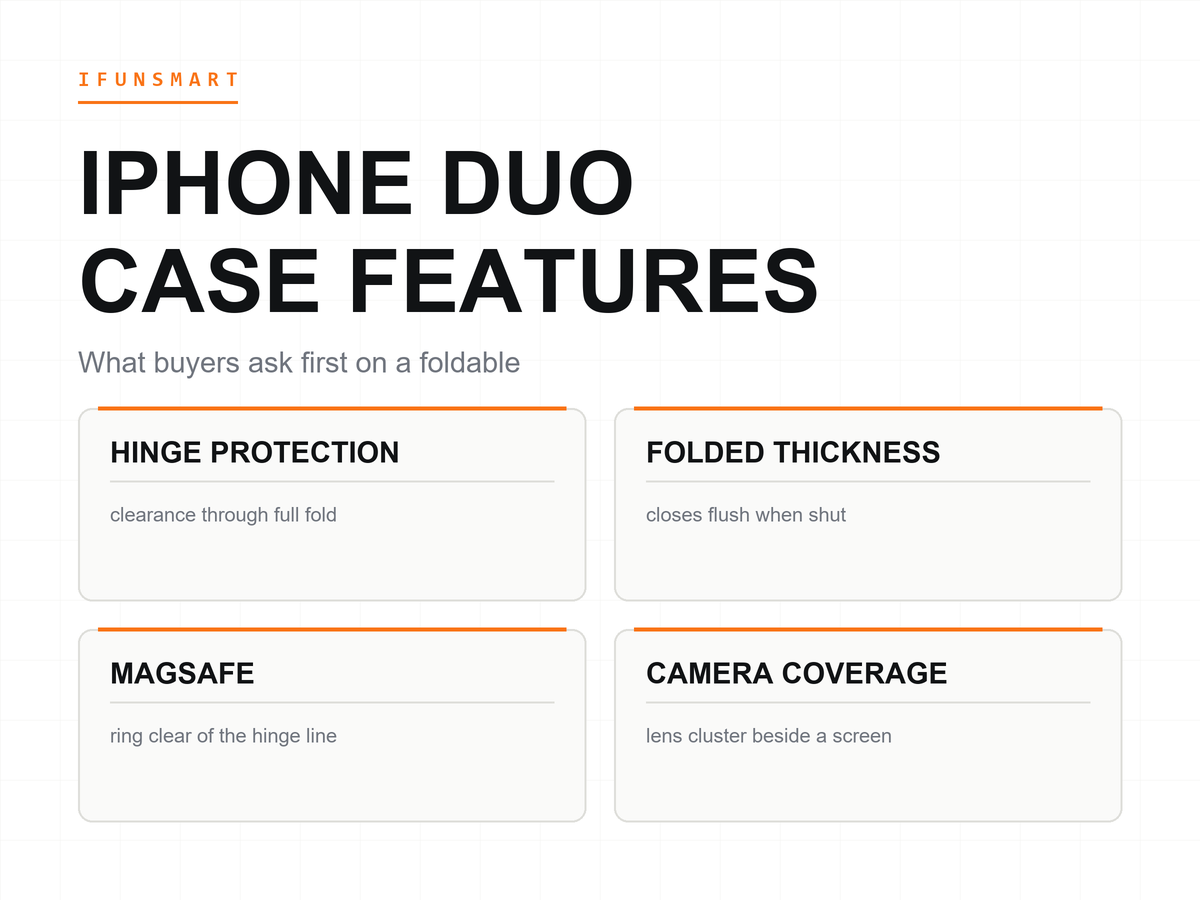
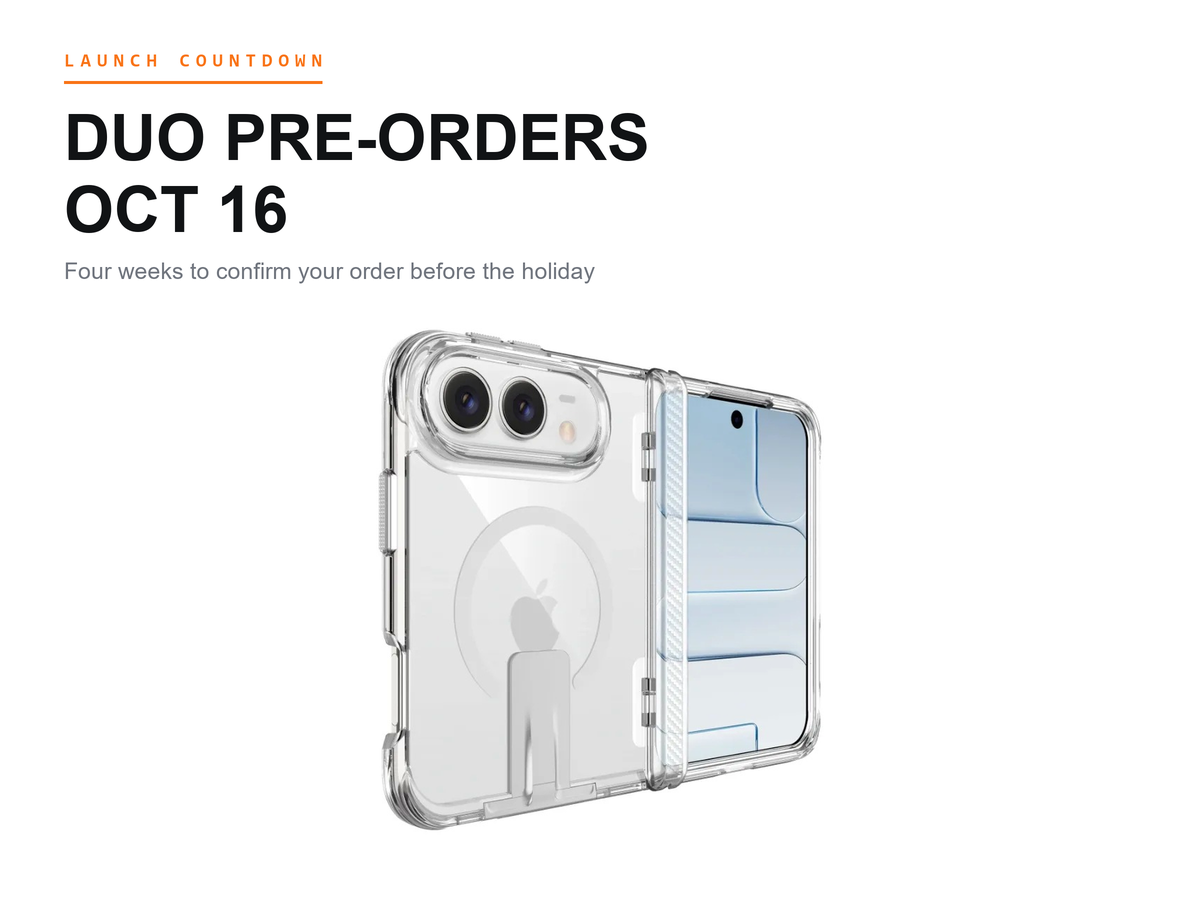
The iPhone Duo is Apple's first foldable iPhone, and it changes the questions buyers ask about cases. Pre-orders open October 16 and the phone goes on sale October 23, 2026. When buyers move from slab phones to a folding one, five features come up before price does: hinge protection, folded thickness, MagSafe behavior, camera coverage, and finish.
Last updated: September 13, 2026.
Why a Foldable Changes the Case Conversation
A foldable is a different industrial object, so the buyer conversation starts from different ground. On a slab phone, most case questions end at fit and drop protection. On a folding one, the case wraps a device that opens, closes, and carries two displays, so every feature question has a moving part in it.
The device itself sets the frame. Apple's spec sheet lists the iPhone Duo at 254 g, folding to 117.8 mm by 84.1 mm by 11.3 mm and opening to 117.8 mm by 164.6 mm by 5.2 mm, with a 7.6-inch inner display and a 5.4-inch outer display. Every case feature a buyer asks about traces back to one of those numbers.
Hinge Protection Comes First
The hinge is the question that arrives before all others, because it is the part that can fail. Hinge protection is the structure a case builds around the folding joint so the moving interface stays clear of debris and takes impact away from it.
Apple's own engineering puts the joint front and center: the spec sheet describes a 3D-printed hinge cover made with 100% recycled titanium. A case sits around that cover, not on top of it, so the mold has to leave the joint free to rotate through its full angle while keeping grit out of the gap. Our hinge-protection foldable case is built around exactly that clearance.
The buyer questions are practical. Does the case bind when the phone opens? Does it close flush at the folded thickness? Does grit collect at the hinge over weeks of pocket carry? Each one is answerable on a sample, which is why our foldable process runs a hinge pass on T0 samples before any production run is committed: the case is opened and closed through the full fold angle, and the halves are checked for a flush close.
Folded Thickness Is a Fit Spec, Not a Style Choice
On a slab phone, case thickness is comfort. On the Duo, it is fit.
The body is 5.2 mm thick when open and 11.3 mm when closed. A case adds wall thickness to both halves, and the two halves close against each other, so every tenth of a millimeter is subtracted from the closing clearance twice. A case that reads fine on a caliper can still refuse to close flush, and a case that closes under stress wears the finish on both faces.
This is why buyers who are comparing suppliers should ask one question before price: how was the folded-thickness tolerance verified? The honest answer involves a physical sample on a physical hinge. Our tooling is cut from 1:1 device data, and the closed-profile check on a sample is what turns that data into a case that actually shuts.
What Buyers Ask About MagSafe on a Folding Phone
MagSafe behavior is the third conversation, and it has a foldable-specific wrinkle: magnet placement has to coexist with the hinge line that runs across the back.
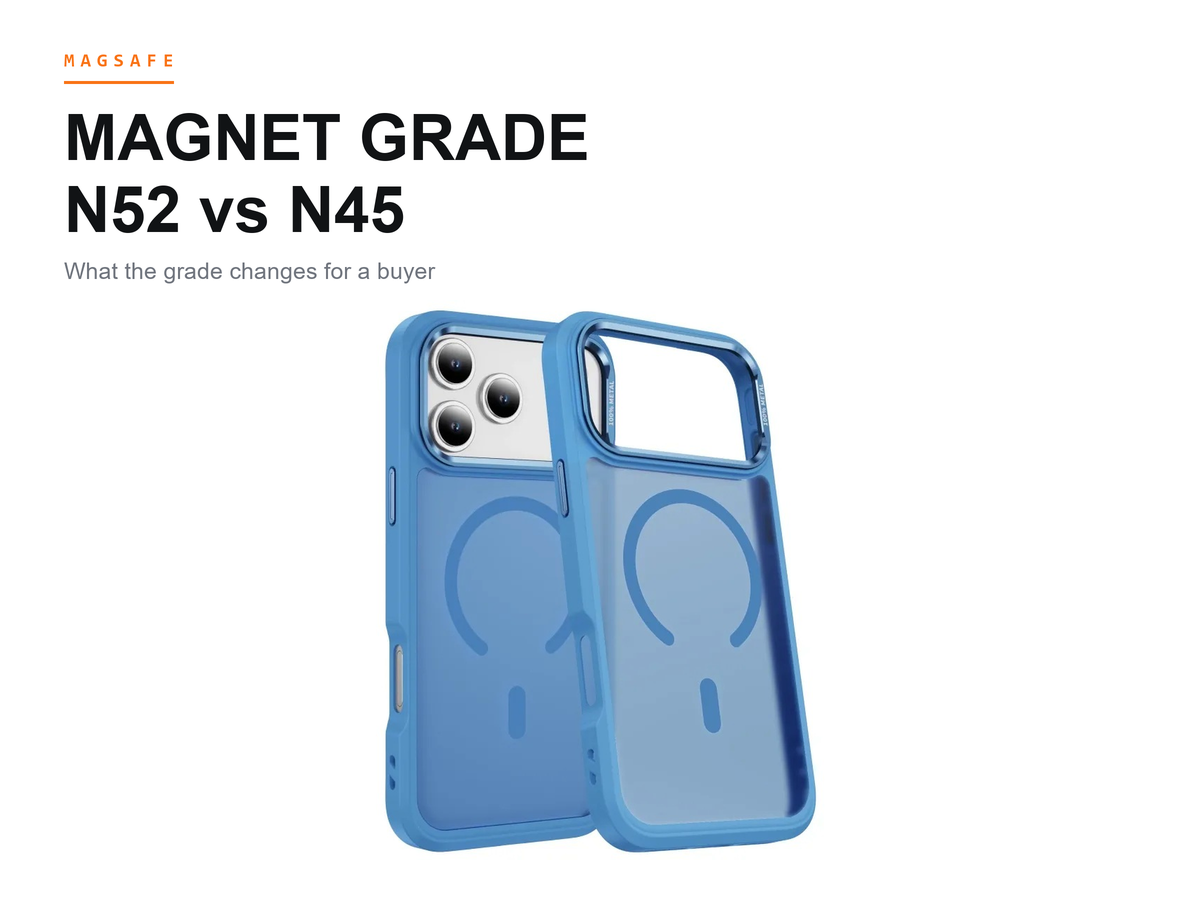
The device supports MagSafe wireless charging up to 25 W, and Qi2 at the same level, so the accessory ecosystem a buyer already sells — wallets, mounts, chargers — carries over only if the case's magnet ring sits where the phone expects it. A ring placed for a slab phone can land half across the hinge zone on a foldable, which weakens attachment exactly where the case is thickest.
Buyers ask two things here. First, whether the case holds a wallet and a charger at full strength; that is answered by ring placement, and we check it against the device geometry rather than assuming it. Second, whether wireless charging still reaches its rated speed with the case on; alignment matters as much as magnet grade for that answer. The clear MagSafe kickstand model shows the pattern: ring centered on the lower half, clear of the hinge line.
Cameras, Stylus, and the Finish Decision
The remaining questions cluster on the outside of the device.
The Duo carries its cameras on the outer half, above the 5.4-inch cover display, so camera coverage on a foldable means protecting a lens cluster that sits beside a screen, not on its own island. A raised lip has to clear the lenses without crowding the display edge.
The device also supports Apple Pencil (USB-C), which pairs and charges at the device edge. A case adds thickness between the pencil and that rail, so buyers who sell to note-taking users ask whether attachment still works with the case on. We check it on samples and say plainly what we find.
Finish is the last question, and the two-color range makes it simpler than on the Pro line. The Duo ships in Night Sky and Star White. A frosted matte hides fingerprints and suits the dark tone; a clear build shows the device color and the MagSafe ring, and on a white body it shows yellowing faster if the material grade is low. The spring-hinge crystal case is the clear-path example, and matching finish to tone is the advice we give whether the buyer orders fifty or fifty thousand.
What a Case Cannot Do
One boundary belongs in every foldable case conversation, and we would rather state it than let a buyer assume otherwise. Apple rates the device IP68, at up to 6 meters of freshwater for 30 minutes. A case adds no ingress protection. A hinge opening is a moving gap by definition, so no case keeps water out, and any supplier who implies otherwise is selling past the product. What a case does is mechanical: it cushions, it shields the joint from debris, and it takes the scratch and the drop.
Common Questions From Buyers
Will a Duo case block Apple Pencil pairing?
The device supports Apple Pencil (USB-C), which pairs at the device edge, and a case adds thickness between the pencil and that rail. Whether attachment stays solid depends on the case wall and the edge cutout, so we test it on a sample and report what we find rather than promise an outcome.
Does the case slow wireless charging?
The phone supports MagSafe and Qi2 wireless charging at up to 25 W, and the case's job is to stay out of the way: magnet ring placement aligned to the device, thickness kept low, no steel in the charge path. Alignment is checked against device geometry on our MagSafe-compatible builds.
Which finish should I stock for each color?
Lean frosted matte toward Night Sky, where fingerprints show most, and clear toward Star White, where the device color and the MagSafe ring sell the case. On the white body, clear material grade matters more, because low-grade TPU yellows fastest on light tones.
What to Do Next
We tool foldable cases from 1:1 device data, verify hinge movement and closed profile on samples, and run MagSafe-compatible options in frosted and clear finishes for both Duo colors. Our foldable range is in production now, and reorders run on existing molds. Ask us for the current foldable mold list and we will send it with the finish options for each color.
Tell us which foldable models you carry and the markets you sell into, and we will confirm tooling status, sample availability, and a realistic ship date for your first order.
Request the iPhone Duo case spec sheet and we will confirm what we can ship for your market.
Apple, iPhone, iPhone Duo, and Apple Pencil are trademarks of Apple Inc. iFunSmart is an independent manufacturer and is not affiliated with, authorized, sponsored, or endorsed by Apple Inc. Apple product names are used solely to indicate compatibility with our products.