Sep 17, 2026Business Solutions
The iPhone Duo Freight Math Nobody Quotes You
A foldable case is thicker and bulkier than a slab case, so it can cost more to ship than its weight suggests. Here is how to price the volume weight.
The iPhone Duo is a bigger, heavier item than any iPhone case you have shipped before. It weighs 254 g and folds to 11.3 mm thick, and a foldable case is bulkier than a slab case in every dimension that drives freight. If your supplier quotes a case price without quoting the volume weight it ships at, you are comparing an incomplete number to a complete one.
Last updated: September 12, 2026.
What Volume Weight Is, and Why It Bites Case Buyers
Volume weight is a billing weight that air and express carriers assign when a package's dimensions take up more space than its actual weight justifies. A carrier compares the real weight to the cubic size of the carton, and bills whichever is higher. A definition worth keeping: dimensional weight is the chargeable weight a carrier calculates from a shipment's length, width, and height, and it is billed when it exceeds the actual weight.
Phone cases are the classic victim of this rule. They are light but bulky, so a carton of cases often hits the dimensional threshold long before it hits its weight limit. On a foldable case, the same problem gets worse, because the item itself is thicker.
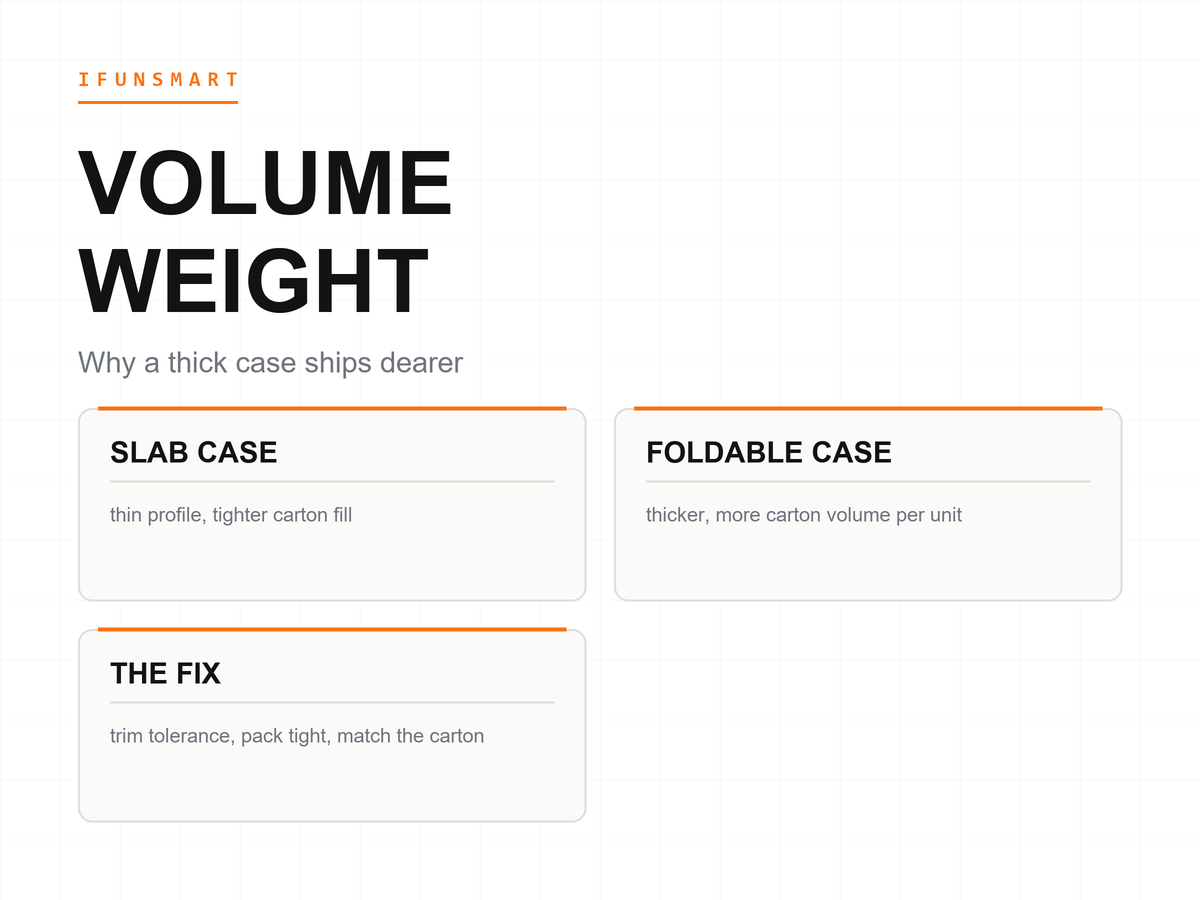
Why the Duo Case Ships Bigger Than a Slab Case
A foldable case has to cover a hinge and frame both displays, so it is not just a slightly larger slab case. Compare the two devices. The iPhone 18 Pro measures 150.0 mm by 71.9 mm by 8.75 mm. The Duo folds to 117.8 mm by 84.1 mm by 11.3 mm and opens to 117.8 mm by 164.6 mm by 5.2 mm, at 254 g.
That 11.3 mm folded thickness and 254 g weight are both above the slab phone, and a case has to clear the hinge and the camera housing without pinching. In practice the finished case is thicker and takes more carton volume per unit than an iPhone 18 Pro case, even though the two look similar on a product page.
The consequence is simple: on a per-unit basis, the Duo case can cost more to ship than its actual weight suggests, and the gap shows up in the chargeable weight on your freight invoice rather than in the case price.
The Cost Error Buyers Make on Freight
The first error is quoting a landed cost from the unit price alone. If you compare two suppliers on case price and neither figure includes dimensional weight, you have compared two incomplete numbers and called the cheaper one cheaper.
The second error is assuming freight scales with unit count. It does not scale cleanly when the product is thick, because a carton fills by volume before it fills by weight. Adding units to a box that is already dimensionally limited raises the chargeable weight faster than the piece count.
The third error is ordering the Duo on the same carton plan as a slab phone. A packaging layout built for a thin case leaves wasted air around a thick one, and wasted air is what you pay for.
How to Actually Reduce the Chargeable Weight
Four levers move the number, and all four are engineering choices rather than freight negotiations.
The first is trim the case, not the protection. A case that adds 1 mm of unnecessary wall thickness on a 5.2 mm body raises carton volume across the whole order. Tooling that holds tolerance tight keeps the case no thicker than it needs to be.
The second is pack for volume, not for looks. Compact packing that removes dead air from each carton lowers the dimensional weight even when the unit weight does not change. We have written about compact packaging before, because it is one of the few freight costs a factory can genuinely influence.
The third is match the carton to the item. A Duo case needs a carton sized for a thick item, not a carton sized for a thin one with extra filler. Filler is a cost with no product in it.
The fourth is decide air versus ocean with the real number. Air freight is priced on chargeable weight, so a bulky item punishes air far more than ocean. If a launch is urgent, pay air only for the units that need to arrive first, and send the balance by sea.
Why This Matters Most on a Launch
Freight cost hurts more on a flagship launch than in steady state, because launch orders are large and timed to a date. A mis-sized carton that adds a few percent of chargeable weight across a launch order is not a rounding error; it is a real margin line.
It also compounds with timing. The Duo goes on sale October 23, 2026, with pre-orders October 16 and more countries on October 30. An urgent air shipment of a bulky item is the most expensive way to restock. Planning the Duo order early enough to use ocean freight is the cheapest fix available, and it costs nothing but a calendar decision.
A Worked Way to Compare Suppliers
Ask each supplier for the carton dimension and pieces per carton at your order quantity, then calculate the chargeable weight yourself before you compare prices. Two suppliers can quote the same case price and land at different landed costs purely because one packs tighter.
Then confirm the fit tolerance in writing. A case that is 0.5 mm too thick is not just a fit risk; it is a carton-volume cost multiplied by your full order. Tolerance and freight are the same conversation on a thick case.
If you want the packing spec and pieces-per-carton figures for our Duo case, tell us your target quantity and destination, and we will send them so you can run the math yourself.
Common Questions From Buyers
Does a foldable case really cost more to ship?
Yes, on a per-unit basis. The Duo case is thicker and takes more carton volume than a slab case, so its chargeable weight is higher even when the case price looks similar. The difference shows up on the freight invoice, not the product page.
What is a typical ocean transit time from China?
Ocean freight from Guangzhou to most major markets typically runs four to six weeks door to port, before inland delivery. Treat it as a planning range, not a quote; the exact figure depends on lane and season, so confirm it with your forwarder.
Can you help me lower the freight on a Duo order?
Yes, and the levers are packing and tooling, not negotiation. Compact cartons that remove dead air, and molds held to tolerance so the case is not thicker than needed, both lower chargeable weight. Tell us your order size and destination and we will quote the packing spec with the case.
What to Do Next
We build the Duo case with MagSafe-compatible options and both standard and compact packing, and we can quote a packing spec alongside the case so your landed cost is complete. The Duo wave gives you more planning time than the Pro wave, which means you can choose ocean freight instead of air.
Tell us your order quantity and destination market, and we will confirm the pieces per carton, the packed dimensions, and a ship date you can price properly.
To see how compact a foldable case can pack, start with the clear MagSafe hinge kickstand case for iPhone Duo or the skin-feel magnetic ring case.
Request a quote with the packing spec and we will give you a landed-cost number you can actually compare.
Apple, iPhone, iPhone Duo, iPhone 18 Pro, and iPhone 18 Pro Max are trademarks of Apple Inc. iFunSmart is an independent manufacturer and is not affiliated with, authorized, sponsored, or endorsed by Apple Inc. Apple product names are used solely to indicate compatibility with our products.