Oct 20, 2026Business Solutions
Three Lines That Test a Supplier's Reply
A first inquiry gets a useful reply only when it names the product, the models, and the first question. Three lines that reveal how a supplier answers.
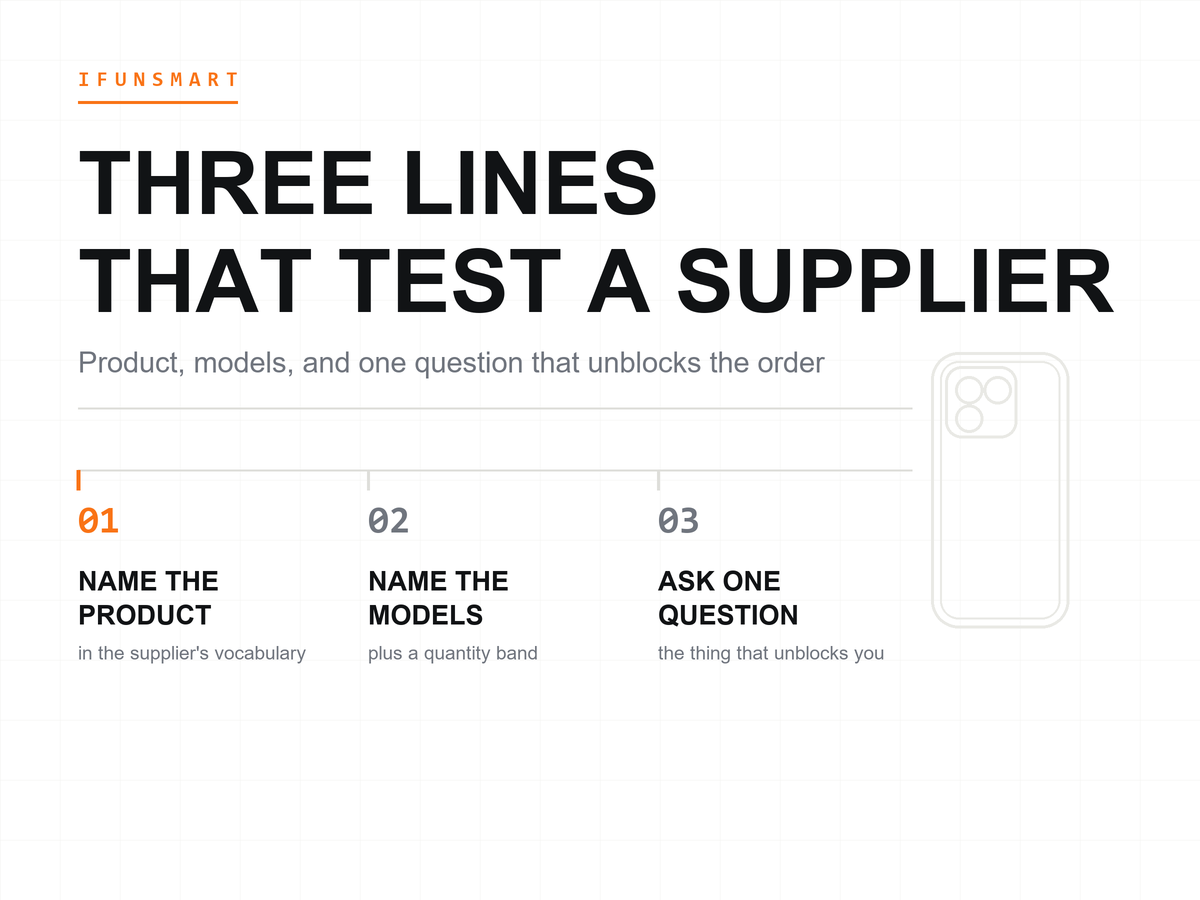
An inquiry can only be answered on the terms it sets. At iFunSmart, a first message that names the product, the models, and the single thing the buyer needs first moves straight to a useful reply, and those three lines double as a test of how any supplier will behave later. Copy the structure.
Last updated: October 20, 2026.
Why Most First Inquiries Get Vague Replies
A first inquiry is a buyer's opening message to a supplier, and its only job is to get a reply that is useful enough to justify a second message. Most first messages do not do that job. A request for a catalog gets a catalog. A question about phone case prices gets a list of questions back. Neither reply moves the buyer closer to a decision, because neither message told the supplier what the buyer actually needed.
The vague reply is usually not a supplier failing. It is the mirror of a vague message. A supplier who cannot tell which models matter, which market the buyer serves, or what would unblock the order has to answer with a list of possibilities, and that list costs both sides a day.
One buyer's first message asked about minimum order quantity before anything else, and the same thread asked about production lead time before deciding whether to order. Both questions were fair, and both were single lines. The buyers who get the fullest answers name more than one thing, and the three-line structure is the shortest message that does.
Line One: Name the Product
Start with what the buyer wants, in the supplier's vocabulary. Item codes work better than descriptions. A buyer who asks about a specific silicone case by its catalog code gets the picture of that exact case, not a page of similar styles. Category words such as clear case or magnetic case are the fallback when no code exists.
iFunSmart's catalog carries codes and names side by side. Ask for a silicone case buyers ask about by code and the reply names that exact case. Ask for a card-holder SKU in the catalog and the reply opens with that SKU. Line one names the product. It also shows the supplier that the buyer did the first minute of homework, and suppliers notice that.
Then Name the Models and the Quantity Band
The models decide whether the answer is even possible. An order for an iPhone 18 Pro Max armor case is one conversation, and a mixed order covering several models is another, with different stock positions and lead times. Naming the models in the first message saves the supplier from guessing and the buyer from receiving a reply built for the wrong phones.
The quantity can stay a band. A buyer does not need to commit to a number in the first message, and no honest supplier expects one. A few hundred pieces, or a first small batch, tells the supplier whether to answer in wholesale terms or sample terms. The band is a direction, not a promise, and the reply can quote both sides of it.
End With the One Thing That Unblocks You
Every buyer has a first question that nothing else can replace. For some it is pictures, because the listing is waiting. For others it is sample terms, or lead time, or how a custom logo would sit on the back plate. The question should be one question. A message that ends with six questions gets six short answers, and a message that ends with one question gets an answer the buyer can act on.
Asking for one thing also reads as confidence. It tells the supplier the buyer knows the sequence of a purchase, and it gives the supplier one job to do well. A buyer once asked by item code for pictures of two specific cases and got exactly that, because the question named precisely what was needed.
Reading the Reply as a Test
The three lines set up a reading. Does the reply answer all three? Does it name the models back, confirm the product, and answer the one question directly? A reply that skips the models is a supplier working from a template, and a template cannot answer what the message never asked. A reply that answers the one question in detail is a supplier paying attention. Neither answer proves a factory is good, but the second one is how a working relationship starts.
The test also works in reverse. A buyer who sends the same three lines to several suppliers can compare the replies line by line, and the comparison is fair because every supplier received the same question. What differs is the answer, not the inquiry.
Common Questions From Buyers
Is it fine to ask about minimum order quantity in the first message?
It is. One buyer opened with that exact question and got an answer. The minimum order quantity belongs in the message, just not alone. Pair it with the product and the models, so the supplier can give the number for the right case instead of a general rule.
How much detail should the first message include?
Three lines are enough: the product, the models with a quantity band, and the one question that unblocks the purchase. Everything else can wait for the second message. Extra detail is fine when it is specific, such as a target market or a deadline, and the three lines come first.
What if the reply is vague anyway?
Read it as data. A supplier who cannot answer three clear lines will not get clearer under a bigger order. Send the same three lines to the next supplier and compare, because the inquiry is the cheapest filter in sourcing.
What to Do Next
Write the three lines before opening a chat window. Name the product in catalog terms, name the models and a quantity band, and end with the one thing you need first. Then send the same message to every supplier on the list, because a fair comparison needs the same question.
Send iFunSmart the models, the quantity band, and the one thing you need first, and we will answer all three lines in one reply within 24 hours.
Apple, MagSafe, and iPhone are trademarks of Apple Inc. iFunSmart is an independent manufacturer of phone cases and accessories and is not affiliated with, authorized, sponsored, or endorsed by Apple.