Oct 27, 2026Business Solutions
A Sold-Out Color: Replenish or Switch Shade?
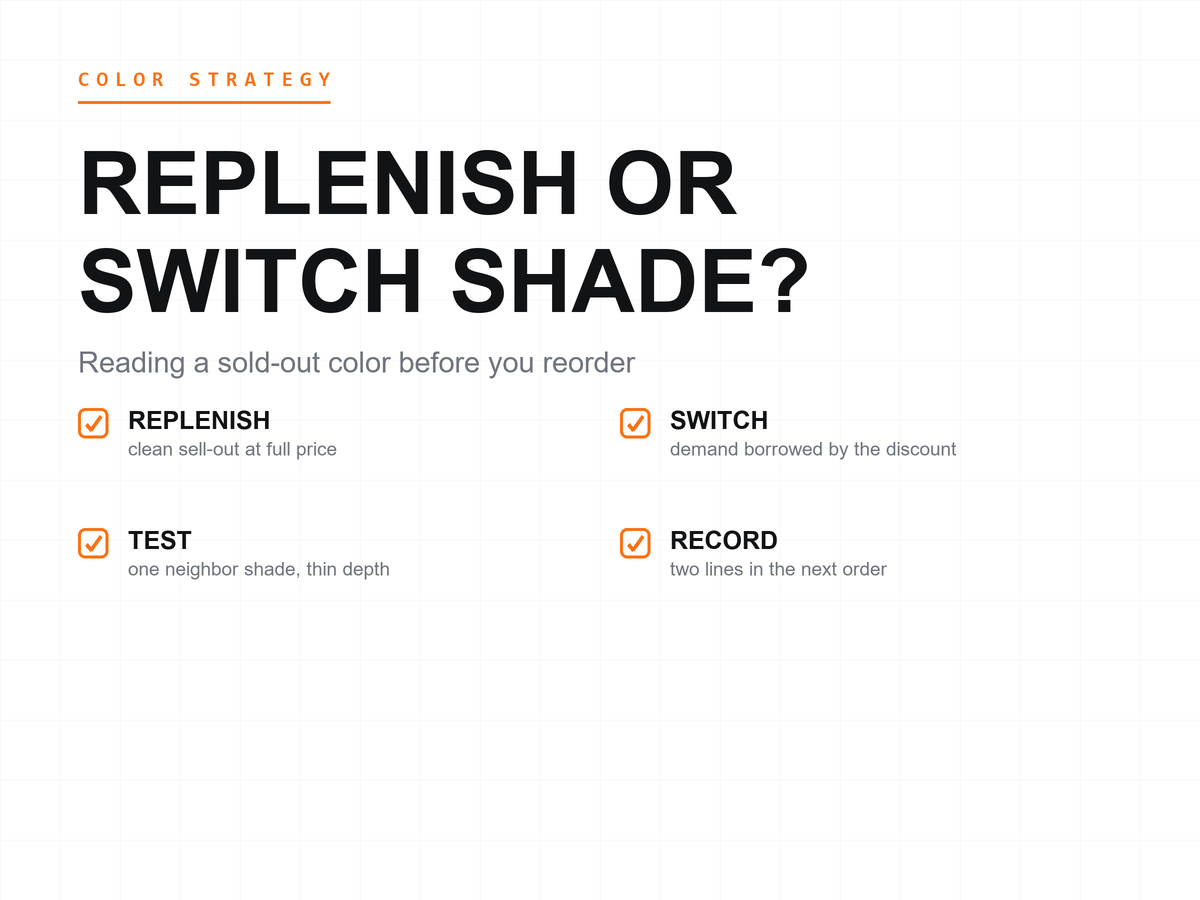
A color that sold out is clean demand or a borrowed one. Reading the first run decides the next order: replenish the proven shade, or test a neighbor color.
When a case color sells out, the next order is a decision, not a reflex. Buyers at iFunSmart ask the same question each season: replenish the exact shade, or move the money to a neighbor color? The answer should turn on one measurable input — how the first run actually performed. Here is the judgment line.
Last updated: October 27, 2026.
The Question a Sold-Out Color Really Asks
A sold-out iPhone case color carries two messages at once, and they point in opposite directions. It says the market wanted the shade. It also says the market's appetite for that shade is now an unknown, because nobody can tell you how much of the sell-out was real demand and how much was a lucky first run.
The honest reading separates the two. A color that sold out fast, at full price, with customers coming back to ask for more, is evidence of demand. One buyer who cleared out our burgundy and light blue stock came back asking us to produce the same colors as soon as possible. That is the replenish signal in its purest form. A color that sold out slowly, or only after a discount, or in a rush that no one asked for twice, is a different animal: the shelf ran out, not the demand.
That is why the question is not what shade you like. The question is which signal the sell-out carries, and the answer comes from the records the first run left behind.
When Replenishing Is the Stronger Move
A clean sell-out at iFunSmart is a shade that sold fast at full price, with few returns and no heavy discounting. That is the case where replenishing wins, because the evidence is one-sided: the market paid the full price and cleared the shelf.
Replenish in this situation, and keep the range small. Re-order the proven color in depth instead of spreading the same budget over three untested shades. Depth on a proven color is the lower-risk position a reorder can take. The mold is ready, the packaging is approved, and a proven shade like the Smoke MagSafe case for iPhone Duo can go straight back onto a production line, which is exactly the speed a sold-out shelf needs.
The reorder is still not automatic. Check what the first run did at the channel level before scaling it up. If the color sold out in one market and sat in another, replenish for the market that moved it, not both. A sell-out in one channel is a market fact. A sell-out everywhere is a stronger one, and the two call for different order sizes.
When the Demand Was Borrowed
Some sell-outs at iFunSmart are real, and some are borrowed from the price tag. If the color only moved during a promotion, or moved because a neighbor color was unavailable, the demand belongs to the moment, not to the shade. Replenishing then is paying to relive a discount.
The test is simple to run from records you already have. Compare the weeks before the promotion against the weeks inside it. Compare the return rate of the color against the rest of the range. Compare the sell-through by channel. Three quiet comparisons usually show which way the demand flowed.
A shade that fails those comparisons is a switch candidate, not a replenish candidate. The money is better placed in a neighbor color that has not had a run yet, because the proven color's run already said what it had to say. Keeping dead money in a color the market borrowed is how a discount becomes a permanent feature of the listing.
What "Similar" Means on a Shelf
On an iPhone case shelf, neighbor colors are not interchangeable, and the shelf is where the difference shows. A neighbor shade sits next to the sold-out one and carries its own identity: lighter or darker, cooler or warmer, with a gloss level of its own. If the switch shade reads as the sold-out color's twin, it inherits the comparison. If it reads as a different option, it earns its own run.
The switch works when the neighbor is close enough to keep the category and far enough to be a new shelf decision. A smoke finish next to a clear one is that kind of pair. The Clear MagSafe case for iPhone Duo reads as a different option, not as a smoke twin, and the same pairing runs on the iPhone 18 Pro wall, where the Cherry Smoke MagSafe case plays the smoke role.
A neighbor shade does not inherit demand automatically. The switch still has to earn its first run, so treat it as a test order smaller than the proven color's reorder would have been, and watch the same numbers that judged the first color. The switch is a second bet on the same shelf, not a repeat of the first result.
Questions Buyers Ask About Switching
Neighbor colors raise the same three questions at iFunSmart every season.
Is a neighbor shade a safe substitute?
Not on its own. A neighbor shade is a category neighbor, not a replacement, and the market decides whether it can carry the same demand. The switch is safer when the two colors sit close in tone and far in identity, and when the failed signal behind the sold-out color is read first. A substitute chosen without reading the first run is a guess wearing a plan.
When does switching cost less than replenishing?
When the first run says the demand was borrowed. A color that only moved on promotion, or only while another shade was out of stock, will carry that discount expectation into a reorder, and a fresh neighbor shade starts clean. The comparison does not settle what your market will buy next; it only ranks which decision has better evidence behind it.
Can the reorder carry both the proven color and a test shade?
Yes, and this is the structure careful buyers land on most often. Put the depth in the proven color, where the evidence is, and put a thin test order in one neighbor shade, where the question is. The two lines ship together, and the numbers from each decide the order after that. This is not hedging for its own sake; it is depth on evidence and width on a question, which are two different bets with two different jobs.
Write the Decision Into the Next Order
A replenish or switch call made in your head is an opinion, and at iFunSmart we see the difference in every reorder conversation. Made on paper it is a decision, and only the paper version survives contact with the sales report. Two lines are enough: which color gets the depth, and which neighbor shade gets the test. Everything else follows from those two.
When you send us those two lines — the color that sold out, and the shade you want to test beside it — we will read them against the models you sell and confirm your restock option in writing. Our contact page at iFunSmart states "Response within 24 hours," and the confirmation you get names the option and the models it covers.
Send us the sold-out color and the neighbor shade you want to test, and we will confirm your restock option in writing.
Apple, iPhone, and MagSafe are trademarks of Apple Inc. iFunSmart is an independent manufacturer of phone cases and accessories and is not affiliated with, authorized, sponsored, or endorsed by Apple.