Oct 12, 2026Business Solutions
Date Clauses for Your Order Confirmation
A confirmation with one date is a hope. Three date clauses to write in: production completion, dispatch to the forwarder, and how changes are agreed.
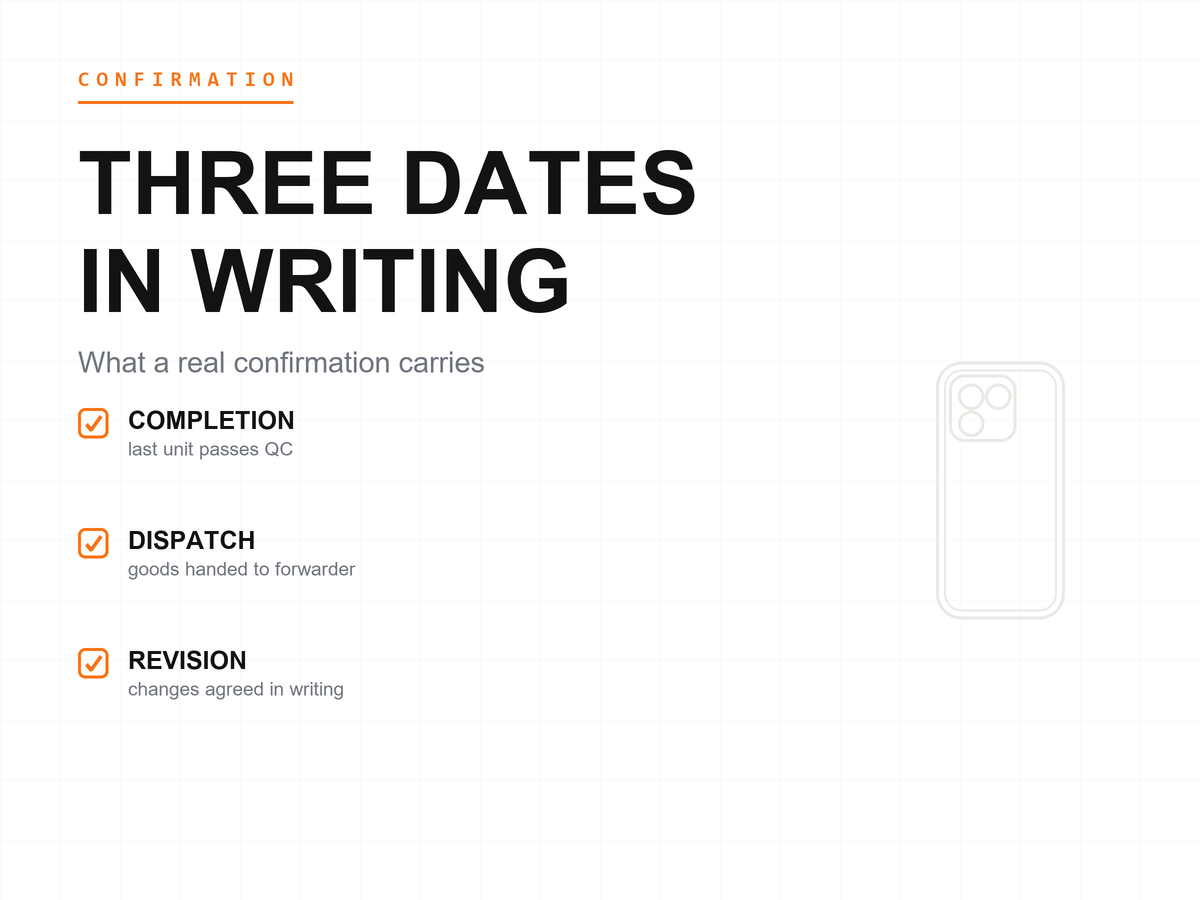
A single date on an order confirmation is a hope, not a schedule. iFunSmart writes three date clauses into the confirmation before a run starts: the production completion date, the handover date to the forwarder, and the written process for changing either one.
Last updated: October 12, 2026.
Why a Single Date Is Not a Schedule
A date clause is a written term on the order confirmation that names one date together with the event the date belongs to. The event is the part buyers skip, and it is the part that decides how the date gets used.
Take a confirmation that carries one number and no named event. One reader assumes the line finishes production then. Another assumes the goods leave the building then. The number is identical. The plans built on it are not, and the gap usually shows up later, when a shelf sits empty and nobody can say which date failed.
Dates also travel by rumor. A number quoted in a chat and repeated in a sales email starts to feel official, though nothing on paper backs it. A date becomes a commitment when it sits on the order confirmation and both sides have agreed to it, which is why we state these dates on the order confirmation before the run starts rather than after.
We do not quote turnaround days in this article, because a turnaround that fits one order misleads the next. The dates that govern your run are confirmed per order, in the confirmation, as written terms.
The Production Completion Date
The production completion date is the date the last unit of your order passes QC. It is not the day production starts, and that difference is the whole reason the term exists.
Start dates are soft. They move with the tooling queue, the material arrival, and the workload already on the line. A completion date is firmer, because the floor can schedule backward from it through molding, assembly, inspection, and packing, and departments downstream read it as a deadline rather than an estimate.
The clause should name its event, its run, and the order it covers. A completion clause that names only a month invites drift, and drift is how a confirmed date turns into a discussion. Name the event in the same sentence as the date: the last unit clearing the QC gate.
The 2700GS magnetic case for the iPhone 18 Pro Max is a reorder worth a written date. Its mold is cut, the finish is settled, and the schedule is the only open question, which is exactly when an unwritten date costs the most.
The Handover Date to the Forwarder
The handover date is the day the packed order leaves the floor and passes to the forwarder. It is a different event from the completion date, and the space between the two is where most date surprises live.
Units can clear QC and still not move. Carton packing, label printing and application, and the forwarder's collection slot all sit between the last QC pass and the truck. We print and apply labels in-house, so the label step runs inside that window rather than through a third party, and the window still takes time.
The handover clause should also mark where our schedule stops. Once the goods pass to the forwarder, the journey runs on the carrier's schedule and the conditions of the lane. We do not fold transit days into the factory dates, because a date that pretends to control an ocean lane is a guess, not a commitment.
Treat a premium build on the schedule as the test case. The armor case for the iPhone 18 Pro Max still has to be packed, labeled, counted, and handed over before any forwarder will load it.
How a Date Change Is Agreed
Dates move, and a confirmation that assumes otherwise becomes a document nobody uses twice. The revision clause is the third date term, and it should read as a process rather than a permission.
A workable pattern runs in four steps: the side that needs the change asks in writing, the request names a reason and a proposed new date, both sides confirm the new date in writing, and the new date takes over only once that confirmation exists. Nothing is automatic, and nothing changes on a phone call.
Written does not mean hostile. It means traceable. A date changed by voice leaves one side planning against the old number, with no document that shows where the plan broke.
The clause should not promise unlimited rescheduling, and it should not pretend a confirmed date can never move. What it should say is how a new date gets agreed. We confirm changes the same way we confirm the original dates, in writing, so both sides plan from one version of the schedule.
The Three Dates Move as One Chain
The three clauses describe one chain rather than three separate points. A late completion pushes packing, label work, and the handover slot behind it, and from there the carrier and the shelf absorb whatever is left.
That chain is why a single number on a confirmation is risky. When the number slips, the reader cannot tell which link slipped. A completion date that moves squeezes packing and can push the handover, while a handover that moves may or may not touch the carrier's booking, depending on how much room the booking had.
The chain also tells you where to ask. Inspection questions belong to the completion clause, carton and label questions to the handover clause. Sailing time is the carrier's subject, not a factory date at all.
Tell us the models you plan to run and the shelf date behind them, and the three clauses can be confirmed in writing when your confirmation is drawn up.
Common Questions From Buyers
Which date should a buyer plan against?
Both, for different jobs. Receiving, warehousing, and shelf plans build on the handover date, because that is the day the goods begin to move. Inspection staffing builds on the completion date, since that is when units start flowing through packing. Track a single date and you are tracking half a chain, and the half you skip is where surprises live.
Can a confirmed date be changed after production starts?
It can be raised at any point, and whether it is granted depends on the stage, the reason, and the room left in the schedule. The process stays the same: ask in writing, name the reason, propose a new date, and wait for written confirmation before planning around it. A change that has not been confirmed has not happened.
Does the confirmation date cover transit?
No. Factory dates end at the handover, where the goods pass to the forwarder. Sailing, customs, and the final delivery leg run on the carrier's schedule and the conditions of the lane, and we do not write them into the confirmation as if they were ours to control. When a supplier offers a delivered date down to the day, ask which part of that date the supplier actually controls.
What to Do Next
Ask for the three clauses in writing before you approve a run: the completion date with its QC event, the handover date with its packing and label steps, and the revision process with its written path. Then read them together, as a chain. A confirmation that answers all three tells you when your goods finish, when they move, and what happens if the plan has to change. That is the whole job of a date.
iFunSmart is a Guangzhou factory, founded in 2010, molding cases with 1:1 precision and in-house CNC tooling. We state these dates on the order confirmation before the run starts, so your receiving plan and our production floor work from one document.
Send us the models on your list and the shelf date you are planning toward, and we will write the three date clauses into your confirmation before the run starts.
Apple and iPhone are trademarks of Apple Inc. iFunSmart is an independent manufacturer of phone cases and accessories and is not affiliated with, authorized, sponsored, or endorsed by Apple.