Oct 12, 2026Business Solutions
Store Reorders vs Online Reorders: Two Readings
The same reorder trigger reads differently on a store shelf and in a dashboard. Keep two logs, read each channel on its own terms, reconcile on review.
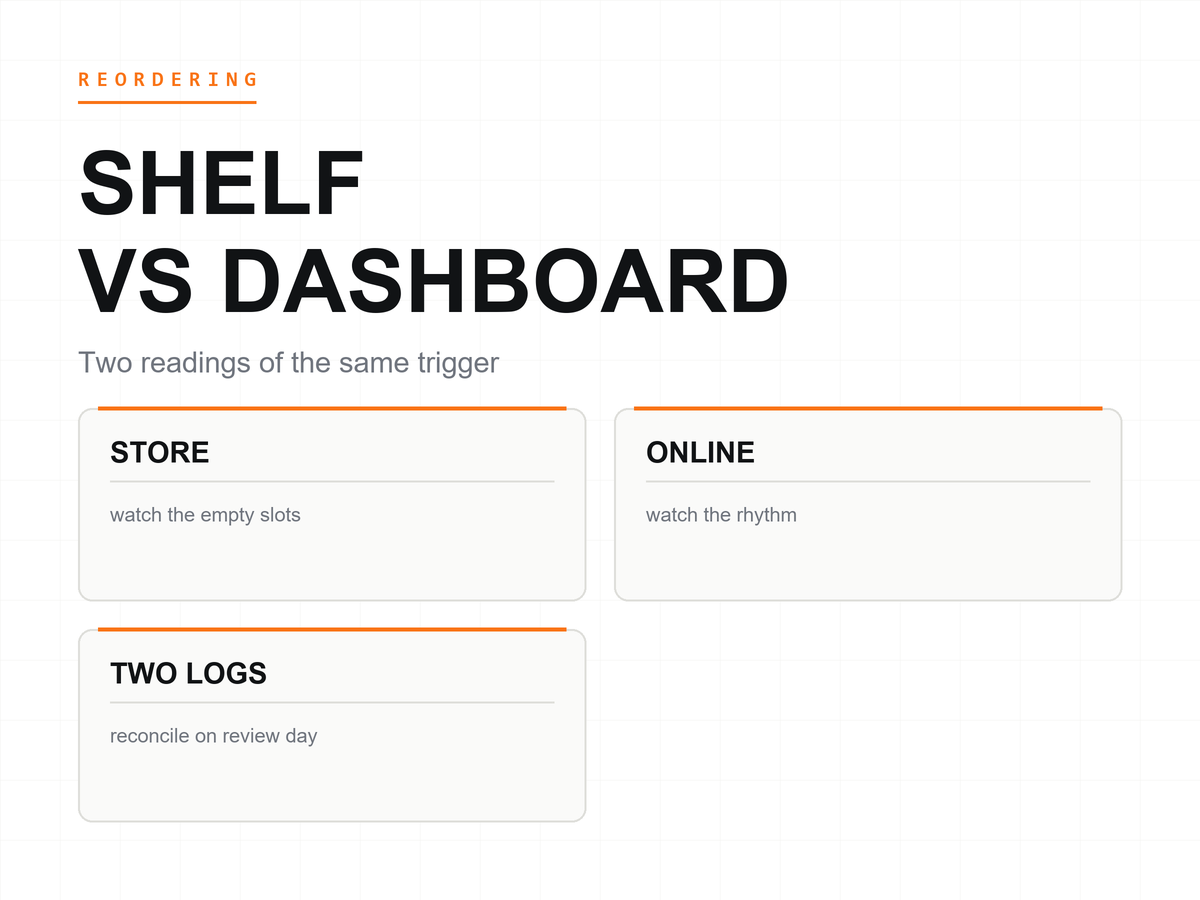
A reorder trigger that fires on a store shelf and one that fires in a dashboard are not the same signal. The same iPhone case can empty a peg in a shop and sit still on a listing, and a buyer who blends the two numbers reads neither. Keep them apart.
Last updated: October 12, 2026.
Two Channels, Two Kinds of Signal
A reorder trigger is channel-blind. It fires when the cover left in a channel drops to the length of the replenishment cycle, and the same arithmetic serves a wall and a listing. What changes is the evidence that reaches you first.
A store reading tends to be slow and clean. A facing empties because a customer picked the case up and paid, and the shelf rarely has another story to tell. The trade is time: a real gap shows only after enough shoppers have walked past.
An online reading tends to be fast and mixed. A listing reports pace as it happens, and the report carries promotions, seasonal pushes, traffic swings and shipment delays inside it. Speed is the gift; the noise is the price.
The pattern is a tendency, not a law: a shop can move fast in a launch week, and a listing can crawl through a quiet month. Averaging the two produces a sentence in neither language.
Reading a Store: The Empty Slot
The wall keeps score in empty spaces: which facing emptied first, which color customers asked for and did not find, whether a strip has visibly thinned. A shelf answers in positions rather than in figures.
An empty slot is clean evidence because a sale is the only thing that produces it. Even a promoted sale still had to be chosen and paid for at the counter. The shelf does not explain why; it reports that somebody chose.
Read the slot, not the pile behind it. A facing that emptied because you stocked it thin has told you about your own order rather than about demand. The gap's shape carries the detail: one finish gone while its neighbors sit, or a strip that keeps closing.
Staff memory is a channel too. The model a customer picked up and put back, the color somebody asked about twice — those arrive as conversation, and a note taken the same day turns them into a record.
The same iPhone and Galaxy models often sell in both worlds. That is why a card-holder SKU that sells both ways earns a line in each log instead of one blended verdict. Where the two logs later agree, the agreement is the strongest entry either will hold.
Reading a Listing: The Rhythm
A dashboard answers a different question. The wall says that something sold; the listing says how it sold — units across a window you set, where stock ran out, and the attention the page drew while it lasted.
Rhythm is the thing to read. A listing that sold steadily wrote one story; one that moved in a burst wrote another. The burst usually has a name — a promotion, a holiday, a shipping upgrade you offered. The dashboard reports the pace, not the reason; adding the reason is your half of the job.
Stockouts are the loudest line in the listing log. A SKU that ran out did not stop selling; it stopped being available, and shoppers who arrived during the gap left or bought something else. That lost stretch never shows up as a figure, which is why a stockout date belongs beside the return date.
Traffic and sales separate here too. A listing seen often and bought rarely is being compared and passed over. A listing bought with little browsing is being searched out by name. Two different problems, two different fixes, and the dashboard shows both without naming either.
A matte SKU on the shelf can be a wall favorite with a quiet listing, or the reverse. When one finish reads warmly in one channel and coldly in the other, that split is the finding, and it disappears the moment the two channels are summed.
Two Logs, One Review Date
A channel-specific reorder log is the record of what moved inside one channel, kept per SKU and per color, and read on its own terms before either channel is compared with the other.
Both logs carry the same fields on separate pages: what sold, what emptied, the date the reading was taken, and any event that could bend the period. Write the fields you will actually fill.
Do not merge the two between review dates. Blended, a strong wall and a stalled listing average into a middling figure that describes neither, and a reorder decided from that figure is aimed at a customer who does not exist. The channels meet on the review date.
The review date is where the two readings face each other. The trigger line still sets when the next purchase fires, and the deepen-or-widen choice still follows the logs it is built on. If you want to know which finishes we run for a model that keeps surfacing in your logs, ask and we will name them.
The Reconcile: What the Pair Decides
Laid side by side, every position falls into one of three readings.
Agreement between the logs is the strongest entry either will hold. Both channels moved, so that SKU and its color have earned depth; size the next order like a position with a record.
When only one channel moved, resist the copy-and-paste reorder. A finish that sells from a wall but stalls on a listing may be photographed poorly or sit beside tougher comparison shopping. A finish that sells online but sits in a shop may be placed where nobody walks. The moving channel says where the next unit belongs; the quiet one may be asking for a fix rather than a verdict.
A position that moved in neither log has answered. Retire it and give the space to something that has not had its chance; holding a slow starter in hope is how a shelf fills with furniture.
The reconciliation is a conversation, not a formula. Which reading fits depends on your channel mix. We do not publish a blended rule, because no factory watches the shelf counts or the dashboards on your side of the transaction.
Common Questions From Buyers
Which channel's reading should I act on first?
The cleaner one for the decision you are about to make, not the louder one. If the decision can wait a cycle, the shelf answer is worth waiting for, because a sale is the only thing that produced it. If cover is running thin, act on the listing rhythm and discount it against the events you logged.
Why do the two channels disagree about the same SKU?
Because they measure different moments. The wall measures what happened when a customer stood in front of the case; the listing measures what happened when the case sat on a screen beside other listings. Presentation, price comparison, and how people shop each channel explain most of them. A disagreement is data about the channel, not a defect in either log.
What belongs in a channel-specific log entry?
The SKU and its color, the channel it belongs to, what sold, what emptied, the date of the reading, and any event that could bend the period. Add the questions customers asked, since unmet demand speaks before it buys. Keep each entry to a line; a log survives on brevity.
What to Do Next
Two readings kept apart and reconciled on a calendar is the whole method, and it costs one habit at the counter and one note at the dashboard. We mold cases in Guangzhou, and a reorder of a SKU your logs agree on usually rides tooling that already exists.
Send us the SKUs your two logs agree on, and we will confirm the tooling and the production window behind them.
Apple, iPhone, Samsung, and Galaxy are trademarks of their respective owners. iFunSmart is an independent manufacturer of phone cases and accessories and is not affiliated with, authorized, sponsored, or endorsed by Apple or Samsung.