Oct 8, 2026Business Solutions
Packing Cases and Accessories in One Carton
One shipment, two product types, and a scratch risk between them. How to pack hard cases and small accessories together so both arrive shelf-ready.
One purchase order that covers cases and small accessories saves freight and coordination, and it adds a scratch risk between them: hard cases with polished faces share a carton with metal edges, stands, and corners. This article explains how the mix gets packed so both arrive shelf-ready — the trade methods, and what iFunSmart commits to in writing.
Last updated: October 8, 2026.
What a Mixed Carton Is
A mixed carton is one shipping carton that carries finished cases and small accessories from the same purchase order, packed so each product type is protected from the other as well as from the journey. The definition is easy to write and easier to get wrong, because the two types inside it have opposite shapes.
A hard case is large for its weight, and its value sits on its surface. A gloss finish, a smoke tint, a coated pattern — these are the faces a customer judges from across the shop, and a scuff across one turns a shelf-ready unit into a discount candidate. Accessories run the other way: small, dense, and edged. A folding stand closes on a hard line, a metal plate carries sharp corners, and a hinged lid stores spring behind a narrow frame. Small pieces are dense for their size too: a card-holder accessory that rides the same carton pairs a card bay and a metal stand with a clear body, useful on a shelf and unforgiving in a carton that lets it wander.
Left loose in one box, these profiles grind out damage on their own. A carton vibrates for weeks, gets tilted and stacked, and crosses more pairs of hands than anyone tracks. Contact that is harmless in an hour of shop handling becomes abrasion over a month of transit. Good packing reduces that risk; it cannot remove the risk a rough route adds, and the sections below treat that limit as the starting point.
How Packers Separate Cases from Accessories
The methods in this section are ordinary practice across the trade, described as what experienced packers do rather than claimed as an iFunSmart exclusive. They share one idea: the two product types should not touch, and nothing should start them touching.
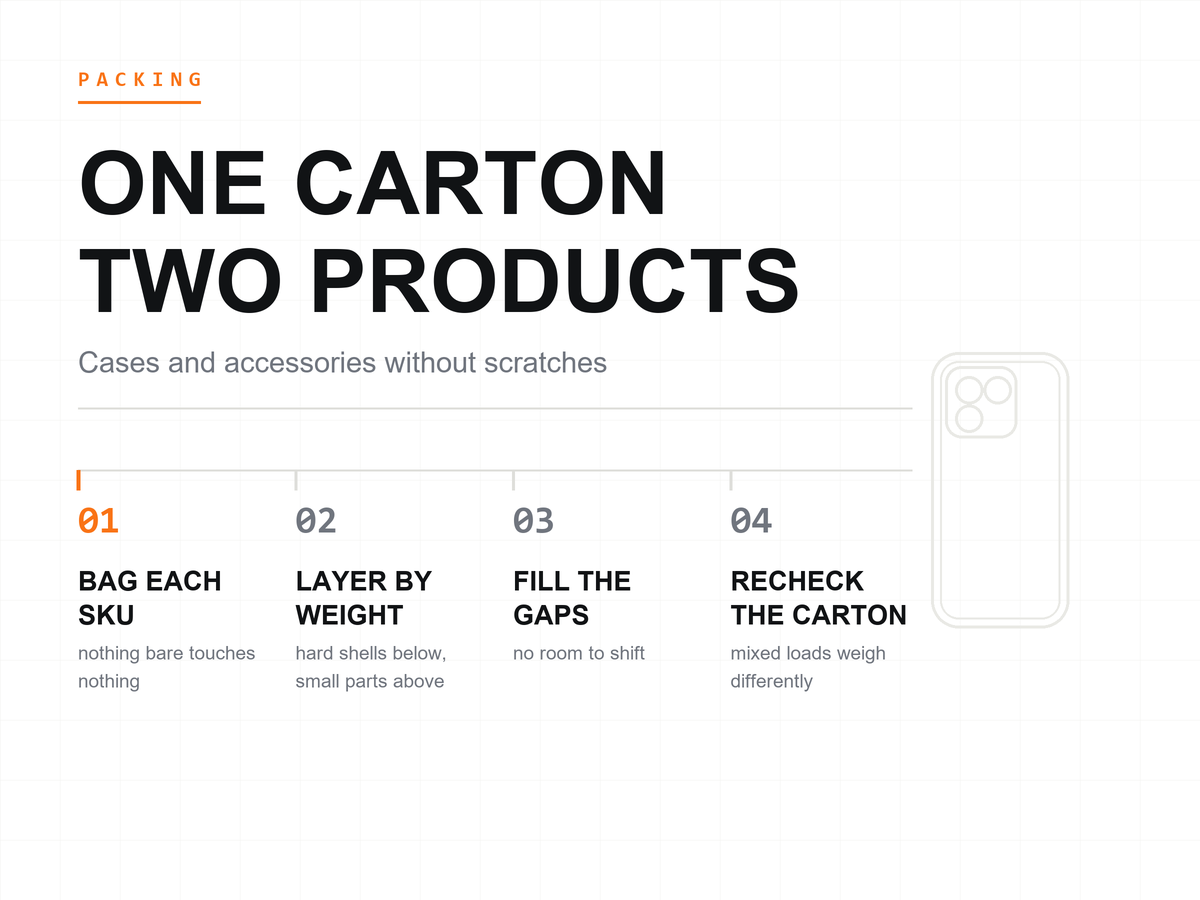
Zoning comes first. Hard cases lie flat in the lower section of the carton, arranged so their finished faces meet a surface that cannot mark them, while the bagged accessories sit in a separate compartment above, held in place by a divider. A partition turns a single carton into separate addresses, and separate addresses do not trade scratches.
Bagging comes next. Each SKU travels in its own bag, and the metal-edged pieces get a bag of their own, so an edge rubs film instead of finish. Bags also make a carton countable on arrival: a receiver can check quantities section by section without unwrapping the whole load. Labels close the loop — we print and apply labels in-house, and a bag whose label names its contents is faster to check than a bag you have to open.
How do packers keep metal parts away from polished faces?
Through distance first, then a barrier. The divider keeps the bagged accessories in their own compartment instead of letting them settle onto the case stack, and the bags absorb the rubbing that vibration causes, so contact happens film-on-film rather than metal-on-finish. Orientation does quiet work too: stands folded closed and plates laid flat remove the corner-first contacts that do the worst damage. None of this needs specialized machinery. It is discipline, and any factory that ships consolidated orders should be able to describe its version in a paragraph.
Fill the Gaps, Then Recalculate the Carton
Separation fails if the load can migrate. Empty space is the enemy. A carton with room inside lets its contents shuffle at every handling point, and a divider only works while nothing slides past it. Packers fill the gaps — paper, foam, and air pillows are the common choices — until the sections hold still when the carton is tipped. The material matters less than the outcome: no migration, no new contacts.
The other half of the job is arithmetic. A mixed carton does not weigh or cube like a cases-only one. Accessories are denser than cases, and a bulky armor case with its slide cover and raised frame swells a master carton on its own. Carton size, gross weight, and the freight figure behind them get recalculated for the mix rather than copied from a cases-only order. What that does to the freight budget is a container-math question with an article of its own; the packing point is narrower — a carton you mix is a carton you re-spec.
One habit belongs on the buyer's side: ask whoever packs the carton to photograph each filled section before it is sealed, so the record of the layout travels with the shipment.
The Arrival Check, in the Right Order
A mixed carton rewards an ordered unpack. Most receivers open the accessory compartment first: bagged small parts shift in transit, and a dent in a metal stand shows immediately, while a scuff on a case face can hide under film and shop lighting. Count the bags against the packing plan while the section is still open, then pull a case sample from each section and check the polished faces under a strong light. If something arrived marked, photograph it beside the section it came from while the packing material is still in place — the state of the divider and the fill is evidence of how the carton traveled, and evidence settles a dispute faster than a description does.
What to Agree Before Production Starts
Every method above is a decision someone makes for a specific mix, and the honest summary is short: the packing plan depends on the product mix. A carton of slim clear cases and one carrying armor builds, stands, and card holders do not take the same layout, and a plan that suits one can mis-serve the other. So settle the plan while the order is still words on paper — we pack mixed orders to the plan agreed on the order confirmation, and the layout you agreed is the layout the carton gets, sections, bags, and fill included.
Common Questions From Buyers
Does packing cases and accessories together raise the scratch risk?
Loose packing raises it sharply. A planned layout reduces it to what the route itself adds, and that is the honest baseline: vibration, stacking, and handling exist whether a carton holds one product type or several. The risk is not created by mixing — it is created by contact, and a mixed carton is where the two sit closest together. Zone the carton, bag the parts, fill the gaps, and contact stops being a design feature of the shipment.
Which accessories need their own bags?
Anything with an edge a case face would notice: folding stands, metal plates, camera-cover sliders, card holders with rigid frames. Finished and clear cases benefit from a bag of their own as well, because film takes the abrasion instead of the finish. The test is short — if two items can mark each other, they do not share a bag.
When should you raise packing with the supplier?
Before production, not after inspection. The plan is settled on the order confirmation, which is the one moment where a change costs a conversation instead of a claim. Ask which sections the carton will carry, where the metal parts ride, and what fills the gaps. The answers are short, and they show how a factory treats your goods before you risk a shipment on the question.
What to Do Next
List what rides in your next mixed order: which cases, which accessories, which of them carry metal. Put the packing plan on the table while the order is being confirmed — sections, bags, fill, labels — and keep an arrival check beside the carton when it lands. We have made cases in Guangzhou since 2010, and the mixed cartons that arrive clean are the ones whose plan was written down before the first case went in.
Send us your case and accessory mix, and we will settle the packing plan with you on the order confirmation.