Business Solutions
Phone Case Drop Protection: What the Numbers Mean
A drop rating is a lab result — a height, a drop count, a surface and a pass test — not a guarantee. Read MIL-STD-810G and 810H, feet vs metres, and the four numbers to ask for in writing.
BLUF
A drop number on a phone case listing is a lab result, not a promise: a height, a number of drops, a surface and a pass test. Read all four together — a bare height, or a bare "military-grade" badge, tells you almost nothing.
Short answer
Every rugged phone case listing carries a number. 10FT, 16FT, 18FT, "military-grade", "MIL-STD-810H", "drop tested 5,000 times" — the numbers look precise and comparable, and they are neither. A phone case drop rating is a statement about one laboratory test: a case, usually with a phone inside it, dropped from a set height, a set number of times, onto a set surface, in a set pattern. If the phone still works afterwards, the case earns the claim. Change any one of those four — the height, the count, the surface, the pass test — and the same case earns a different number.
The one fact that decides whether a drop number means anything is the test behind it. A listing that states the height, the count, the surface and the pass test — and names the lab — is giving you a specification you can compare and check. A listing that states only a height, or only a badge, is giving you a headline. Section 8 lists the eight questions to ask in writing before the deposit.
One rule runs through the whole guide, and it is the rule this series has kept from the first article: never take a listing number as a fact about performance. A number is only as good as the test behind it — and the test is only as good as the report that describes it. Ask for the report. If there is no report, the number is a headline, not a specification.
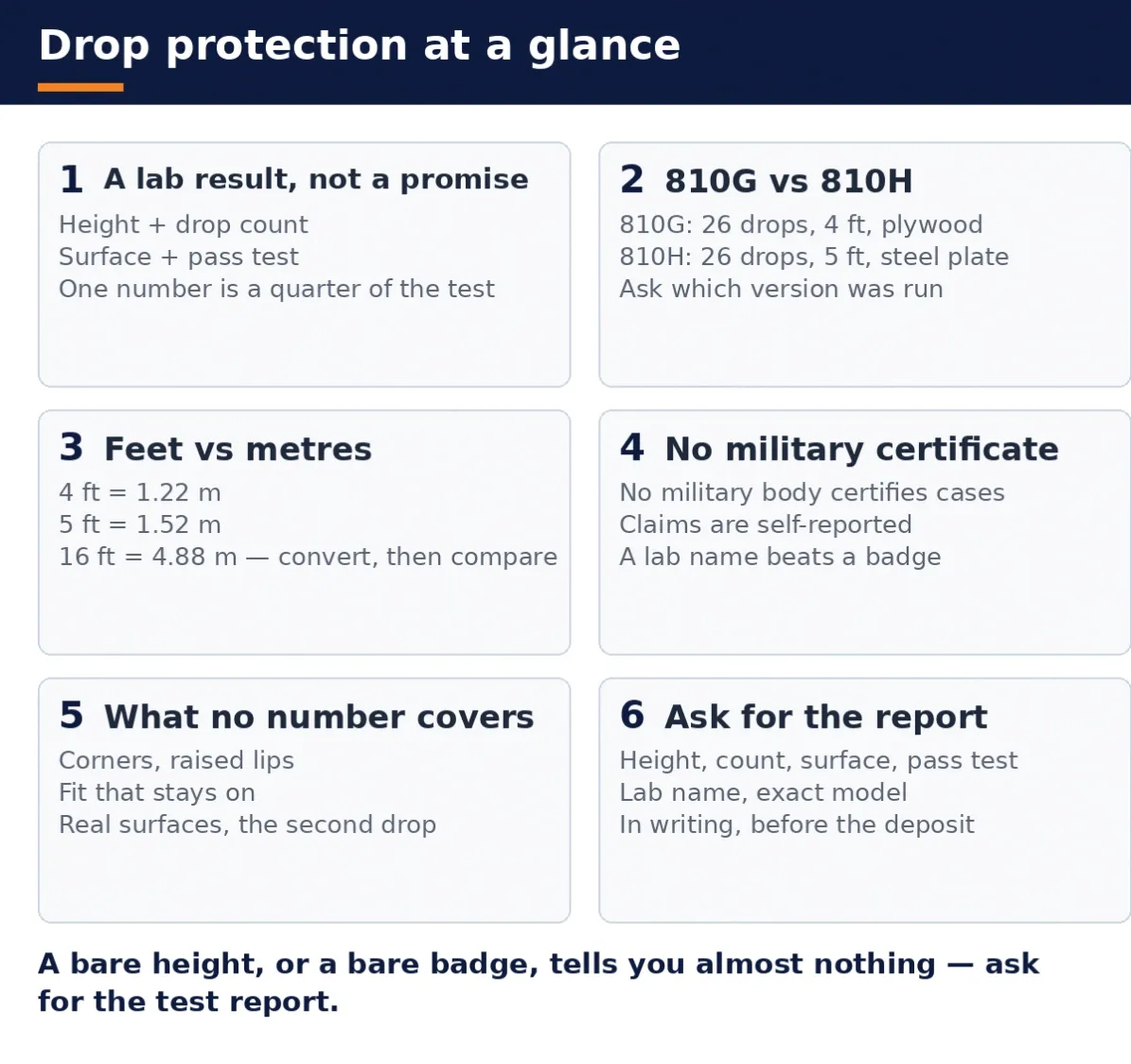
Drop protection at a glance
Question | The short answer |
|---|---|
What is a drop rating? | A lab result: a height, a drop count, a surface and a pass test — not a guarantee the phone survives any fall |
What does "military-grade" mean? | Tested following MIL-STD-810 Method 516 — 810G is 26 drops from 4 ft onto plywood over concrete; 810H is 26 drops from 5 ft onto steel over concrete |
Who certifies it? | Nobody — the US Department of Defense does not certify commercial phone cases; claims are self-reported |
Feet or metres? | Same test, different ruler: 4 ft = 1.22 m, 5 ft = 1.52 m, 10 ft = 3.05 m, 16 ft = 4.88 m, 18 ft = 5.49 m |
What four numbers matter? | Height, drop count, surface, pass criteria — plus who ran the test |
What does no number cover? | Corners, raised lips, fit that stays on, the real surface, and what happens on the second drop |
What do you ask for? | The test report in writing — height, count, surface, pass criteria, lab name — before the deposit |
1. What a drop number actually is
A drop rating is a statement about a laboratory test, and the test has four parts. First, a height: the point of release, usually written in feet or metres — 4 ft, 10 ft, 16 ft, 18 ft. Second, a number of drops: how many times the case was dropped, and in which orientations — flat on each face, on each edge, on each corner. Third, a surface: what the case landed on — plywood over concrete, bare concrete, a steel plate over concrete, or something softer. Fourth, a pass test: what counted as passing — the phone still working, the screen intact, the case still fitted, or simply "passed" with no definition.
Most listings give you one of the four: the height. A listing that says "18FT drop protection" has told you the release height and nothing else. It has not told you how many times the case was dropped from 18 feet, onto what, in which orientations, or what counted as a pass. Two cases can both say "18FT" and have been tested in completely different ways — one dropped once, flat, onto plywood; the other dropped twenty-six times, on every face, edge and corner, onto steel. The number is the same. The test is not.
The height is also the point of release, not the height of a real fall. A case dropped in a lab is released from a fixed height onto a flat, known surface, with the phone seated correctly in the case. A real phone falls from a hand, a pocket, a table or a car roof, spinning, onto concrete, tile, asphalt or a pebble, and it lands on a corner more often than flat — because a phone is a flat rectangle and a corner is the first thing to meet the ground. The lab test is repeatable, which is its value; it is not a simulation of a real fall, which is its limit. A buyer who treats the lab number as a guarantee about real falls is buying a promise the test never made.
The other way to read a drop number is as a comparison tool, and it works only when the tests match. Two cases tested the same way — same height, same count, same surface, same pass test — can be compared on the height. Two cases tested differently cannot. That is why the rest of this guide keeps coming back to the same four questions: what height, how many drops, onto what, and what counted as a pass. A listing that answers all four is telling you something. A listing that answers one is selling you a number.
2. Feet vs metres: putting two listings on the same ruler
Phone case listings mix feet and metres freely, and the mix hides real differences. A case rated at 10FT and a case rated at 3 m are the same height — 10 feet is 3.05 metres. A case rated at 16FT and a case rated at 5 m are close but not the same — 16 feet is 4.88 metres, so the 5-metre case was tested from slightly higher. A case rated at 18FT was tested from 5.49 metres. The conversion is simple arithmetic — one foot is 0.3048 metres — and the table below puts the common listing figures on one ruler so a buyer can compare them without doing the maths in the middle of a quote.
Listing figure | In metres | What it is |
|---|---|---|
4 ft | 1.22 m | The MIL-STD-810G transit-drop height |
5 ft | 1.52 m | The MIL-STD-810H transit-drop height |
10 ft | 3.05 m | Roughly twice the 810H height |
12 ft | 3.66 m | A common rugged-case claim |
16 ft | 4.88 m | A figure seen on an iFunSmart rugged product page (Mech Armor IB25-017: "drops up to 16FT") |
18 ft | 5.49 m | A common heavy-duty claim — ask what test produced it |
20 ft | 6.10 m | A common heavy-duty claim |
25 ft | 7.62 m | A very high claim — ask what test produced it |
Three things to notice in that table. First, the standard heights — 4 ft and 5 ft — are low. A phone dropped from a hand or a pocket falls from roughly waist height, which is inside the tested range of the standard test. The standard was written for equipment dropped in transit, not for phones dropped from balconies, and a case that passes the standard has passed a waist-height test, repeated twenty-six times. Second, the big figures — 16FT, 18FT, 25FT — are far above the standard. A case tested from 18 feet was tested from more than three times the 810H height, which is a much harder test — if the test was real, and if the count, the surface and the pass test match the height. A very high figure with no test behind it is the figure most worth questioning, not the figure most worth trusting. Third, feet and metres are the same test written two ways, and a supplier that quotes one in feet and another in metres is not quoting two different tests — convert first, then compare.
The other number that needs converting is the drop count, and it does not convert — it adds up. A case dropped 26 times has survived 26 impacts. A case dropped once has survived one impact, and one successful drop is luck, not evidence. The standard test is 26 drops for a reason: it covers every face, every edge and every corner, so the case is tested where phones actually break. A listing that states a height but no count has told you the easiest part of the test and hidden the hardest part.
3. MIL-STD-810G vs 810H: the two versions behind the badge
"Military-grade" is the most common phrase on rugged case listings, and it points to MIL-STD-810, a United States Department of Defense document of environmental test methods. The document runs to more than 800 pages and covers many conditions — temperature, humidity, vibration, dust, shock — not just drops. The part relevant to phone cases is the transit drop test, Method 516, Procedure IV. There are two versions a buyer is likely to meet, and they are not the same test.
MIL-STD-810G, released in 2008, uses Method 516.6. The transit drop test is 26 drops from 48 inches — 4 feet, about 1.22 metres — onto two inches of plywood laid over concrete. The 26 drops are distributed across the device: six face drops, twelve edge drops and eight corner drops, and the drops may be split across no more than five test units. The plywood matters: it absorbs some of the impact energy before the case has to, which makes the test less severe than the same height onto bare concrete.
MIL-STD-810H, released in 2019, uses Method 516.8. The transit drop test is 26 drops from 60 inches — 5 feet, about 1.52 metres — and the default surface is a steel plate over reinforced concrete. The steel plate matters in the opposite direction: it is rigid, so the dropped item absorbs the impact rather than the surface, which makes the test harsher than the same height onto plywood. The 810H test is the more stringent of the two — a foot higher, onto a harder surface, with the same 26 drops across faces, edges and corners.
| MIL-STD-810G (Method 516.6) | MIL-STD-810H (Method 516.8) |
|---|---|---|
Released | 2008 | 2019 |
Drop height | 48 in (4 ft, about 1.22 m) | 60 in (5 ft, about 1.52 m) |
Number of drops | 26 — 6 faces, 12 edges, 8 corners | 26 — 6 faces, 12 edges, 8 corners |
Surface | 2-inch plywood over concrete | Steel plate over concrete (default) |
Test units | Up to 5 | Up to 5 |
Two confusions recur on listings, and both are worth naming. The first is the version confusion: some listings write "MIL-STD-810H" and then describe the 810G test — 48 inches onto plywood — because the older version is the one most cases were actually tested to, and the newer letter looks better on the page. A listing that says 810H and 4 feet is describing the 810G test under the 810H name, and the buyer should ask which version was actually run. The second is the method confusion: MIL-STD-810 covers many test methods, and only Method 516 is the drop test. A listing that says "MIL-STD-810" without a method number has not said which test was run at all — the standard also covers vibration, temperature and humidity, and a case can meet those without ever being dropped.
The practical point is simple: the version and the method are the claim. "Military-grade" on its own is a badge. "Tested to MIL-STD-810H, Method 516.8, 26 drops from 5 feet onto steel over concrete" is a test description, and it can be checked. Ask for the version, the method, the height, the count and the surface — in writing, on the quote — and a supplier that ran the test will answer without difficulty.
4. "Military-grade": what it is and what it is not
The phrase "military-grade" sounds like a certification, and it is not one. MIL-STD-810 is a test-method standard: a public, repeatable recipe for how to run a test. It is not a certification scheme. There is no military body that tests commercial phone cases, no certificate issued by the Department of Defense, and no central authority that inspects a maker's results. A manufacturer runs the test — in its own lab, or in a third-party lab — and declares that the product meets the standard. The declaration is self-reported.
That does not make the claim useless. It makes it a description of a test, not a seal of approval — and the value of the description depends entirely on how specific it is. A listing that says "tested to MIL-STD-810H, 26 drops from 1.2 m onto every face, edge and corner" is telling you something real: a height, a count, an orientation pattern. A listing that says only "military-grade" is telling you that the maker knows the phrase. The difference between the two listings is the difference between evidence and marketing, and it is visible in one line.
Three related phrases need the same treatment. "Drop resistant" generally means the case was designed or tested to reduce the risk of damage from a drop — a broad term with no fixed height requirement. A case labelled drop resistant could have been tested at waist height or at table height, and the label alone does not say which. "Drop proof" implies a higher level of confidence, suggesting the case can survive a drop without damage to the phone — but in practice it is still a marketing claim rather than a certified standard, and the conditions behind it vary widely between brands. Neither term is regulated. Neither term has a fixed test behind it. And "shockproof" is the same kind of word: it describes an intention, not a measurement.
The strongest signal on a listing is not a phrase at all — it is a name. Some makers have their cases tested by an independent lab and cite the lab on the page. A third-party lab had to put its own name on the result, which is a genuinely better signal than a self-declared number, because someone outside the company checked the work. A lab name does not make a bad case good, but it makes a good claim checkable — and checkable is what a distributor is buying. When a listing cites no lab, no version, no method, no height and no count, the buyer is being asked to trust the badge. A distributor that will sell hundreds of cases on the strength of a badge should ask for the report instead.
5. The four numbers that matter on any listing
Strip every drop claim down to four numbers, and the comparison becomes straightforward. A listing that gives all four can be compared with another listing that gives all four. A listing that gives one cannot be compared with anything — and the missing three are the questions to ask.
- Height — how far it was dropped from. The release height, in feet or metres. A stated height beats no height every time, and a higher tested height is a harder test — provided the other three numbers match. Convert feet to metres first (section 2) so two listings are compared on the same ruler. Be suspicious of a very high figure with no test behind it: a 25-foot claim with no count, no surface and no lab is a headline, not a result.
- Count — how many drops, and in which orientations. A single successful drop is luck. Repeated drops across multiple orientations show the structure holds up. The standard is 26 drops — six faces, twelve edges, eight corners — because corners and edges are where phones break. Ask how many drops, on which faces, edges and corners, and whether the drops were spread across several test units or all on one case. A case that survived 26 drops on one unit is stronger evidence than a case that survived 26 drops spread across five units, because the one unit took every impact.
- Surface — what it landed on. The surface determines how much energy the case must absorb. Concrete and steel plate transfer nearly all the impact force into the case. Plywood absorbs some energy before the case even responds. A case rated for a height on a padded or plywood surface may not perform the same way on tile or concrete, which is where real drops actually happen. When a listing does not specify the surface alongside the height, that missing detail is worth questioning — and a listing that specifies a steel or concrete surface is making a tougher claim than one that specifies plywood.
- Pass criteria — what counted as passing. The best listings say the device remained functional and the screen intact. Vaguer ones just say "passed". Ask what was checked after the drops: did the phone still work, was the screen unbroken, did the case stay on the phone, were the buttons and ports still working. A pass test that checks only that the case did not crack is a weaker test than one that checks the phone inside it. And ask whether the test was run with the phone in the case, on that exact phone model — a case tested empty, or on a different model, has not been tested as sold.
Two more questions sit behind the four numbers. Who ran the test — the maker's own lab, or an independent lab whose name appears on the report? And when was it run — on the current production version of the case, or on an early sample? A test run on a prototype does not describe the case that ships, and a test run by the maker's own lab is worth less than the same test run by a lab with no stake in the result. None of this makes a drop claim worthless. It makes the claim worth exactly what its report supports — and the report is the document to ask for, in writing, before the deposit.
6. What no drop number covers
A drop rating measures one thing: whether a cased phone survived a set of lab drops. Four things that decide whether a phone survives a real drop are not in the rating at all, and a buyer who only reads the number will miss all four.
Corners. Drop a phone flat on its back and the whole rear panel shares the load. Drop it on a corner and all the energy funnels into one small point — which is exactly why corners crack screens, pop displays out of frames and bend chassis. The corners are the first thing to look at in the photos: visible extra material, a thicker, often ribbed or hollowed section at each of the four corners. Air-cushion corners work by compressing during a fall, stretching the impact time and reducing the force — the same physics, in a small pocket of air or soft material, that a car crumple zone uses at a larger scale. A case with a high drop number and thin, unreinforced corners is a case whose number was earned on flat drops and whose corners were never the test. Ask whether the corner drops were part of the count, and look at the corner in the product photo.
Lips. The lip is the raised edge of the case that stands proud of the screen and the camera glass. When a phone lands face-down on a table, the lip touches first and the screen never does. Most decent cases quote a screen lip somewhere around one to two millimetres and a camera lip that is often taller, because the camera glass sticks out further than the screen. A drop rating says nothing about the lip: a case can pass a 26-drop test with a lip so low that a face-down drop on a table still touches the glass, because the test checks whether the phone still works, not whether the glass touched the table. Measure the lip on the sample — a ruler across the screen edge, in millimetres — and compare it with the camera lip. A case with no raised lip is a case with no face-down protection, whatever its drop number says.
Fit that stays on. A case protects a phone only while it is on the phone. A case that pops off on the first corner impact has stopped protecting the phone at the exact moment the protection is needed — and the drop test may still record a pass, because the phone inside it survived that one impact on its own, or because the pass test checked the case rather than the phone. Check the fit on the sample: the case should seat fully, with no gap at the corners, no lift at the edges, and no movement when the phone is twisted gently in the hand. A loose case is a failed case, and no drop number fixes a loose fit.
The real surface — and the second drop. Lab drops land on flat plywood, concrete or steel. Real drops land on asphalt, tile, a kerb edge, a pebble, a metal stair nosing — surfaces that concentrate the impact into a point the flat lab surface never produces. And a real phone is dropped more than once. A case that survives one 18-foot drop may not survive twenty pocket-height drops over a year, because each impact loosens the fit, compresses the corners and weakens the material a little further. The lab test is a single event on a new case. The distributor's customer drops the same case for a year. Ask the supplier what the case is made of and how the corners are built — TPU bumpers, air pockets, layered PC and TPU — and check the sample for the construction, not just the number.
Our own range illustrates the point honestly — and the inconsistency across our own pages is exactly the premise of this guide. The same phrase, "military-grade", means something different on every page:
- Mech Armor (IB25-017) states "drops up to 16FT" and names no lab, no standard version, no drop count and no surface.
- 360° Rotating Ring Stand states "Certified to exceed military drop-test standards (MIL-STD-810H)" and "Survived over 5,500+ drop tests from heights up to 1.2 meters" — the only page with a drop count and a height — and names no lab or surface.
- Duo hinge-protection case states "SGS-certified military drop protection" and "MIL-STD 810G-516.7" — the only page naming a test lab and a standard version — and names no height, count or surface.
- Premium Armor promises "military-grade defense" and a "Fall-Free Guarantee" with no height, count or standard at all.
- Star Grid R2 carries no drop wording whatsoever.
That is why the right question to ask us, and to ask any supplier, is the one in section 8: send the test report, and let the report carry the number. (Note: "18FT" and "99%" figures sometimes attributed to our pages could not be verified in live page text on 2026-11-24 — ten product pages checked — so this article does not cite them.)
7. How to check drop protection on a bench sample
A sample is where a drop claim becomes checkable, and the check is a bench inspection, not a consumer anecdote. Do not drop the sample phone on the floor to "see what happens" — a single uncontrolled drop proves nothing, risks the sample phone, and tells you less than a ruler and a careful look. Check the sample the way a factory QC bench checks it: fit, construction, lips, corners, and the documents that came with it.
- Check the fit first. Seat the sample phone fully in the case. Check every corner: the case should wrap the corner with no gap and no lift. Twist the cased phone gently — the case should not shift, rattle or peel away at the edges. Press each corner: the case should stay seated. A case that moves on the phone will move off the phone on impact, and no drop number covers that.
- Check the corners and the construction. Look at the four corners for visible reinforcement — thicker material, ribbing, hollowed air pockets. Compare the corner thickness with the side walls: the corners should be the thickest part of the case, not the thinnest. Check the material split: a hard PC back with a soft TPU bumper is a layered build, and the layers should meet cleanly with no gap and no sharp edge. Run a finger along the parting lines where the mould halves met — a rough or raised parting line is a moulding defect, not a design feature.
- Measure the lips. Lay a straight edge across the screen side of the cased phone and measure the gap between the straight edge and the screen glass — that is the screen lip, and a decent case measures around one to two millimetres. Do the same across the camera side: the camera lip should stand proud of the lens glass. A lip that is flush with the glass is no lip at all, and a face-down drop will touch glass first.
- Check the buttons, ports and camera cutouts. Press each button through the case — it should click cleanly, not stick or need extra force. Check the charging port and speaker cutouts are centred and clear, and the camera cutout does not intrude into the lens field. A case that blocks a port or presses a button permanently is a case that fails in daily use, whatever its drop rating says.
- Check the magnet and the accessories, if the style has them. For a magnetic case, check the pull force on the bench sample with a MagSafe charger or ring — it should hold firmly and release with a deliberate pull, not slide off under its own weight. For a ring-stand or slide-cover style, cycle the moving part on the bench sample and check it sits flush when closed and holds its position when open. A hinge that loosens after a few cycles will loosen further after a year of use.
- Check the documents, not just the case. Ask for the test report with the sample: the height, the drop count, the surface, the pass criteria, the lab name, and the model the test was run on. Check the report against the listing — the listing figure should match the report figure, and the report should name the exact style and model. A report for a different model, or a report that states a lower height than the listing, is a finding, not a detail. Samples carry a fee that is refundable on orders of 500+ pcs — ask us to confirm the amount per style in writing — and the fee is the cheapest check in the order, because a wrong style in a bulk order is a wrong style the buyer has already paid for.
8. Eight questions to ask a supplier in writing
A drop claim is only as strong as the answers behind it. Ask these eight questions in writing — on the RFQ, not in a chat message — and keep the answers with the order. A supplier that ran a real test will answer all eight without difficulty. A supplier that cannot answer them has told you what the number is worth.
- What height was the case tested from, and in feet or metres? Get the release height in writing, and convert it (section 2) before comparing it with another supplier's figure.
- How many drops, and on which faces, edges and corners? Get the count and the orientation pattern — the standard is 26 drops across 6 faces, 12 edges and 8 corners — and ask whether the drops were on one unit or spread across several.
- What surface did it land on? Plywood over concrete, bare concrete, steel plate over concrete, or something softer — the surface is half the test, and a height without a surface is not a complete claim.
- What counted as a pass? The phone still working, the screen intact, the case still fitted — get the pass criteria in writing, not just the word "passed".
- Who ran the test, and can we see the report? A lab name and a report that names the exact style and model. If the test was run in-house, say so — and weigh the claim accordingly.
- Which version and method — 810G Method 516.6 or 810H Method 516.8? A listing that says "military-grade" without a version and a method has not named its test. If the listing says 810H and the report says 48 inches onto plywood, the test run was the 810G test.
- Was the test run on this model, with the phone in the case? A report for a different model, or a case tested empty, does not describe the case being sold. Confirm the model in writing — including models added late to an order.
- What does the case itself show — corners, lips, fit? Ask for the corner construction, the screen and camera lip heights in millimetres, and the material split (PC back, TPU bumper, air pockets). Then verify all of it on the bench sample in section 7 before the deposit.
One honest note closes the guide. A drop number is a useful tool and a poor promise. It is useful when it comes with a height, a count, a surface, a pass test and a lab name — because then it can be compared, checked and trusted as far as the test reaches. It is a poor promise when it stands alone, because a bare number has never stopped a phone from landing on its corner on a kerb. A distributor that asks the eight questions, checks the bench sample and keeps the report with the order has bought protection it can describe to its own customers. A distributor that buys the number has bought a headline — and headlines do not survive the first real drop.
FAQs
Q1: What does a phone case drop rating actually mean?
A phone case drop rating is a lab result, not a guarantee. It states that a cased phone survived a set of drops from a stated height, a stated number of times, onto a stated surface, judged by a stated pass test. Change any one of those four — height, count, surface, pass test — and the same case earns a different rating. A listing that gives only the height has given you one quarter of the test. Ask for the other three, and for the test report, in writing, before the deposit — and remember that a lab drop onto a flat surface is not the same as a real fall onto a kerb edge.
Q2: What is the difference between MIL-STD-810G and MIL-STD-810H for phone cases?
The difference is the version of the transit drop test, Method 516. MIL-STD-810G (Method 516.6, 2008) is 26 drops from 48 inches — 4 feet, about 1.22 metres — onto two inches of plywood over concrete. MIL-STD-810H (Method 516.8, 2019) is 26 drops from 60 inches — 5 feet, about 1.52 metres — onto a steel plate over concrete by default. The 810H test is the more stringent of the two: a foot higher, onto a harder surface, with the same 26 drops across 6 faces, 12 edges and 8 corners. Some listings write "810H" and describe the 810G test — 48 inches onto plywood — so ask which version and method was actually run, in writing, and check it against the report.
Q3: Is "military-grade" a real certification for phone cases?
No. MIL-STD-810 is a US Department of Defense test-method document, not a certification scheme, and no military body certifies commercial phone cases. A manufacturer runs the test — in its own lab or in a third-party lab — and declares that the product meets the standard, so the claim is self-reported. The claim is useful when it is specific — "tested to MIL-STD-810H, Method 516.8, 26 drops from 5 feet onto steel over concrete" — and weak when it is only the badge. A third-party lab name on the report is the strongest signal, because someone outside the company put their name on the result.
Q4: How do I compare a 16FT drop rating with a 5-metre drop rating?
Convert first, then compare — one foot is 0.3048 metres, so 16 feet is 4.88 metres and 5 metres is about 16.4 feet, which means the 5-metre case was tested from slightly higher. But the height alone does not settle the comparison: ask for the drop count, the surface and the pass criteria for both cases, because a 16-foot claim from one drop onto plywood is a weaker test than a 5-metre claim from 26 drops onto steel. A height with no count, no surface and no lab behind it is a headline, not a result — and a very high figure with no test behind it is the figure most worth questioning.
Q5: How can a distributor check drop protection before a bulk order?
Check the bench sample and ask for the test report, in writing, before the deposit. On the sample: check the fit at every corner, the visible corner reinforcement, the screen lip (around one to two millimetres) and the camera lip measured with a straight edge, the buttons and cutouts, and the magnet or hinge on styles that have them. On the report: the height, the drop count and orientations, the surface, the pass criteria, the lab name, and the exact model the test was run on. Samples carry a fee that is refundable on orders of 500+ pcs — ask us to confirm the amount per style in writing. A case that passes the bench check and whose report matches its listing is a case a distributor can describe honestly to its own customers.
About iFunSmart
iFunSmart — Ifun Electronics Technology Co., Ltd, Guangzhou, China — has made phone cases since 2010: 1000+ designs, 500+ models, 500K+ pieces a month, exported to 30+ countries. We reply within 24 hours. Send your brief — model, material, colours, logo and quantity — and we will quote it line by line, send a sample (fee refundable on orders of 500+ pcs), and confirm the fit, the MOQ and the inspection records in writing before your deposit.
WhatsApp: +86 13632248734 — https://wa.me/8613632248734 — or email contact@ifunsmart.com — or visit www.ifunsmart.com.
Read more
- Rugged Phone Cases: Armor Builds for Field Teams — https://www.ifunsmart.com/posts/rugged-phone-cases-armor-builds-field-teams
- Phone Case Sampling: How to Evaluate a Sample Before a Bulk Order — https://www.ifunsmart.com/posts/phone-case-sampling-how-to-evaluate-a-sample-before-bulk
- Phone Case Quality Check Before Shipment: The Checklist — https://www.ifunsmart.com/posts/phone-case-quality-check-before-shipment-checklist
- Phone Case Warranty & Returns: What to Ask Before Ordering — https://www.ifunsmart.com/posts/phone-case-warranty-returns-what-to-ask-before-ordering
- How to Source Phone Cases from China: First-Order Checks — https://www.ifunsmart.com/posts/how-to-source-phone-cases-from-china-first-order-checks
- Phone Case RFQ: What to Send a Factory in Your First Enquiry — https://www.ifunsmart.com/posts/phone-case-rfq-what-to-send-a-factory-in-your-first-enquiry
- Slim Phone Cases: Thin TPU vs Thin PC vs Aramid — https://www.ifunsmart.com/posts/slim-phone-cases-thin-tpu-vs-thin-pc-vs-aramid
- Mixed-Model Phone Case Orders: How to Combine Models — https://www.ifunsmart.com/posts/mixed-model-phone-case-orders-how-to-combine-models