Business Solutions
Mixed-Model Phone Case Orders: How to Combine Models
A mixed-model phone case order combines models, styles and colours on one PI and one shipment — but MOQ applies per line, not per total. Build the mix, the order sheet and the carton plan.
BLUF
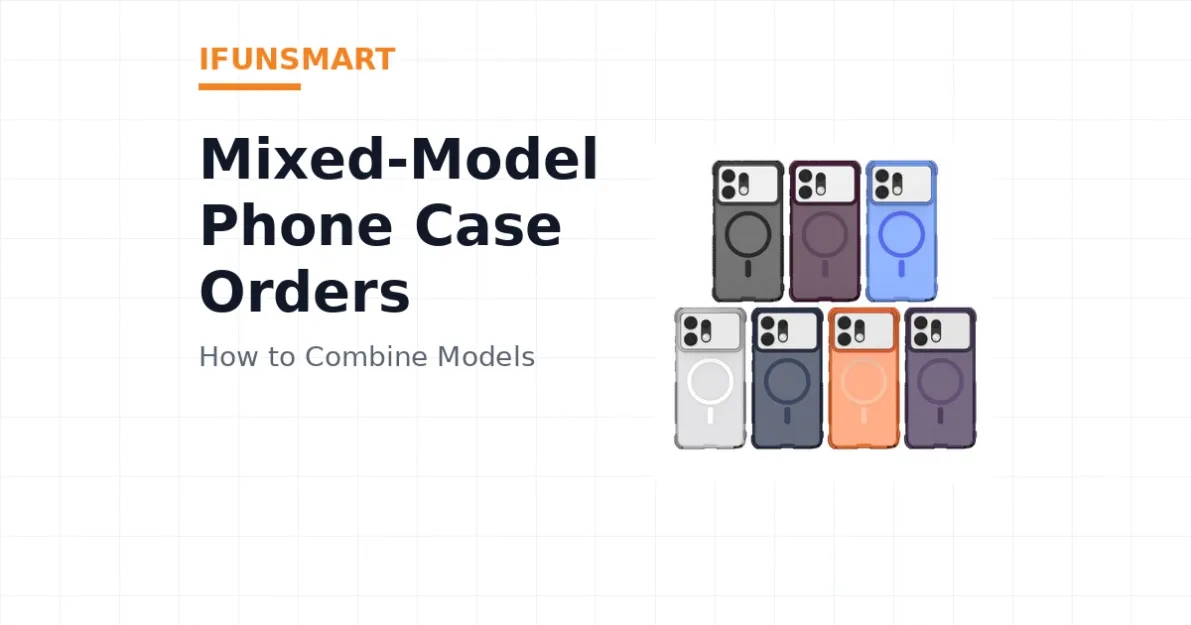
A mixed-model order puts several models, styles and colours on one proforma invoice and one shipment — but the MOQ still applies per line, not per total. Build the mix model-first, write one order row per model × style × colour, and label every carton to its row.
Short answer
A distributor rarely orders one model in one style in one colour. A real first order mixes: two or three phone models, two or three case styles per model, and two or three colours per style — because the shop shelf, the Amazon listing and the corporate-gift buyer each need a different slice of the range. A mixed-model phone case bulk order is simply that mix written down properly: one proforma invoice, one payment sequence, one shipment — and one order row per model × style × colour, each row carrying its own quantity, logo and packaging.
The one fact that decides whether a mixed order works is the MOQ rule. The most common MOQ is 50 pcs per colour per model, and it applies per line — per model, per style, per colour — not per order total. Ten lines at 50 pcs is a 500-piece order; one line at 500 pcs is a single-SKU order. A buyer who plans the mix around the total and forgets the per-line MOQ ends up with a quote that quietly drops lines, or a factory that quietly merges colours. This guide shows how to build the mix so the total and the lines both work: the mix in section 3, the order sheet in section 4, the carton plan in section 5, and the eight checks in section 6.
Two numbers frame the whole guide. Bulk distributor orders start at 500 pcs per order in total — so a mixed order needs enough lines to reach 500 without over-ordering any single line. And the sample fee is charged and refundable on orders of 500+ pcs — so the sample for a mixed order is approved per line, in the exact model, style and colour of that line, before the bulk run. Everything else in the order — the models, the styles, the colours, the logo, the packaging — is agreed line by line, in writing, on the order sheet.
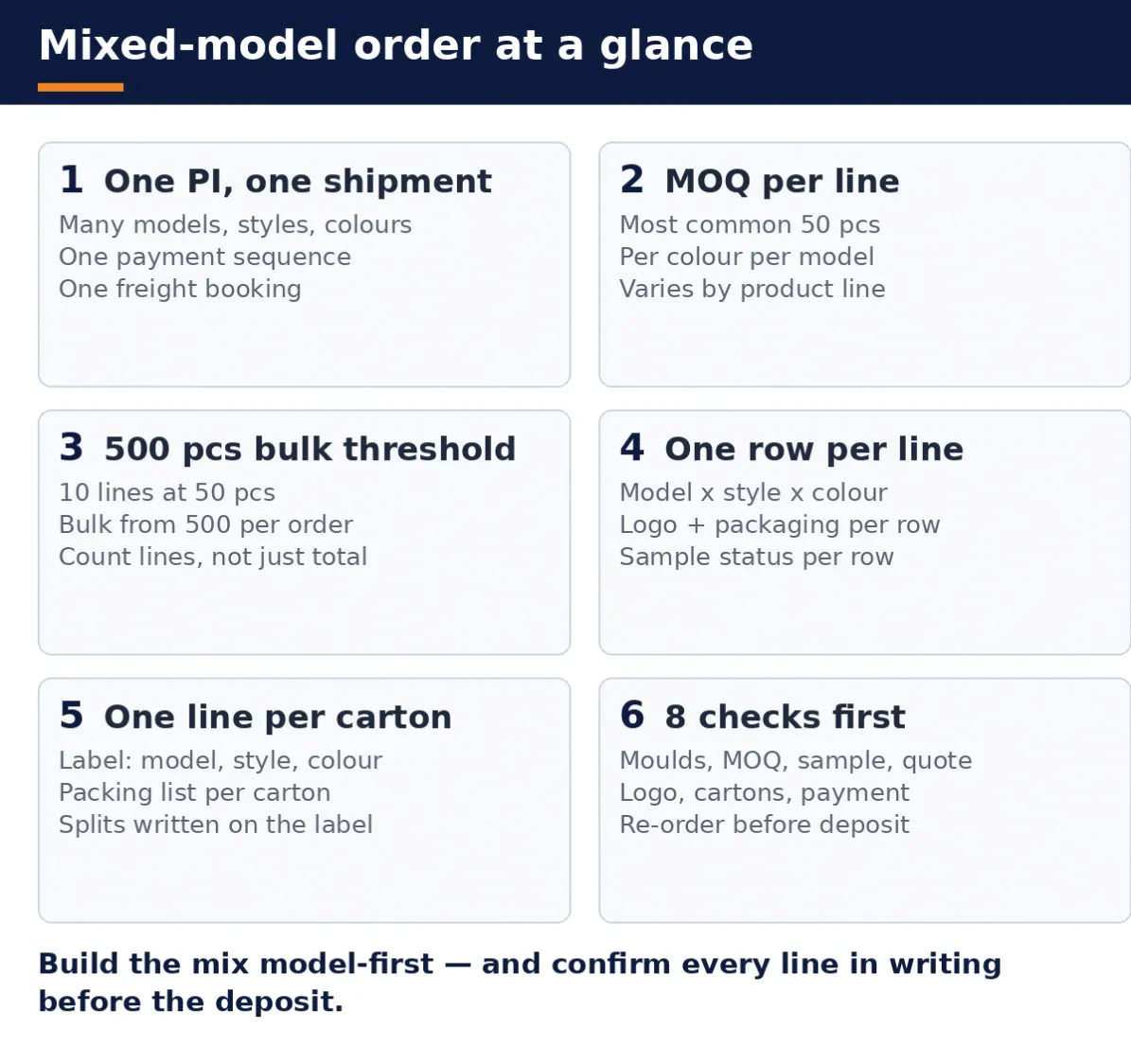
Mixed-model order at a glance
Question | The short answer |
|---|---|
What is a mixed-model order? | Several models, styles and colours on one PI, one payment, one shipment — one order row per model × style × colour |
What does MOQ apply to? | Per line: most common 50 pcs per colour per model; it varies by product line, never a single flat number |
How big is a first mixed order? | Enough lines to reach 500 pcs per order in total — for example 10 lines at 50 pcs |
What does the order sheet carry? | Model, style, colour, quantity, logo method and position, packaging — one row per line |
How do the cartons arrive? | Labelled per line — model, style, colour, quantity — with a packing list per carton |
What is checked before the deposit? | The 8 checks in section 6: moulds, MOQ per line, sample per line, quote per line, payment, cartons |
1. What a mixed-model order is — and what it is not
A mixed-model order is one order that covers more than one model, more than one style, or more than one colour. Most distributor orders are mixed in all three ways at once: an iPhone 18 Pro Max clear magnetic case in black and blue, a Galaxy S26 Ultra rugged case in black, and a Galaxy A57 leather wallet in brown — three models, three styles, four colours, one order. The factory runs each line separately and ships them together, on one proforma invoice, under one payment sequence, in one shipment. That is the whole point of mixing: one negotiation, one payment, one freight booking, one customs entry — instead of three of each.
What it is not is a way around the MOQ. The most common MOQ is 50 pcs per colour per model, and it is charged per line. A mixed order of 500 pieces spread across 20 lines is 25 pieces per line — below the MOQ on every line — and no factory can run it as quoted. The mix does not lower the MOQ; it multiplies it. Every line you add adds its own MOQ to the order total, and the order total is the sum of the lines, not a number you choose first and split afterwards. Section 2 works this through with real numbers.
It is also not a mixed carton. A mixed-model order is not one carton with a jumble of models inside it. Each line is packed, labelled and listed separately, and the cartons are the unit the buyer checks on arrival. If the cartons are mixed, the buyer cannot verify the order without opening every carton — and a distributor that cannot verify the order cannot sell it. Section 5 says how the pack identity runs from the order row to the carton.
And it is not a sample order. A sample is one piece of one line, approved before the bulk run. A mixed order still needs a sample per line — or at least per style — approved in the exact model, colour and logo method of that line. A buyer who approves a clear magnetic sample and then orders a leather wallet on the strength of it has approved nothing. Samples carry a fee that is refundable on orders of 500+ pcs — ask us to confirm the amount per style in writing — and the fee is the cheapest insurance in the order, because a wrong line in a mixed order is a wrong line the buyer has already paid for.
2. The one rule that decides the size: MOQ applies per line
The MOQ question in a mixed order is never "what is the MOQ for the order" — it is "what is the MOQ for each line". On our range the most common MOQ is 50 pcs per colour per model, and it varies by product line: IPDK Duo styles are 100, ISF Samsung styles are 50, IP leather IP001–007 are 50 and IP008–018 are 30, IQ styles are mostly 30 (IQ-001/002 are 50), and IPD styles are 20, 30 or 50 by line. The MOQ is a property of the line — the style on the model in the colour — not of the order, not of the model, and not of the buyer. Two lines of the same style in two colours are two MOQs. Two models of the same style are two MOQs. The factory sets up, moulds, prints and packs per line, and the MOQ is the smallest run that setup is worth doing.
Work it with the most common figure first, then adjust for the lines that differ. A lean first mixed order — 2 models × 2 styles × 2 colours, 50 pcs per line — is 400 pieces. That is below the 500-piece bulk distributor threshold, so it is a first order, not yet a bulk distributor order: it proves the range, it does not yet earn bulk terms. Add one more line — a third colour on the best-selling style, or a third model — and the order is 450 pieces. Add two more lines and it is 500 pieces: 10 lines at 50 pcs, which is exactly the bulk threshold. The arithmetic is the planning tool: count lines, multiply by the MOQ per line, and the total takes care of itself.
The over-extended order is the same arithmetic run the wrong way. Two models × 6 styles × 3 colours at 50 pcs per line is 1,800 pieces — and 36 lines to check, pack, label and sell. A distributor that orders breadth it cannot sell through ends up with the same dead stock the colour guide warns about, multiplied across 36 lines instead of one. The discipline is the same as the colour guide's: depth on the lines that sell, breadth only where the channel needs it, and every line justified by a buyer, not by a catalogue page.
Three mistakes recur in mixed orders, and all three come from planning by the total instead of by the line. First, the split total: a buyer asks for 500 pieces "mixed across models" and the quote comes back with lines dropped or colours merged, because 500 pieces cannot cover 20 lines at 50 pcs each. Second, the forgotten line: a buyer adds a model at the last minute — a Galaxy A37 to go with the A57, or an iPhone 17 to go with the 17 Pro Max — and the added line has no MOQ, no sample and no logo approval, so it holds up the whole order or ships unapproved. Third, the wrong MOQ: a buyer plans every line at 50 and then finds one line is an IPDK Duo style at 100, or an IQ style at 30, and the total and the carton plan both shift. The fix for all three is the order sheet in section 4: one row per line, MOQ per row, written before the quote is requested.
3. Breadth or depth: how to choose the mix
A mixed order is a choice between breadth and depth, and the right answer depends on the channel the cases are going to. Breadth is more lines: more models, more styles, more colours. Depth is more pieces per line: fewer lines, deeper stock on each. A distributor cannot have both on a first order, because the MOQ per line turns every extra line into 50 more pieces. The mix is the decision about where the 500 pieces go.
Start with the models, because the models decide everything else. The models a distributor stocks are the models its customers already carry — and the installed base is the guide, not the launch news. iPhone 18 Pro Max and iPhone 17 Pro Max are the current flagships; the standard iPhone 17 and iPhone 17 Air are a year past launch and moving at volume; Galaxy S26 Ultra and S26 are the Samsung flagships; Galaxy A57, A37 and A27 are the volume Android models. A first mixed order that covers two iPhone models and one Samsung model reaches the two biggest installed bases with three moulds — and three moulds is three lines of fit to confirm in writing. A first order that covers six models reaches more customers and confirms six moulds, six samples and six sets of artwork. The model list is the first thing to agree, because every model added adds a mould check, a sample and a line to the order sheet.
Then the styles, one or two per model. A style is a job: a clear magnetic case for the buyer who wants the phone visible, a rugged case for the field team, a leather wallet for the buyer who carries cards, a ring-stand case for the buyer who watches video. One model needs at most two or three styles on a first order — the best-selling style for that model, plus one style for a different buyer. More than three styles per model on a first order is breadth the distributor cannot explain to a shop buyer, and each style is a separate line with its own MOQ, its own sample and its own artwork position. The styles that exist for a model are the styles on the live product pages for that model — and the gaps are gaps: there is no dedicated leather wallet for iPhone 17 Pro Max, 17, 17 Air or 17 Pro, no liquid silicone for the standard iPhone 17, and no aramid case anywhere on the range, so those lines are "ask us", never assumed.
Then the colours, two or three per style. Colour is where mixed orders most often go wrong, because colour feels free and it is not: every colour is a separate line with its own MOQ. The verified colour counts show the range: Liquid Silicone comes in 10 named colours, Star Grid R2 in 6, Silky Matte in 6, Tech Fabric in 9, Litchi Two-Tone in 8. Ordering all 10 colours of one Liquid Silicone style on one model is 500 pieces on a single style — the whole bulk threshold on one line. Ordering two colours of that style is 100 pieces and leaves the other eight colours for the re-order, when the sell-through tells the distributor which colours its channel actually wants. Black first, then the best-selling colour for the channel, then one accent — and the rest of the chart is a re-order decision, not a first-order decision.
The mix that works for most first orders is a shape, not a number: 2–3 models, 1–2 styles per model, 2–3 colours per style. That shape is 8–18 lines, and at the most common MOQ of 50 pcs per line it is 400–900 pieces — a first order that reaches the 500-piece bulk threshold without over-ordering any single line. A distributor whose channel is retail shops leans to breadth — more models, because each shop sells a different model mix. A distributor whose channel is Amazon leans to depth — fewer lines, deeper stock on the listings that already sell. A corporate-gift buyer leans to one model, one style, one colour, with the logo — because the gift is identical by definition, and the mix is the wrong tool for that order entirely.
4. The order sheet: one row per model × style × colour
The order sheet is the document the whole mixed order runs on. It is a table — a phone case order spreadsheet the supplier can quote from, pack from and invoice from — and it has one row per line: one row per model × style × colour. If a line is not a row, it is not in the order. If a row is missing a field, the factory will guess it, and the factory's guess is the buyer's problem on arrival.
Each row carries seven fields. Model — the exact model, not the family: "iPhone 18 Pro Max", not "iPhone 18", and never "iPhone Duo" converted into a specific model in the buyer's head, because the Duo pages list "iPhone Duo" only and the specific model must be confirmed in writing. Style — the exact style name from the product page: clear magnetic, rugged ring-stand, leather wallet, liquid silicone. Colour — the exact colour name from the product page, because "blue" on one style is not "blue" on another. Quantity — the pieces for that row, at or above the MOQ for that line. Logo — the method and the position for that row, or "no logo" written out, because a blank logo field is read as "no logo" by one factory and "ask later" by another. Packaging — the box for that row, or "standard" written out. And the seventh field is the sample: approved, or to be approved, for that row — because a row with no sample decision is a row that ships unapproved.
The quote is compared row by row, not order by order. Two suppliers' mixed orders cannot be compared on the total — one total hides different lines, different MOQs and different logo methods. The comparison is the same eight-line quote from the sourcing guide, applied per row: model and fit, material and construction, magnet grade and pull figure per style, colours and quantities with the MOQ per colour per model, logo method and position, packaging and whether it is included, trade term, payment terms. A supplier that quotes the total without the rows has not quoted the order. A supplier that quotes the rows has given the buyer something to check — and the check is the sample per row in section 6.
The order sheet is also where the logo decision lives. A 100-piece trial order can already carry a logo by laser engraving, which is permanent, where silk-screen fades and needs a higher MOQ — and on a mixed order the logo question is per row, not per order. The same logo on a clear magnetic case and on a leather wallet is two different methods on two different materials, and the method must be confirmed per style in writing before the trial. Custom colours are charged per colour per model and custom packaging is quoted per order — ask for both with the quote, per row, so the row price is the row price and not a surprise on the invoice.
5. From order row to carton: pack identity
A mixed order is packed line by line, and the carton is where the order sheet becomes physical. Each carton carries one line — one model, one style, one colour — and the carton label states the line: model, style, colour, quantity in the carton, and the order number. The packing list states the same, carton by carton. The buyer checks the order by checking the cartons, and a carton that cannot be identified without opening it is a carton that cannot be checked.
The rule is simple: one line, one carton set — never two lines in one carton, and never one line split across cartons without the split written on the label and the packing list. A line split across cartons is fine when the quantity needs it — a 500-piece line does not fit in one carton — but the split must be visible: carton 3 of 5 for that line, quantity in this carton, quantity in the line. A buyer who opens a carton and finds two colours inside it has found a packing error, not a packing method, and the error is found at the buyer's warehouse instead of the factory's — which is the most expensive place to find it.
Agree the carton plan in writing before the deposit, as part of the order sheet: how many cartons per line, what the label states, and what the packing list states per carton. The pre-shipment record is the proof: the factory sends photos, a video and the packing list after the goods are ready, and the packing list is checked against the order sheet row by row before the balance is paid. Payment is T/T and Western Union only; new customers may pay a 30% deposit first; after the goods are ready the factory sends photos, a video and the packing list; the customer pays the balance, then the goods ship. The balance is paid after the evidence — and in a mixed order the evidence is the carton-by-carton packing list, not a single photo of a case on a table.
The carton plan is also what makes the re-order work. A distributor that re-orders the same mix does not re-write the order sheet from scratch — it re-uses the rows that sold, drops the rows that did not, and adds the colours the sell-through justifies. The mould is held for the models in the order, the approved sample stays the production standard, and the brief, the quote and the inspection records carry over to the second order. A mixed order that is packed line by line is a mixed order that can be re-ordered line by line — and the second order is where the margin is made.
6. What goes wrong in mixed orders — and the 8 checks that catch it
Most mixed orders fail in one of six ways, and five of the six are paperwork, not product. The first is the dropped line: a line agreed in chat never reaches the order sheet, and the buyer discovers the gap on arrival. The second is the merged colour: two colours quoted as one line, and the factory ships the colour it had in stock. The third is the unconfirmed mould: a model added late — a Galaxy A37 to go with the A57, or an iPhone 17 to go with the 17 Pro Max — with no mould confirmation in writing, so the fit is guessed. The fourth is the unapproved sample: a line ordered on the strength of another line's sample, because the styles look similar. The fifth is the mixed carton: two lines in one carton, and the buyer's warehouse counts what it can see, not what the order sheet says. The sixth is the one product failure: a line that fails its bench checks — fit, parting lines, coating adhesion, magnet pull, hinge friction — and holds up the whole order because it was packed with the rest.
Run the eight checks before the deposit, and each failure has a check that catches it:
- Check the mould list. Moulds held for every model on the order sheet, gaps named honestly — including A38/A58, where no tooling data exists yet, and iPhone 18e, which needs a new mould the factory is still deciding on. A model with no mould is a model to ask about in writing before quoting a customer.
- Check the MOQ per line. The MOQ for the exact style and model on each row, in writing — most common 50 pcs per colour per model, varying by line. Count the lines, multiply by the MOQ per line, and confirm the total reaches 500 pcs per order for bulk distributor terms.
- Check the sample per line. A physical sample approved in the exact model, style and colour of each line — bench-checked against the brief: fit, parting lines, coating adhesion, magnet pull, hinge friction, carton integrity. Samples carry a fee refundable on orders of 500+ pcs — ask us to confirm the amount per style in writing.
- Check the quote per row. Eight lines per row — model and fit, material and construction, magnet grade and pull figure per style, colours and quantities with the MOQ per colour per model, logo method and position, packaging and whether it is included, trade term, payment terms — or no comparison. A price without a spec sheet is a headline, not a quote.
- Check the logo per row. Laser engraving on a 100-piece trial is permanent; silk-screen fades and needs a higher MOQ. Confirm the method for the material in each row, in writing, before the trial — the same logo on a clear case and a leather wallet is two different methods.
- Check the carton plan. One line per carton set, label stating model, style, colour and quantity, packing list per carton, splits written on the label. Agree it in writing before the deposit.
- Check the payment sequence and the landed cost in writing. T/T and Western Union only; 30% deposit for new customers; photos, video and packing list after the goods are ready; balance, then ship. Confirm the trade term and the documents with the shipment — packing list, commercial invoice, certificate of origin where the buyer's import needs one — and confirm the duty treatment for your country with your broker.
- Check the re-order. The mould is held for the models in the order, the approved sample stays the production standard, and the order sheet carries over to the second order — the rows that sold, re-ordered; the rows that did not, dropped.
One honest note closes the guide. A mixed-model order is not a way to buy less than the MOQ, and it is not a way to test a model without a sample. It is a way to buy the range properly — one order, one payment, one shipment, with every line written down, sampled, quoted and packed on its own. A distributor that runs the eight checks has an order it can verify on arrival, sell line by line, and re-order line by line. A distributor that skips them has a shipment it cannot verify, a warehouse it cannot count, and a re-order it cannot repeat.
FAQs
Q1: What is the MOQ for a mixed-model phone case order?
The MOQ applies per line — per model, per style, per colour — not per order total. On our range the most common MOQ is 50 pcs per colour per model, and it varies by product line: IPDK Duo styles are 100, ISF Samsung styles are 50, IP leather IP001–007 are 50 and IP008–018 are 30, IQ styles are mostly 30 (IQ-001/002 are 50), and IPD styles are 20, 30 or 50 by line. A mixed order of 10 lines at 50 pcs is 500 pieces, which is exactly the bulk distributor threshold of 500 pcs per order in total. Confirm the MOQ for the exact style and model on each row, in writing, before the quote — a buyer who plans by the total and forgets the per-line MOQ ends up with lines dropped or colours merged.
Q2: Can I buy mixed phone cases in bulk on one order?
Yes — a mixed-model phone case bulk order puts several models, styles and colours on one proforma invoice, one payment sequence and one shipment. The condition is the per-line MOQ: every line on the order sheet must meet its own MOQ, and the order total must reach 500 pcs for bulk distributor terms. A practical first mixed order is 2–3 models, 1–2 styles per model and 2–3 colours per style — 8–18 lines, 400–900 pieces at the most common MOQ. Each line is sampled, quoted and packed on its own, so the bulk order is verified line by line on arrival.
Q3: What should a phone case order spreadsheet include?
One row per model × style × colour, and seven fields per row: the exact model (not the family), the exact style name from the product page, the exact colour name, the quantity for that row at or above the MOQ for that line, the logo method and position for that row (or "no logo" written out), the packaging for that row (or "standard" written out), and the sample status for that row. The quote is compared row by row on eight lines — model and fit, material and construction, magnet grade and pull figure per style, colours and quantities with the MOQ per colour per model, logo method and position, packaging and whether it is included, trade term, payment terms. If a line is not a row, it is not in the order.
Q4: How many SKUs should a distributor put in a first mixed order?
Enough lines to reach 500 pcs per order in total without over-ordering any single line — for most first orders that is 8–18 lines: 2–3 models, 1–2 styles per model, 2–3 colours per style. Retail channels lean to breadth, more models, because each shop sells a different model mix; Amazon sellers lean to depth, fewer lines with deeper stock on the listings that already sell; corporate-gift buyers lean to one model, one style and one colour with the logo, because the gift is identical by definition. Every line should be justified by a buyer, not by a catalogue page — a line with no buyer is dead stock, and in a mixed order dead stock multiplies across every line you added.
Q5: Can I combine iPhone and Samsung cases in one order?
Yes — combining phone case models in one order is the normal shape of a distributor order, and iPhone and Samsung lines sit on the same proforma invoice, the same payment sequence and the same shipment. Each model is still its own line with its own mould check, its own sample and its own MOQ: confirm the mould in writing for every model on the order sheet, including models added late, and approve a physical sample in the exact model, style and colour of each line before the bulk run. Two models that share a style name are still two lines — the fit, the artwork position and the magnet figure are confirmed per model, never carried over from the other one.
About iFunSmart
iFunSmart — Ifun Electronics Technology Co., Ltd, Guangzhou, China — has made phone cases since 2010: 1000+ designs, 500+ models, 500K+ pieces a month, exported to 30+ countries. We reply within 24 hours. Send your brief — model, material, colours, logo and quantity — and we will quote it line by line, send a sample (fee refundable on orders of 500+ pcs), and confirm the fit, the MOQ and the inspection records in writing before your deposit.
WhatsApp: +86 13632248734 — https://wa.me/8613632248734 — or email contact@ifunsmart.com — or visit www.ifunsmart.com.
Read more
- Bulk Phone Case Orders: How Volume Changes the Order — https://www.ifunsmart.com/posts/bulk-phone-case-orders-volume-guide
- Reordering Phone Cases: Keep Best Sellers in Stock — https://www.ifunsmart.com/posts/reordering-phone-cases-keep-best-sellers-in-stock
- Phone Case Colours: What Distributors Stock First — https://www.ifunsmart.com/posts/phone-case-colours-what-distributors-stock-first
- Phone Case MOQ: 50 Pcs Per Colour Per Model — https://www.ifunsmart.com/posts/phone-case-moq-50-per-colour-first-order
- Phone Case Sampling: How to Evaluate a Sample Before a Bulk Order — https://www.ifunsmart.com/posts/phone-case-sampling-how-to-evaluate-a-sample-before-bulk
- How to Source Phone Cases from China: First-Order Checks — https://www.ifunsmart.com/posts/how-to-source-phone-cases-from-china-first-order-checks
- Phone Case RFQ: What to Send a Factory in Your First Enquiry — https://www.ifunsmart.com/posts/phone-case-rfq-what-to-send-a-factory-in-your-first-enquiry
- Phone Case Payment Terms: What a First Order Looks Like — https://www.ifunsmart.com/posts/phone-case-payment-terms-first-order