Oct 29, 2026Business Solutions
Receiving Exceptions: Photographing the Problem
A short shipment or a crushed carton is only a claim if the photos prove it. Five shots that settle a receiving dispute before it becomes an argument.
A receiving exception is the gap between what the shipping papers say left the factory and what your dock received, and the photos taken in the first minutes decide whether it becomes a claim or an argument. iFunSmart ships cases from Guangzhou. The record starts after the carton lands.
Last updated: October 29, 2026.
What Counts as a Receiving Exception
A receiving exception is a recorded difference between the shipping papers and the goods as they arrived: a carton crushed on one corner, a count that runs short, a bag holding a SKU the order never named.
A short count can begin at the packing table or in transit. A crushed carton can be a stacking failure, a forklift strike, or a wet pallet. These failures look alike on a loading bay and behave nothing alike later.
Words do not carry that weight. A message that calls a carton badly damaged describes a feeling. A frame showing a crushed corner beside the carton label and a ruler describes an event.
The camera protects the honest version from both directions. A buyer who photographs before touching the carton cannot be accused of causing the damage. A supplier whose label appears unchanged in the frame does not have to argue about what was in the box.
The Frames That Do the Work
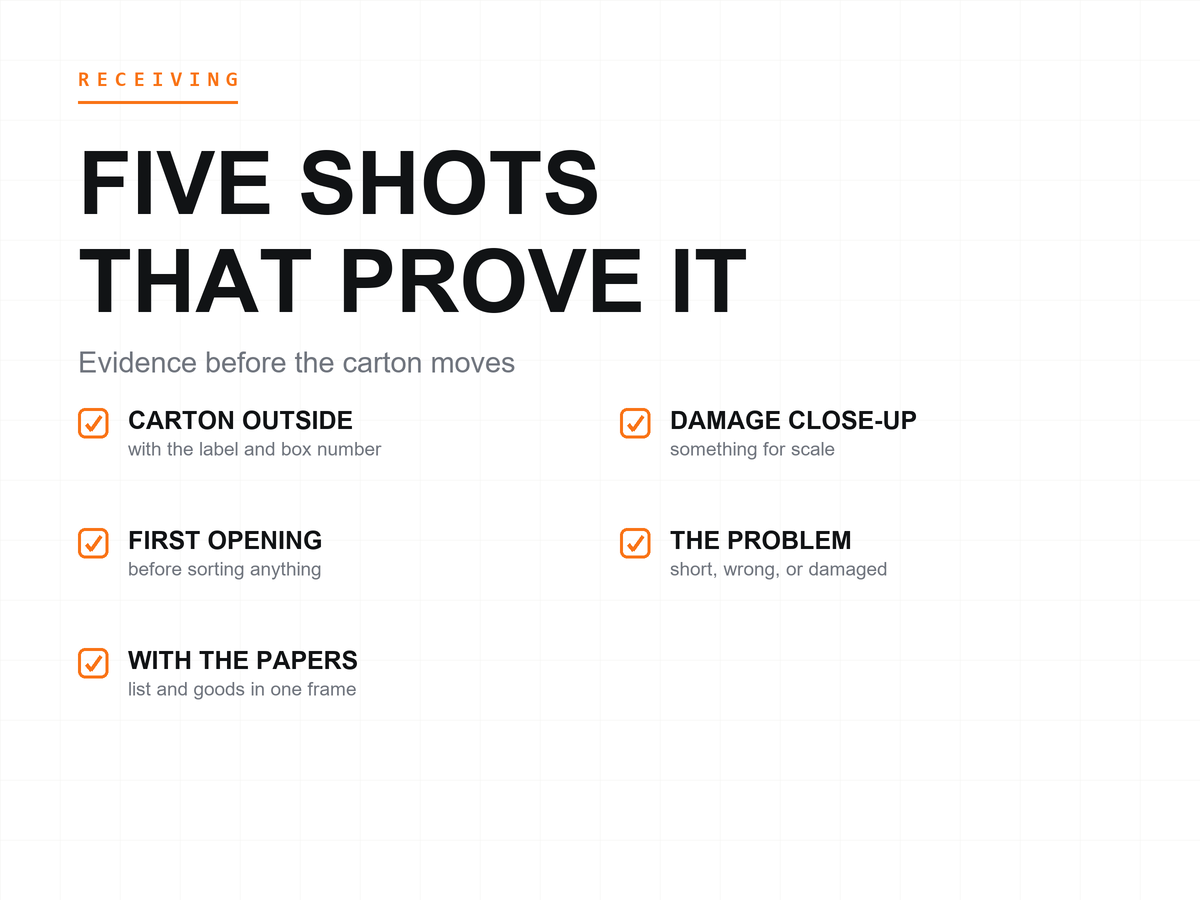
Five frames carry a receiving exception: the sealed carton, the damage with a scale, the first layer untouched, the failed item, and the paper beside the count. Shoot them in that order.
Start with the closed carton, label square to the camera, before you move it. The label carries the carton number, and that number ties every later frame to one line of the packing list. A damage photo without an identified carton is a photo of a box. Where the label is torn or missing, photograph the face where it should sit, plus the pallet tag that travelled with the carton.
Then the damage itself, close, with something for scale beside it: a finger, a coin, a ruler. Depth without a reference reads as shadow, and a reviewer who cannot judge depth will not judge severity either. Show where the damage sits against the nearest corner, because a corner crush and a face puncture describe different handling. A crush deep enough to deform a bulky armor case inside its packaging is a claim about handling, not about a finish.
Before anything is lifted out, photograph the first layer as the carton opened. This frame proves two things at once: the packing order matched the packing list, and nobody at your dock created the disorder. A carton packed short usually sits lower than its own list implies, and a carton already sorted no longer shows the packer's arrangement at all.
Then the item that failed, with the problem and its identity in the same frame. In a missing unit, the empty pocket is photographed beside the list line that promised it. For a wrong SKU, the carton label line and the bag label go into one frame, close enough to read together. A damaged finish wants side light, because a flat-lit surface hides its own mark. A short pocket for a small card-holder SKU is easy to miss in a full carton and easy to prove before the bay is emptied.
Last, the paper and the goods together. Lay the packing list beside the counted stack, carton number visible in both, and shoot from above. Without that frame a shortage is an opinion. It also answers the first question any reviewer asks: counted against what.
Order and Timing on the Dock
Photograph the outside before you sign the delivery receipt. The signature is the handover line. Where the driver cannot wait for a full inspection, sign with a written exception instead of a clean one, naming the carton and the visible damage. That line on the receipt is a photograph in words, and it keeps the claim open.
Open in the order the frames describe, and resist the instinct to tidy. Sorting a carton before photographing it removes the evidence of how it was packed, which is the second half of every short-count argument. Keep the carton, the inner bags, and the void fill until the claim closes.
What transfers on signature, and how long a window stays open, are set by the carrier's terms and the trade term on your order. This article can say what to photograph and when. It cannot supply the clause that governs your carrier.
The Facts the Camera Does Not Capture
A photo set without a written key is a folder of images. Give each exception one short note: the carton number, the arrival date, the exception type, the count difference against the packing list, and the SKU codes involved. One note per carton beats one long message per shipment, because every carton is a separate conversation. Name the image folder for the carton too.
Buyers who work through a label layout line by line at the proof stage, asking for a smaller font here and a single line there, are building exactly the reference this article uses. A carton that matched its approved proof needs no argument at all.
What the frames prove is narrow, and the narrowness is the point. They record the condition of the goods at handover. They cannot show what happened before the carton reached your dock, who handled it in between, or how long a crush took to form. A claim that stays inside that boundary is hard to refuse.
How a carton label is worded and how a mixed carton's packing list is laid out belong to the shipping side. Sampling plans and defect grading belong to the inspection standard, which decides what counts as a defect before the goods leave. This article starts after those decisions, with a carton on your dock that disagrees with its paper.
Where the Factory Side Ends
Our part of the record is the paper we issue: the order confirmation, the packing list, and the carton label itself. We print and apply labels in-house. Send us the carton numbers and SKU codes from an open exception, and we will return the packing records that match them. We do not handle carrier claims on your behalf. The claim is yours to file, and the window for filing belongs to the carrier's terms rather than to us. We do not publish a claim window.
Common Questions From Buyers
Which photo should come first when a carton arrives damaged?
The closed carton with its label readable, taken before the carton is moved or opened. That frame establishes which carton the rest of the set describes. The damage close-up follows, then the first layer, then the failed item, then the paper beside the count.
Do phone photos hold up, or does a claim need something better?
A clear phone photo with a readable carton label and a scale reference carries more weight than a high-resolution image with neither. Shoot in daylight, avoid direct flash on laminate labels because it erases print, and keep the original files rather than resizing them for a chat app.
What if the carton label is missing or unreadable?
Photograph the carton where the label should be, then the pallet tag or any document that travelled with the consignment, and note the carton's position in the delivery. The packing list still pairs with the count, so a shortage stays provable even when the carton's own identity is not. Quote the carton number from your copy of the list, and we will match it against our packing record.
What to Do Next
Settle the receiving routine before the next shipment lands, not on a busy morning: one set of frames in a fixed order, one written note per carton, and a folder named for each carton number. Share your warehouse's exception form with us and the packing list and label content can be built to match it.
Send iFunSmart your warehouse's exception form, and we will build the packing list and label fields to match it before your next shipment.
Apple and iPhone are trademarks of Apple Inc. iFunSmart is an independent manufacturer of phone cases and accessories and is not affiliated with, authorized, sponsored, or endorsed by Apple.