Oct 28, 2026Business Solutions
Duo Cases: Tested on the Actual Device
Every Duo case we ship is fitted to a production device before its run is released. What the device test covers, what a failure does, and what it cannot prove.
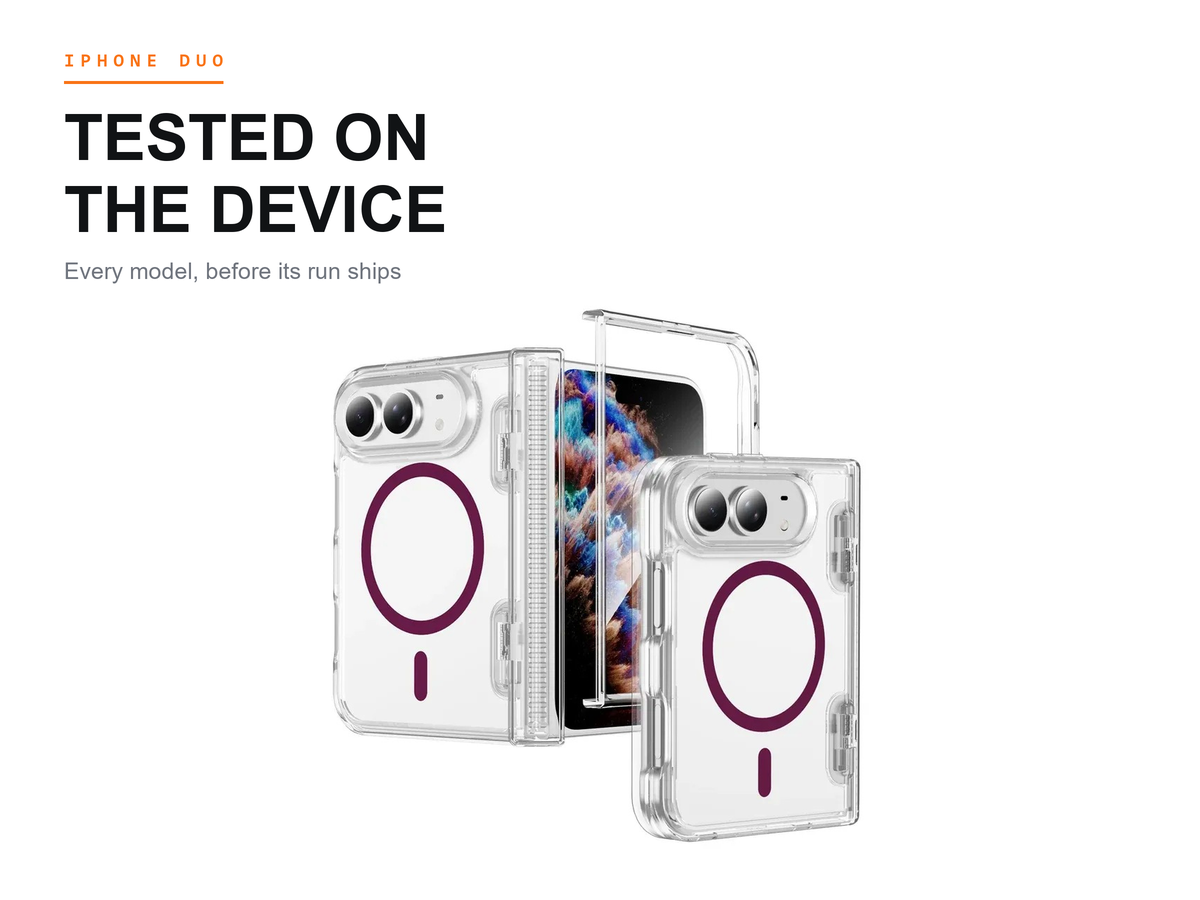
Every iPhone Duo case iFunSmart ships is fitted to a production device before its run is released. The case is opened and closed through the full fold angle, the openings are checked against the real camera and port positions, and the hinge is watched for binding. Here is what that test covers, and what it does not.
Last updated: October 28, 2026.
What "Tested on the Device" Means
A device test means the finished case is mounted on a production iPhone Duo and worked through its full range of motion before the batch is released for packing. It is not a measurement of a drawing, and it is not a check of a pre-production mockup. It is the case on the phone.
Those are different acts. A drawing can be right and a case can still bind at the hinge, lift at the crease, or press the inner display when the phone closes. The device is the only instrument that shows where. This is why the check happens on the floor, on a unit we keep for the purpose, with the case in hand and the phone working.
The mold itself is cut to 1:1 precision from our own tooling library, with new tooling cut on our in-house CNC. Dimensional accuracy is the starting condition. The device test is what confirms the result.
Why a Foldable Cannot Be Cleared on Paper
A foldable changes shape while in use. The two halves rotate around a hinge, the inner display flexes through a crease, and the thickness at the hinge is not the thickness at the edge. A flat projection cannot show any of that.
Three failures appear only on the device. The first is binding: the case resists partway through the fold, so the user feels the phone fight the cover. The second is lift at the crease, where a case that sat flat when open separates when closed. The third is contact with the inner panel, where a hinge cover designed from a drawing sits too close to the flexible screen once the device is actually folded.
None of these fail a measurement. All of them fail a customer. That is the reason a device sits at the end of the line rather than a set of calipers.
The Checks a Duo Case Has to Clear
The sequence starts with the mechanical checks, because those are the ones that can damage a screen.
The case goes on the device and the phone opens and closes through the full fold angle. The check is for binding, for a point where the cover resists, and for the closed profile, where the two halves should meet evenly with no gap along one edge. Hinge coverage is watched through the same motion: the guard has to follow the fold without pinching and without pulling away at either end.
The screens come next. With the device closed, nothing from the case may touch the inner panel or sit near the crease. With it open, the raised edges have to clear both displays.
Then the openings and the function. The camera opening has to clear the module without clipping the frame around it, and the lens has to sit inside its clearance rather than against the case. Each button is pressed through the cover, because a button that works but feels mushy is a return waiting to happen. The charging port takes a cable seated fully, with the plug reaching home rather than stopping against the case. The magnets are checked with a wallet and a mount, and a wireless charge runs with the case on.
Two builds carry most of this work in our current range: the full hinge-protection Duo case, where the hinge guard is the whole point, and the clear MagSafe Duo build, where a rigid back has to stay clear of the crease while the ring holds.
What Happens When a Check Fails
A model that fails a check does not enter the packing line. It goes back to the mold: the shape is adjusted and the case is re-cut, re-fitted and re-tested on the same device before the run is released.
That sequence is the part worth understanding, because it is where a factory either holds a line or explains one away. A model that binds at the hinge cannot be fixed by packing it faster, and it cannot be fixed by telling the buyer to open it carefully. The only honest remedy is changing the mold and testing again.
The record matters as much as the fix. Each tested model keeps a note of which device was used, which check failed, what was changed in the tool, and when the model passed. Without that note, the second batch is a fresh guess rather than a repeat of a verified result.
What the Device Test Does Not Prove
A device test is a strong check and a limited one, and the limits are worth stating plainly.
It is run on one production device per model. Regional units can differ in small ways, and an accessory that sits close to the tolerances of one unit may behave differently on another. The test is not a claim about every Duo in every market.
It does not cover every accessory a buyer might attach, and it does not cover a device that has been dropped, since a bent frame changes what fits. It also does not replace the buyer's own sample check, which is the only test performed on the exact unit the buyer will sell against.
What we do not publish is tolerance numbers. The fit is verified on the device, in the sequence above, and confirmed model by model. A figure quoted here would suggest a precision that only the physical check can establish, so the number stays out and the process stays in.
How to Verify It Yourself on Arrival
Run the same order of checks on your own sample, and run the mechanical ones first.
Fit the case to your device and work the hinge through the full fold before anything else. A case that sticks at any angle is worth photographing immediately, before it goes into a listing or a store. Then close the device and look at the crease zone, open it and check the raised edges against both screens, and finish with the buttons, the port, the magnets and a wireless charge.
If something binds or sits wrong, the answer is not to work around it quietly. Photograph the point that fails, note the model and the order number, and send it back against the terms confirmed on your order. That is why the confirmation states the covered models and the evidence the report needs before a run starts: so a fit problem has a route instead of an argument.
Common Questions From Buyers
Which device do you test on?
A production iPhone Duo unit that we keep for fitting. The same device is used for every check on a given model, so results stay comparable between batches, and a model that passed last time is tested against the same reference the next time.
Does a device test mean any Duo case will fit my phone?
It means the model was fitted to a production device before the run shipped, in the sequence above. That is a verified process, not a promise that every unit in every market behaves identically, because regional devices can vary in small ways. Take a sample from the run and run the checks yourself; a sample in your hand settles more than any statement on a page.
What if a case fails after it reaches me?
Photograph the failing point, note the model and the order number, and report it against the terms confirmed on your order. The confirmation states which models are covered and what evidence the report needs, so the response follows the agreement rather than a conversation.
What to Do Next
The fit check is the part of a Duo order that cannot be inspected from a photo, which is why it happens on a device and why a sample is the fairest way to judge the result. Tell us the models you plan to stock, and we will confirm the fit check for those models and send a sample from the tested run.
Send us your Duo model list, and we will confirm the fit check and ship a sample from the tested run.
Apple and iPhone are trademarks of Apple Inc. iFunSmart is an independent manufacturer of phone cases and accessories and is not affiliated with, authorized, sponsored, or endorsed by Apple.