Oct 2, 2026Business Solutions
When to Reorder Phone Cases: Setting a Trigger Line
A reorder should be a decision already made, not a panic you react to. How to set a trigger line per SKU from sell-through, replenishment time, and a buffer.
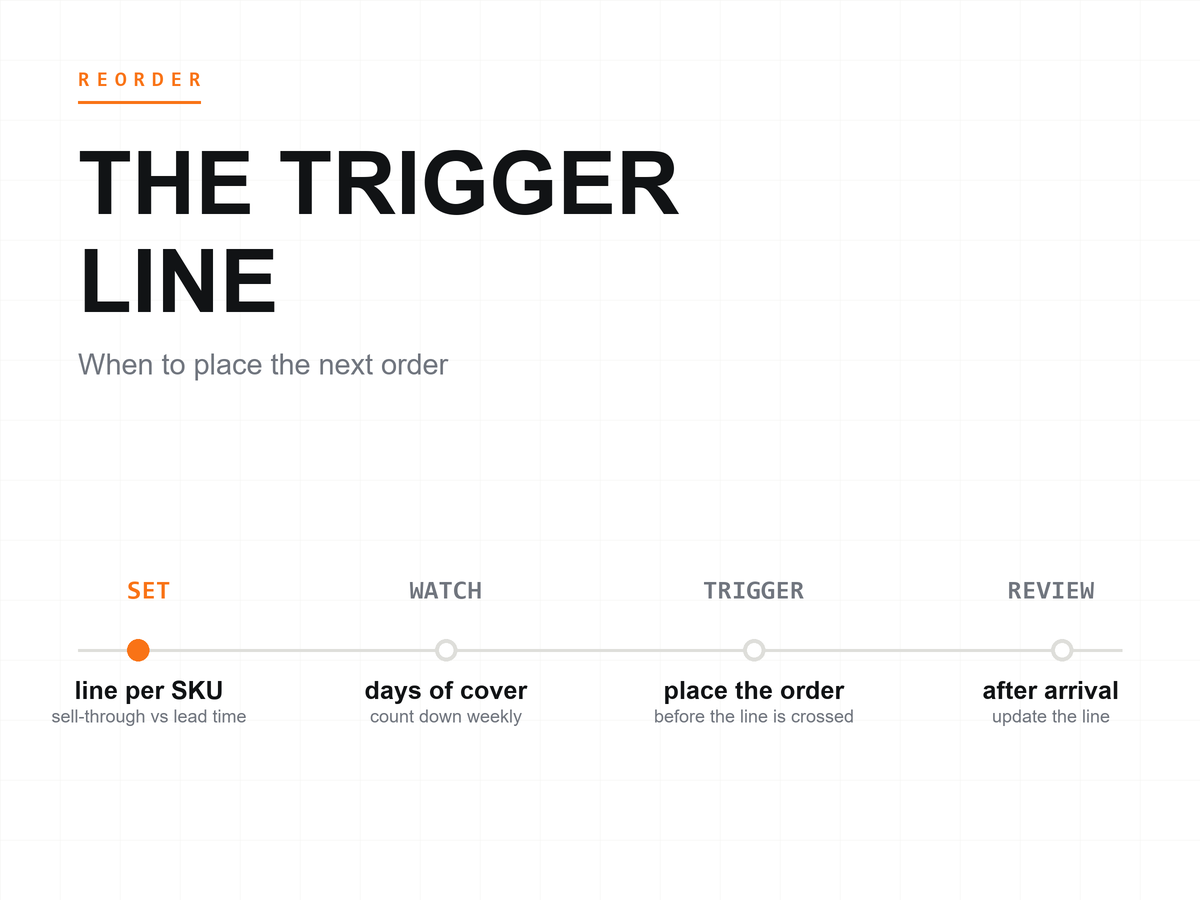
A reorder should be a decision you already made, not a panic you react to. For every iPhone and Galaxy case in your range, a trigger line turns restocking into a scheduled event: the stock level that starts the next purchase while the shelf still has cover. Here is how buyers set one per SKU.
Last updated: October 2, 2026.
What a Reorder Trigger Line Is
A reorder trigger line is the stock level at which the days of supply left in your warehouse drop to the length of your replenishment cycle, so the next purchase goes out before the shelf runs dry.
Three inputs build that number, and only one is a supplier's to give. Velocity comes from your own sales record: how many units of a specific model, color, and channel leave per period. Replenishment time is production days plus the freight leg you plan to use. The buffer is the cover you hold for a busy week or a delayed vessel.
A trigger line is not a forecast. It is a decision, made in advance, about the level where waiting stops being safe.
Stockouts get solved at the worst possible moment: by the time a shelf looks thin, the fast decision is the expensive one. A line turns the reorder into a task with a trigger rather than a debate about whether to act.
We do not publish a universal trigger line, and no supplier can set yours. The number depends on your velocity and your lane, and the judgment stays with you.
How to Set a Line Per SKU
Start with velocity. Pull the sales of one model, one color, one channel, and look at how many units left per period in your busiest stretch, not your average one. Add the replenishment cycle you plan to use, and a buffer you can defend in a sentence.
A SKU, in this sense, is one model in one color sold through one channel, and that is the unit your line should protect. A line for your iPhone cases as a group hides the position that is running out and the one that is not moving.
The design changes the line as well. The line you set for a 2700GS magnetic case for the iPhone 18 Pro Max is not the line you set for a MagSafe case with detachable metal buttons, because each carries its own velocity and its own color split. Two designs from one factory still live on two different clocks.
Write the line down and mirror it in your inventory view. If you want the production and freight timing behind a specific design, ask us and we will walk through it against your own numbers.
Why Sea and Air Need Two Different Lines
A long replenishment cycle needs a higher line, because more can happen between the trigger and the delivery. A short cycle needs a lower one, because the gap you are covering is smaller. That principle produces two lines, not one.
The sea line is your routine line. It sits high enough that a normal vessel schedule lands before the shelf empties, and it keeps your freight cost per unit at the level you planned. The air line sits lower, and it exists for one situation: stock fell faster than the sea leg could answer. Hitting it is not a failure of the sea line; it is the fallback working as designed.
Two lines also make the expensive decision legible. A buyer who runs only an air line pays air freight on ordinary replenishment. A buyer who runs only a sea line discovers the gap when there is nothing left to sell.
Air shortens the transit leg and nothing else. It cannot reopen a production slot that has not started. Which line triggers first depends on the season, your lane, and how much of a gap your cash can carry, so the two numbers are yours to set.
What to Record When a Line Triggers
The trigger is not the end of the process; it is the moment the useful data appears. Log the date, the SKU, the channel, and how many units were on hand when the line was crossed. Add the line value itself, which line triggered, the quantity you started, and the date you expect it to land.
That log is how the next line gets better. If a trigger consistently lands stock after the shelf empties, the line sat too low or the cycle ran long. If stock arrives and then sits, the line sat too high or velocity has changed. The correction comes from two or three honest entries, not from a feeling about the last quarter.
Keep the log per model and per color rather than per supplier invoice. The invoice tells you what you bought; the log tells you whether the timing worked.
Mistakes That Break a Trigger Line
The most common mistake is reordering by instinct. Instinct is usually a memory of the last stockout, and it fires late, when the shelf is already empty.
Copying the previous purchase quantity is the next trap. Quantity and timing are different decisions. If velocity has changed, the old quantity can be right and still land at the wrong moment.
Keeping one line for the whole range breaks the system quietly. A single line makes the slow position look urgent and the fast one look safe.
Seasonal attention does similar damage. Most buyers think about replenishment once a peak is visible, which is when every option costs more. A line works in the quiet months too, and that is when acting on it is cheap.
Setting the line once and walking away is the last one. Velocity drifts, and a line that was right for the last cycle can be wrong for this one. Review it at each trigger.
The line does not replace judgment; it tells you when to spend your attention. It needs a number you agreed with yourself, plus the discipline to act when the number arrives.
Common Questions From Buyers
How do I set a trigger line with no benchmark for my market?
Use your own velocity as the benchmark, because a borrowed industry figure will not match your shelf. Take your busiest selling period, note the cover it required, add your replenishment time, and keep a buffer you can explain. Then let the first cycle correct you. A line built from your own data starts rough and gets sharp.
Should every color have its own line?
Yes, for the same reason every model does. A color is its own position with its own velocity, and a design-level line blends a fast color with a slow one until neither is visible. The slow color triggers late, and the fast color surprises you. If a slow color keeps producing purchases below a workable minimum, that is a signal about your range, not a reason to hide the color inside an average.
What should I do when several SKUs hit their lines at once?
Rank them by what a stockout costs you, and let the shelf position that carries your traffic go first. Stagger the purchases by production window instead of placing one large block, and check whether the urgent positions can travel together on the faster leg. A collision of triggers is easier to handle when you saw it coming. How you fund the batch depends on your cash cycle, not on a rule we could hand you.
What to Do Next
Trigger lines do their job when the supplier behind them can hold a schedule. We are a Guangzhou factory, and our mold library covers the iPhone 18 series, so a reorder of a design we already produce runs on existing tooling.
Send us the trigger levels you run and the designs they cover, and we will confirm the production window and the freight timing your line depends on.
Send us your trigger levels and the designs they cover, and we will confirm the production and freight window for your reorder.
Apple, iPhone, Samsung, and Galaxy are trademarks of their respective owners. iFunSmart is an independent manufacturer of phone cases and accessories and is not affiliated with, authorized, sponsored, or endorsed by Apple or Samsung.