Oct 20, 2026Business Solutions
Magnet Grade Claims: Verify Them in Writing
A grade on the box is a claim until it sits in the written spec. How case buyers verify N52 and N52H claims before committing to a bulk order.
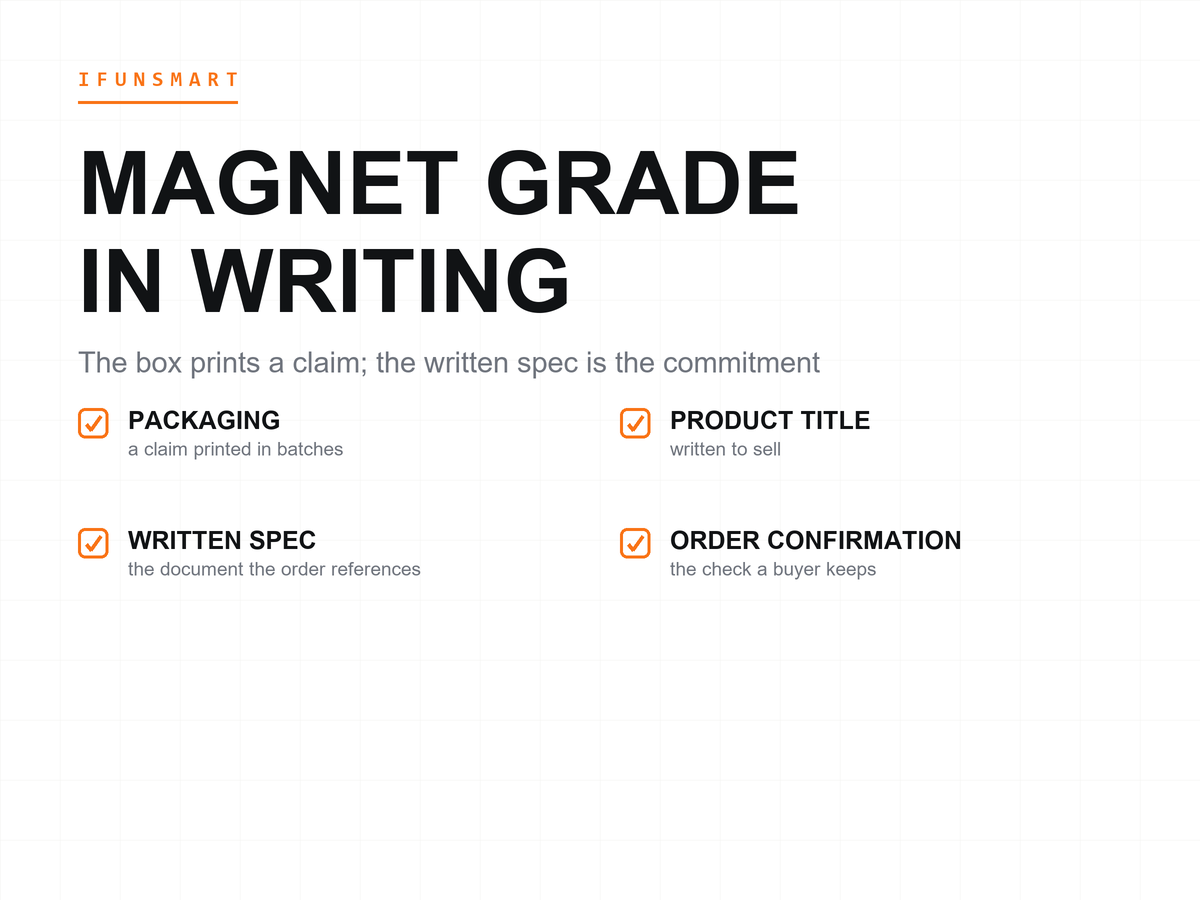
A magnet grade printed on a box is a claim, not a verification. The same grade written into the specification is a commitment. iFunSmart prints grades in catalog titles, and buyers who read the title, the packaging, and the written spec together catch mismatches before a bulk run. Here is how that check works.
Last updated: October 20, 2026.
Where a Grade Claim Lives
A magnet grade is a material designation that names the alloy and the performance class a magnet falls into. On a phone case the grade appears in three places: the printed packaging, the product title, and the written specification. Those three places do not carry the same weight. Packaging is printed in batches and can lag a change. A title is written to sell. The specification is the document a factory answers for when the order is confirmed, and it is the one a buyer can hold up after delivery.
Most buyers read the first two places and stop. The grade on the box matches what they expected, the listing reads well, and the order moves. The risk surfaces later, when a claim about a magnet grade turns out to be about a different part of the order, or about a material the factory never named in writing.
Why the Box Print Is Not the Spec
A printed grade is easy to copy and easy to change. The box a retailer sees may be a version printed for an earlier customer, or a stock design reused across models. None of that means the factory is dishonest. It means packaging is a marketing surface, and marketing surfaces drift. A buyer who treats the box as the specification is checking against a document that was never meant to be checked.
The same logic applies to product titles. iFunSmart's catalog prints grades where they matter, and the iPhone 18 Pro Max line carries a case title that names N52 magnets while another model prints an N52H case in the title. Those titles describe the magnet inside each case, and they are claims until the written spec says the same thing. The spec has the final word because the order references it.
What the Written Spec Should Say
Ask for the grade as a sentence, not as a logo. The useful version names the magnet grade and the part it sits in: the ring, the plate, or both. It also states which model the spec belongs to. A spec that names a grade once and a model nowhere is a sentence that can be attached to anything.
Three things make the spec usable. The grade belongs to the exact model and color being ordered. The wording states whether the grade covers the ring, the back plate, or every magnet in the case. And the same grade appears on the order confirmation, so the written commitment and the purchase order carry identical words.
Reading the Three Documents Together
The verification is a comparison, not a search. Lay the order confirmation, the specification, and the planned packaging side by side and read the grade in each. The three should match word for word. When they do not, the mismatch has a reason, and that reason should be written down before production starts rather than discovered on a shelf in another country.
The H in N52H is a common mismatch point. The letter changes what the grade means, and a packaging proof can drop it by accident. The published article on the H suffix explains heat tolerance in full. For this check the rule is simpler: if the written spec says N52H, the packaging should say N52H, and a missing letter is a change.
A force number in a title adds the same check. A listing may print a force number printed in the title, and that number describes the pull the factory measured for that assembly. When a buyer wants the number in writing, it belongs in the same comparison and carries the same wording on every document.
What a Sample Can and Cannot Add
A sample settles how a case feels and whether the magnet holds a charger through the case. What a sample does not settle is the grade. A buyer can feel grip and test charging, and neither test reads the alloy inside the ring. For the grade itself, the written spec is the only check that survives the distance between a sample in a meeting room and a container at sea.
We do not publish a magnet curve for every case, and we do not state a grade we cannot back in writing. Where the grade sits in the spec, it stays in the spec. Where a test result exists, it is shared on request. Those are two different promises, and this article keeps them separate.
Common Questions From Buyers
What does a magnet grade marking mean on a phone case?
A grade marking names the neodymium material the ring or plate is made from. On a case it describes the magnet that works with MagSafe accessories, and it is a material designation rather than a measurement of pull. The pull depends on ring size and case thickness too, which is why the grade alone cannot tell a buyer how strongly a case holds.
Should I trust the grade printed on the packaging?
Read it as a claim and confirm it as a commitment. Packaging proves what the factory printed, not what the factory tested. Ask for the grade on the order confirmation in writing, then compare the three documents before the run. The comparison takes minutes and survives the shipment.
Does a sample verify the magnet grade?
No. A sample verifies feel and charging behavior through the case, and it cannot read the alloy inside the ring. Keep the sample for what hands can judge, and keep the written spec for what only the spec can prove.
What to Do Next
Write down the models and colors you plan to order, and ask for the magnet grade of each in writing. The answer belongs on the order confirmation next to the model it describes. From there the check is a three-document comparison that takes an afternoon.
Send iFunSmart the models and the quantity band you plan to order, and we will confirm the magnet grade for each model in writing on the order confirmation, with a reply within 24 hours.
Apple, MagSafe, and iPhone are trademarks of Apple Inc. iFunSmart is an independent manufacturer of phone cases and accessories and is not affiliated with, authorized, sponsored, or endorsed by Apple.