Sep 17, 2026Business Solutions
From Sample to Shelf: A Phone Case Order Timeline
Every case order runs the same sequence. The stage that decides whether you hit your selling window is not freight; it is sample approval.
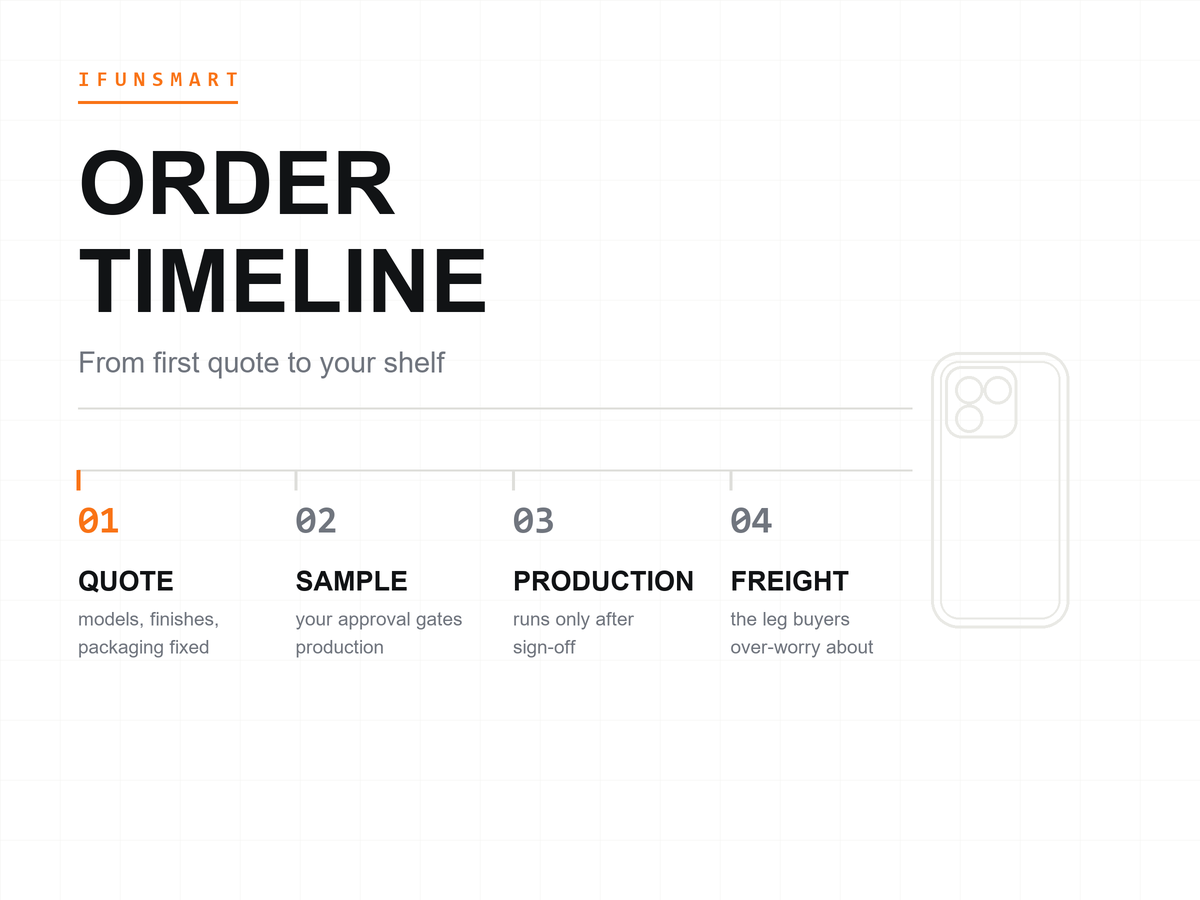
Every iPhone or Samsung case order runs the same sequence, and the order does not change: quote, sample, approval, production, inspection, freight, shelf. What changes is how long each stage takes and which one quietly decides whether you hit your selling window. The stage that decides it is almost never freight, which is the one buyers worry about most.
Last updated: September 12, 2026.
The Sequence Every Order Follows
A production timeline is the ordered set of stages a case order passes through from first contact to retail shelf. Knowing the sequence lets you see where your own order is, and where it can stall.
It starts with the quote and specification, where models, finishes, colors, and packaging get fixed in writing. Then comes the sample, where you check material, magnets, button feel, and fit before committing. Sample approval is the gate: nothing should go to production until you have signed off on what you are buying.
Production follows approval. Then inspection, where the batch is checked before it leaves, then freight, then your shelf. Each stage has a fixed order and a variable length, and the variable lengths are where launches get lost.
Which Stage Actually Decides Your Timing
Freight gets the attention because it is the longest single block and the most visible on an invoice. But on a launch order, the stage that decides your arrival date is usually sample approval.
Here is why. Production cannot start until the sample is approved, and a sample that comes back wrong costs a second round of production time before your real order even begins. Buyers who treat the sample as a formality and then spend two weeks debating a color have already spent their buffer, and the delay lands on the freight end, where the only fix is expensive air.
The practical rule is to compress the approval stage, not the transit stage. Decide on the sample fast, get the approval in writing, and let production start on schedule. That single habit does more for your arrival date than any freight negotiation.
What Makes Each Stage Longer
Four things slow an order down, and they stack.
The first is custom work. A stocked finish in an existing mold has almost no front-end setup. A new mold, a custom color, or a custom retail box each adds a step before production can begin.
The second is unclear specification. An order that changes models or finishes mid-quote starts over. Every change after the quote is issued adds a loop.
The third is a slow sample decision. The sample is sent to be judged; if nobody judges it, the order waits at the gate.
The fourth is late packaging decisions. Retail packaging is a production step; deciding on it after the cases are made means a second pass.
How to Run the Timeline Backward
The efficient way to plan an order is to start from the date it must be on shelves and work backward, not forward from today.
Fix the landed-by date first, then subtract the transit you plan to use. Subtract inspection time, then production time. What is left is your approval deadline, and before that sits the sample round. If the remaining window before your sample deadline is already negative, the order cannot make the date on your current plan, and you need either a stocked style or a freighter decision now rather than later.
We have written about how the cut-off dates for a peak season work backward from the same logic, because Q4 is where this arithmetic hurts most.
Common Questions From Buyers
How long does the whole process take?
It depends on four variables: whether the design already exists, whether there is custom printing or packaging, how fast the sample is approved, and which freight mode you choose. A stocked style with fast approval runs a much shorter cycle than a custom order. Give us your models and your landed-by date and we will map the stages to your window.
Can I skip the sample to save time?
We do not recommend it, and on a custom order we will push back. The sample is the cheapest place to catch a fit or finish problem. Skipping it moves that discovery into your production run, where the fix costs a full batch instead of a single unit.
Why does my order keep slipping?
Nine times out of ten it is specification changes or a late approval, not production speed. Once a quote is issued, every change restarts a loop. Freeze the model, finish, and packaging early, and the rest of the timeline becomes predictable.
What to Do Next
We have written before about how to vet a factory before you commit, and the timeline is part of that picture: a supplier who cannot lay out the stages and their dependencies is guessing at your arrival date.
Tell us the models and finishes you need and the date your stock must land, and we will map the stages against your window and tell you honestly where the risk sits.
Send us your models and your landed-by date and we will confirm a stage-by-stage timeline.
A typical stocked line to time your first order against is the skin-feel magnetic ring case for iPhone Duo or the mid-axis bracket MagSafe case.
Apple, iPhone, Samsung, and Galaxy are trademarks of their respective owners, used solely to indicate compatibility. iFunSmart is an independent manufacturer of phone cases and accessories.