Business Solutions
A Media Pack Buyers Can Actually Use
A catalog PDF, product photos, and poster files answer questions before they are asked. What goes into a media pack, and what stays out of it.
Buyers ask for materials before they ask for terms, and the answer is usually a scatter of attachments. iFunSmart treats the request as one deliverable instead: a media pack for wholesale buyers, assembled in Guangzhou and sent as a single folder. This article covers what goes in, what stays out, and how the versions stay matched.
Last updated: November 4, 2026.
One Folder Beats an Inbox Full of Attachments
The request usually starts small. A buyer asks for a picture of one case, then a catalog, then a poster for the shop window. Each answer leaves the factory as a separate message, and each message becomes another version somewhere in the buyer's downloads. A month later, nobody on either side can say which photo set goes with which document. Scattered files age quietly, and the cost lands later, when a listing carries a build the factory no longer ships.
A media pack is one folder, named and dated, that carries everything a buyer needs to list and sell. The folder is the deliverable. Open it, and the questions a listing would have raised — what the range looks like, which finishes are photographed, who to write to — are answered before they are asked. That is the test a pack has to pass, and not every attachment pile passes it.
What Goes Into the Folder
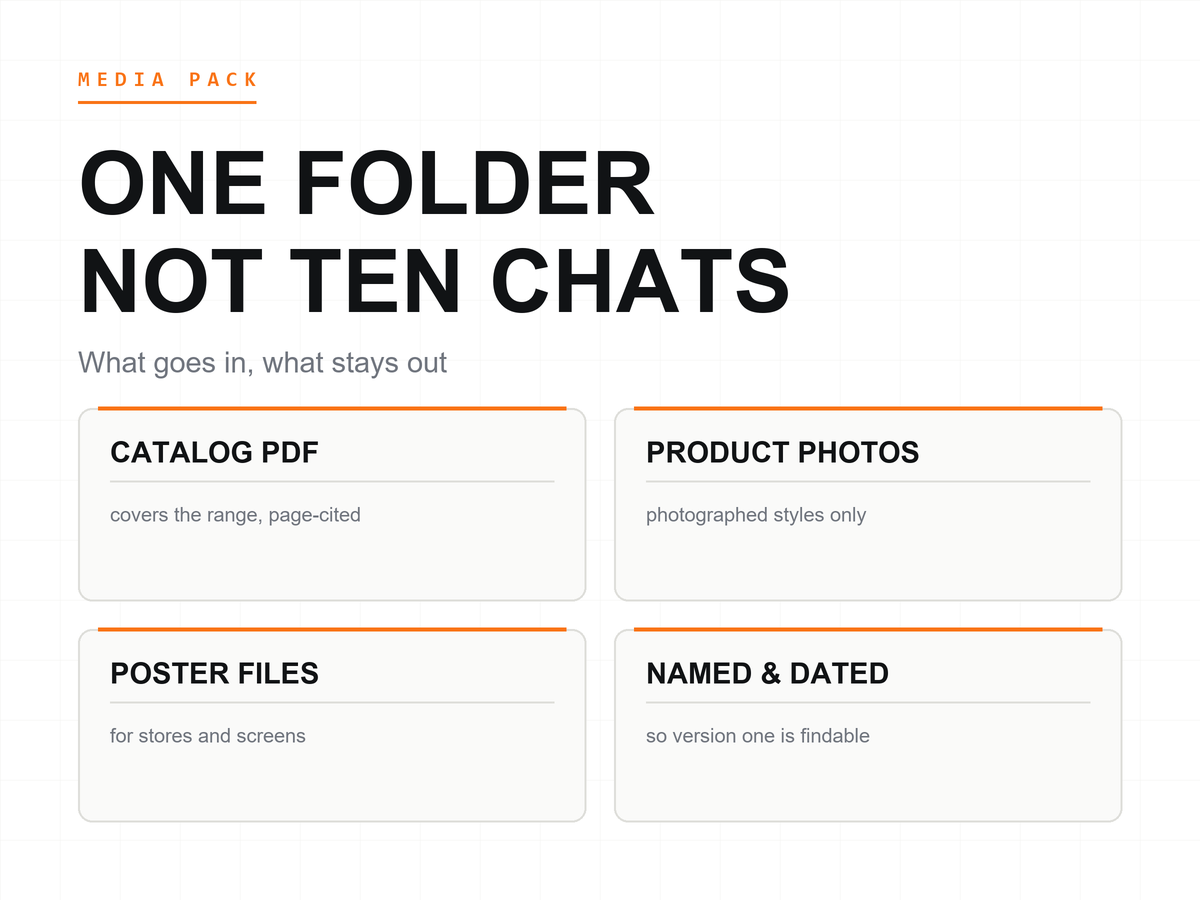
Four things earn their place.
The first item is a catalog PDF that covers the series actually on sale, page by page, so a buyer can quote a page back to us and both sides land on the same case. The cover decides whether the file gets read at all, which is why we lead with a flagship design for the cover page rather than a warehouse shot. The pages behind it should map the range: a foldable build for the range section, slim everyday shells, a clear back, a matte finish, each sitting where a buyer flipping through can find it. A catalog that cannot be quoted is a brochure. A catalog with page numbers is a working tool.
Next come the product images: a white-background main shot for each listed style, plus the detail views that settle questions about buttons, hinges, and lens openings before a customer asks them. On this piece we state our line as it stands: we provide free HD images for the styles we have photographed. Where those images come from and how to request them is its own subject; a pack simply carries the files, and every file in it must be a photograph of a style we actually build.
Poster and one-page files come third, and the buyer's channel picks the form. A counter shop wants something it can print and pin beside the register. A marketplace seller wants a banner-shaped file for the storefront instead. Same case, different channel, so a pack built for both carries both. What it does not carry is a screenshot promoted into a poster file, because a poster is a layout meant for printing or display, and a picture of a screen is neither.
The last item is the plainest and the one most packs forget: how to reach the supplier, with the reply window carried over as the contact page states it. A buyer assembling a listing needs a name to write to, not a form to guess at. We copy that wording across unchanged, so the pack and the website cannot drift.
What Stays Out of the Pack
Some absences are deliberate. A style we have not photographed does not go in as a render dressed up as a product photo, because the file would then describe a product the buyer cannot actually receive. The line we apply is the one we state everywhere: we provide free HD images only for the styles we have photographed. Material carrying a third-party trademark stays out as well, even when it arrived in some older folder, because a listing built on it inherits the problem. Claims stay out too: we do not include unverified ratings or sales figures in a media pack, since a number without a shown source becomes the buyer's liability the moment it is published. Stale price sheets round out the exclusions — a pack quoting an old price is worse than a pack quoting none, because someone plans a margin around it before the correction arrives.
One more boundary belongs here. A media pack cannot put a case in your hand. Finish, weight, hinge stiffness — those travel by parcel, not by folder. Pack and sample are companions, not substitutes.
Naming and Dating: Which Version Is This
A folder solves the scatter. Naming solves the drift. Every folder we send carries a date and the series it covers, and the files inside repeat the pattern, so a buyer holding several packs can tell them apart at a glance without opening any of them. The habit belongs on the buyer's side too: keep the folder under its own name, and the next request can point at it directly instead of re-asking for everything from memory.
Naming protects the factory as well. When a buyer writes about the blue build in the pack, a dated folder lets us pull the exact set, check whether that style has since been revised, and answer about the file in hand rather than from a guess. The same discipline retires dead files: when a revision lands, the poster showing the old finish comes out that day, not the next time somebody happens to notice. A file called final tells nobody anything a week later. A folder named with a date does.
Common Questions From Buyers
Does a media pack replace samples?
No, and it is not built to. The pack answers listing questions: what the range looks like, which finishes are photographed, where the contact line sits. The sample answers hand questions: how the coating feels, whether the hinge closes the way a customer expects, whether the case seats the phone the way the photos promise. Treat the pack as the first move and the sample as the confirmation, and both arrive doing the job they are good at.
What should I check when a pack arrives?
Start with the folder's date, checked against what you already hold, so the pack and your records describe the same moment. The image files come next: open each and confirm it shows a photographed style rather than a drawing. Then read the catalog's series list against what you plan to stock — anything you intend to sell that the pack does not cover is a question to send, not an assumption to keep. Save the folder under its own name before anything else. A pack checked in this order takes minutes. A pack discovered late costs a listing.
How does a buyer get a pack shaped to its channel?
Ask against your own list. The request that works names the models you stock and the channel you sell through, because a counter shop and a marketplace seller need different poster files from the same photo set. Tell us both, and the folder comes back arranged for your shelves rather than assembled from leftovers. If you want to see the format before committing, ask for the image list on a single model you already stock.
What to Do Next
Gather the details before you write: the models you stock, the channel you sell through, and anything you already hold from us. A few lines are enough to start. We build packs per request rather than from a shelf, and we can put a media pack together from your model list, with the photographed styles marked so you know what each file is. We mold cases in Guangzhou, and materials requests get answered the way this article describes — as one folder, dated, checked against what we actually build.
Send us your model list, and we will put a media pack together from it and tell you which styles already have photographed images.
Apple and iPhone are trademarks of Apple Inc. iFunSmart is an independent manufacturer of phone cases and accessories and is not affiliated with, authorized, sponsored, or endorsed by Apple.