Oct 7, 2026Business Solutions
Similar, Not Copied: How to Ask Safely
Many buyers want something like a design they have seen, without copying it. How to describe that brief safely to a supplier, and where the line sits.
A buyer who wants a case that resembles one they have seen is not asking for trouble by default. The trouble starts in how the request is worded. Describe the feel you want, name the phone it fits, and separate what you borrow from what you own. iFunSmart molds cases in Guangzhou for brands that brief this way.
Last updated: October 7, 2026.
Why "Similar" Starts the Right Conversation
A buyer once told us in a chat: "i dont want make copy of it, but im looking for something similar." That sentence is more than a disclaimer. It is a working definition of the whole request.
A "similar, not copied" brief is a request that borrows the feel of a reference product and replaces the identifying elements with the buyer's own. The feel can be borrowed. The identity cannot. When a buyer states both halves up front, the supplier knows which track the project is on, and the talk moves to what the buyer wants instead of what they fear.
The opposite request is the dangerous one: a silent copy of a competitor's shape, texture, and packaging, delivered as if it were the buyer's own idea. Vague wording does not make that request safer; it makes it harder to fix after tooling is paid for and samples are molded.
Suppliers hear both versions regularly. The ones worth working with answer the honest version with a plan, and the vague version with questions.
Describe the Feel, Not the Shape
The safest way to point at a design you like is to describe what it does for the hand and the eye, not to recite its measurements.
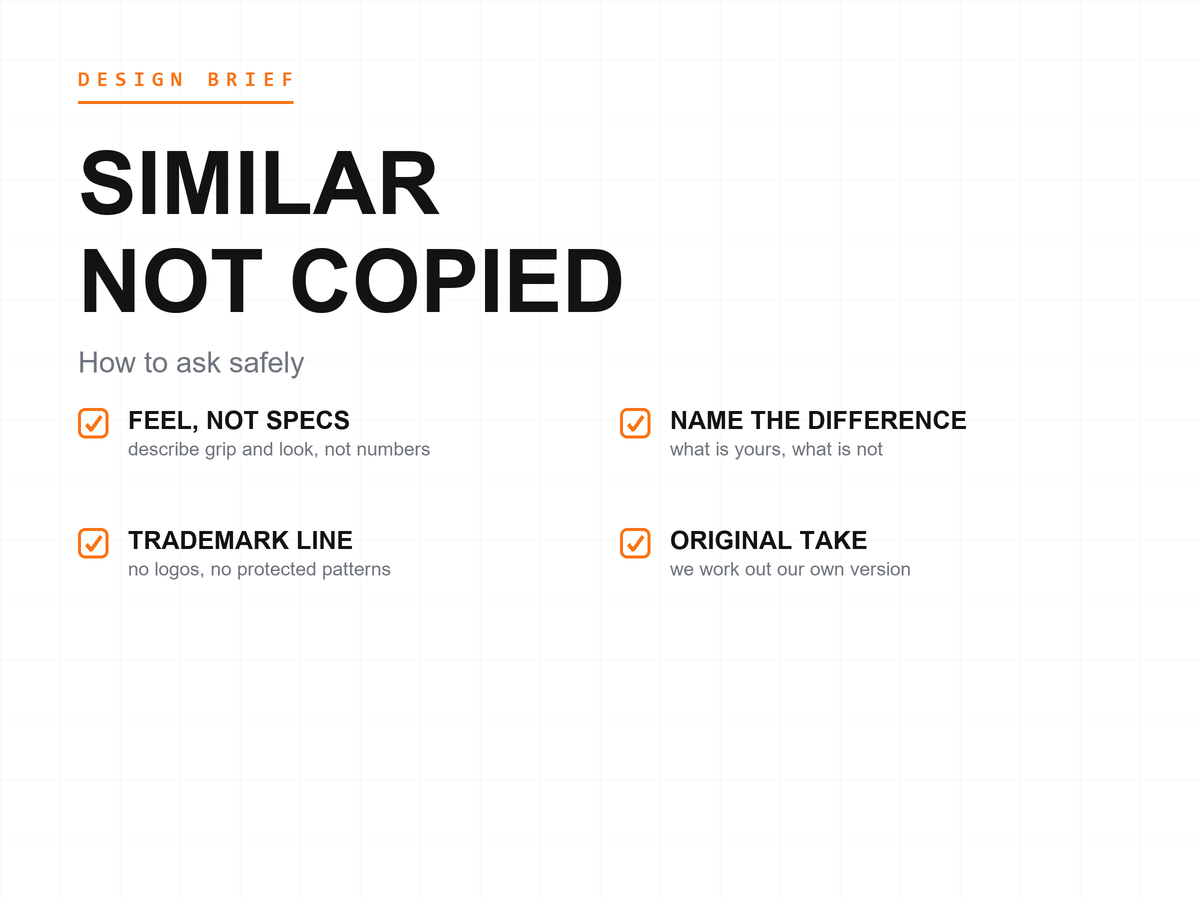
Name the feel you want: grippy or smooth, thick or barely there. The level of protection comes next, from a slim cover to a heavy build. Add where the texture sits and what it does for the grip. Those are function words, and they are yours to use.
What you should not do is paste the reference product's shape parameters into your spec. A camera frame copied in every dimension, a button cutout traced from a photo — each of those moves the request from inspiration to replication, and each is easy for a careful supplier to spot.
Describing the feel also buys a better product. The supplier gets room to reach the same grip with a different texture, and the result belongs to the buyer instead of the original. Color is the easy example: a color finish worth adapting can be reworked into a shade the original does not carry, while the shape and the texture around it stay your own.
Show the Reference and Name the Differences
A reference is worth showing. Images answer questions that words cannot, and a supplier working from a clear reference spends less of your sample budget guessing.
The discipline is to say what you are borrowing and what you are not, in the same message. A useful pattern: "reference the grip and the thickness, replace the color, the texture, and the camera cutout." Another: "start from this shape, but give me my own side profile and my own button style." Naming the differences turns a copy into a starting point and gives the supplier a list to design against.
The differences you name are where the originality lives. The colors you choose and the textures you develop are how a case becomes yours, and the cutout style and the packaging add the rest. An armor silhouette can serve as a reference while every visible layer around it is new: an armor shape to reference does not lock you into its texture, its color, or its branding.
If you already hold a reference in your hand, write that note before you message any supplier. It is the part of the brief worth putting in writing.
The Red Lines: Marks and Signature Design
Some elements are not available for borrowing, and the list is short.
Brand logos come first, and this one is not negotiable. If the reference carries a logo that belongs to someone else, that logo cannot appear on your case, your packaging, or your listing images, and restyling it does not change that.
Protected patterns and artwork sit behind the same line. A famous print, a character, a signature graphic — if the artwork belongs to someone, reproducing it is a problem separate from the case itself, and a responsible supplier flags it at the brief stage, not the shipping stage.
Signature design language is the softest line of all. Some shapes are so tied to a brand that echoing them invites confusion even with no logo present, and the safest brief keeps clear of anything a customer would read as another brand's signature.
Where the line between inspiration and infringement actually sits depends on the specific design, the specific market, and the rights someone holds there. We do not judge that line, and this is not legal advice. What we do is simple, and we state it early: we do not reproduce protected designs, and we will say so before tooling starts rather than after.
What the Factory Can and Cannot Do
A supplier cannot turn a copy into an original for you, and you should distrust one who offers to try. The original has to come from the brief.
What a factory like ours can do starts from the same place: we can note the reference and work out an original take. The reference goes next to the brief, the differences you named become the spec, and our in-house CNC work turns the spec into a case that keeps the feel without the identity.
The base helps too. Our Guangzhou factory was founded in 2010 and runs 1,000+ molds, so many original takes start from an existing base instead of a blank sheet. That keeps the tooling talk short and the sample round focused on the parts that are actually new.
What we cannot do is borrow the parts that cannot be borrowed. When a reference includes a logo, a protected pattern, or a signature shape, we ask for the buyer's own version of it before any work starts. A supplier who skips that step is not doing the buyer a favor.
Common Questions From Buyers
How do I show a reference without asking for a copy?
Send the reference with a written note that says what you want from it and what you want changed. A short note is enough, and it is the record you would want if the project is ever questioned.
Can I name the phone the case fits?
Yes, and you should. Naming the model — an iPhone 18 Pro, an iPhone Duo, a Galaxy S25 — is a compatibility fact, not a design claim, and it tells the supplier which base to work from. What to avoid is borrowing the phone maker's logos or presenting the case as the maker's own. We have written separately about keeping a listing free of trademark problems.
What if the reference is a phone maker's own design?
Treat it the same way. Borrow the feel, replace the identity. If the element you want is the logo, the pattern, or the signature shape, that element is off the table, and no supplier who wants your business should offer it. A supplier who does offer it is not protecting you.
What to Do Next
The safe request is not the quiet one. It names the feel, shows the reference with the differences spelled out, and keeps marks and signatures off the table. A brief written that way moves fast because the supplier is answering a clear question and the answer has a design behind it.
If you are drafting a brief like this, send it with the reference attached and the differences you want named. We will note the reference, work out an original take, and flag anything that cannot be borrowed before you spend on tooling.
Send us your reference and your list of differences, and we will work out an original take before tooling starts.
Apple, iPhone, Samsung, and Galaxy are trademarks of their respective owners. iFunSmart is an independent manufacturer of phone cases and accessories and is not affiliated with, authorized, sponsored, or endorsed by Apple or Samsung.