Business Solutions
Replaceable-Panel Phone Cases: One Frame, Many Backs
Replaceable-panel phone cases: one frame, five backs. How the P7 modular case works, what to check on a sample, and how to order — MOQ 50, bulk from 500, free samples for distributors.
BLUF
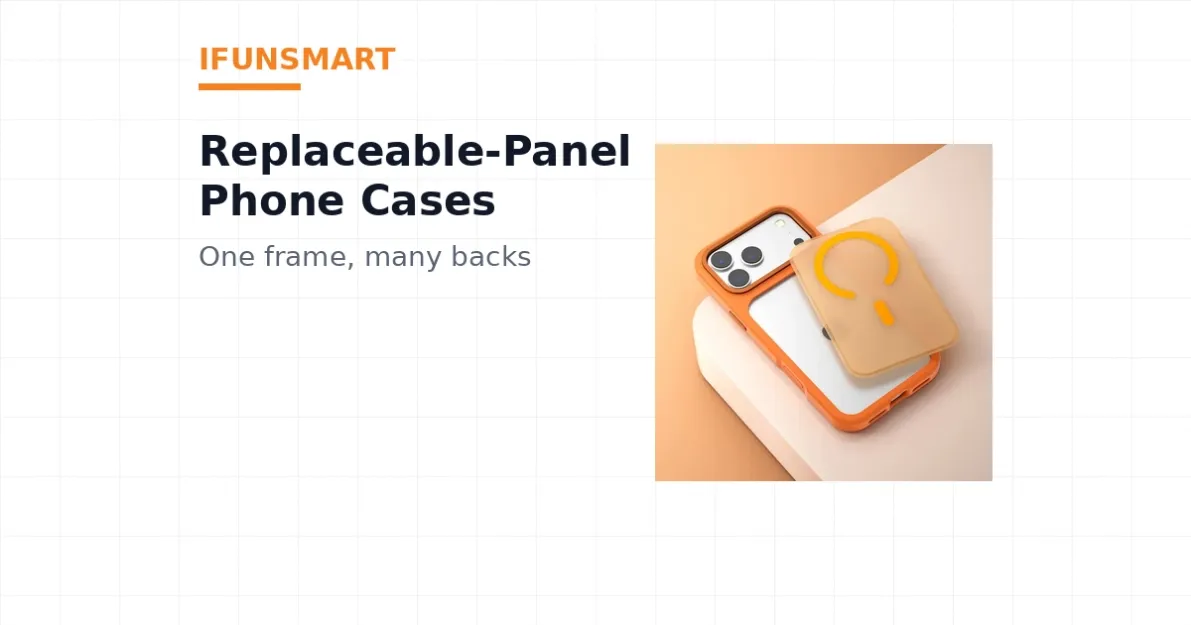
A replaceable-panel case is one frame with many backs: one bumper frame, and a back panel you swap for a new look, a stand or a colour. Our P7 covers the iPhone 18 Pro Max only, in five panel styles and six colours. Check model, panel hold and charging first.
Short answer
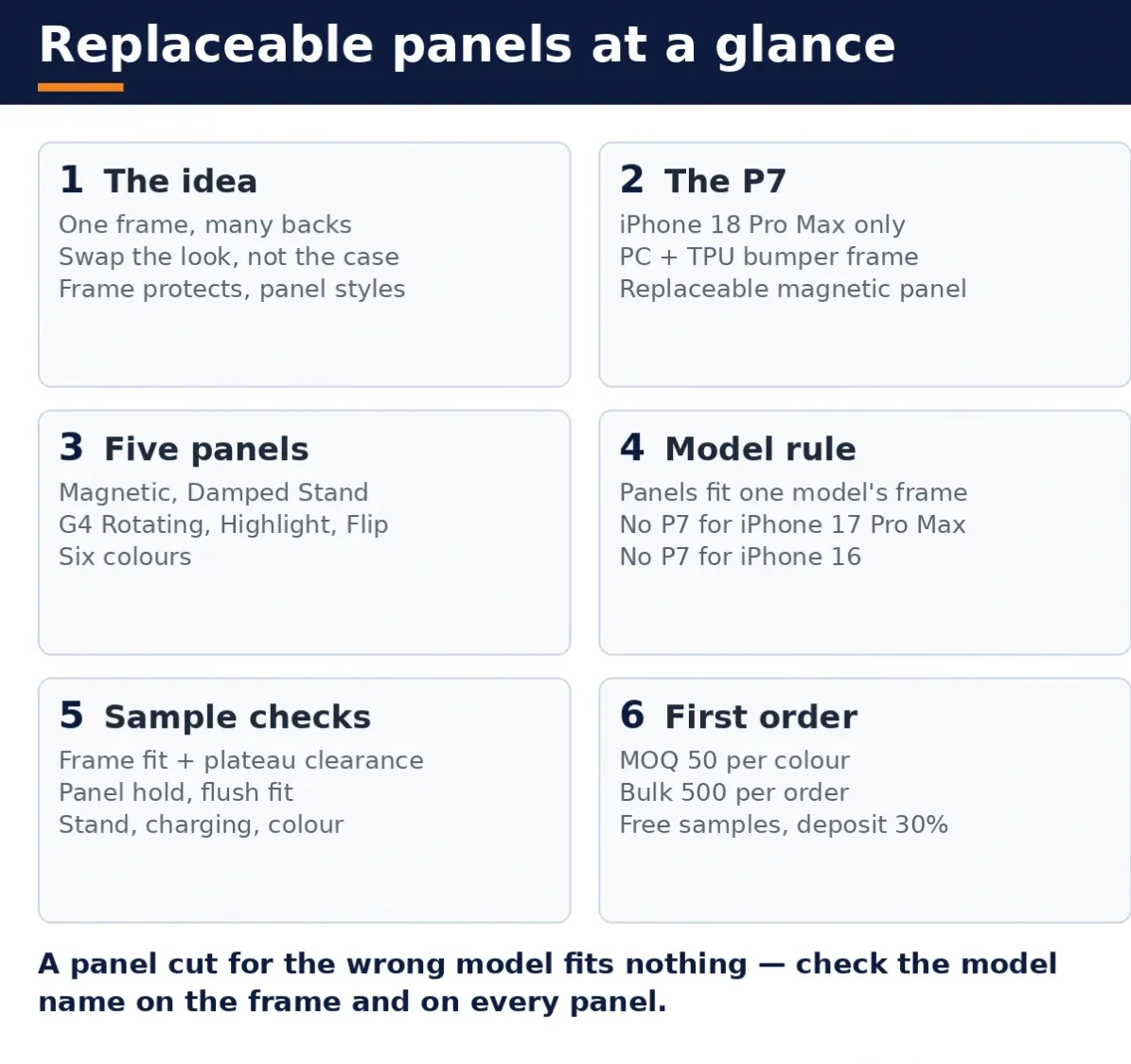
A replaceable-panel phone case splits the case in two: a bumper frame that stays on the phone, and a back panel that comes off and swaps. One frame can carry several backs, so a retailer can sell the frame once and the panels as add-ons, and a distributor can refresh a range with new panels instead of new moulds. Our P7 replaceable-panel case covers the iPhone 18 Pro Max, with a PC and TPU bumper frame and a replaceable magnetic back panel in five stand styles — Magnetic, Damped Stand, G4 Rotating, Highlight and Flip — in six colours: Blue, Pink, Purple, Orange, Black and Cherry Red. It is the only replaceable-panel case on our site: a search of all 174 products finds one P7 page, for the iPhone 18 Pro Max only, and no P7 for the iPhone 17 Pro Max or the iPhone 16. Panels are cut for one model's frame, so a panel ordered for one model does not fit another model's frame. Our most common MOQ is 50 pcs per colour per model, bulk distributor orders start at 500 pcs per order in total, and samples are free for distributors. Order the frame and the panels together, approve them on one sample, and confirm in writing which panel styles and colours your order covers before you pay anything.
1. What a replaceable-panel case is — and what it is not
A replaceable-panel case is a two-part case. The first part is the frame: a bumper that wraps the edges of the phone, holds the buttons and the ports, and carries the raised lip that keeps the screen off a flat surface. The second part is the back panel: a flat piece that covers the back of the phone and attaches to the frame, on our P7 with magnets. The panel comes off, and another panel goes on. The frame stays.
That split is the whole idea, and it is worth stating plainly because it decides what you are buying. You are not buying five cases. You are buying one frame and five backs for it. The protection — the bumper, the corners, the lip, the camera bezel — lives in the frame, and it is the same whichever panel is on the back. The look, the stand and the grip live in the panel, and they change when the panel changes. A buyer who understands that split orders differently from a buyer who treats each panel as a separate case: the frame is the durable part, the panels are the fashion part, and the order should reflect that.
What it is not: it is not a case that fits every phone. A panel is cut for one model's frame, and a frame is cut for one model. Our P7 frame is cut for the iPhone 18 Pro Max — 163.4 by 78.0 by 8.75 millimetres, 249 grams, with a full-width camera plateau — and its panels are cut for that frame. No P7 exists for any other model on our site, and a panel for another model would not fit this frame even if it existed. Treat every panel as model-specific: the model name goes on the frame order line and on every panel order line, and the sample check confirms both together.
It is also not a case with a fixed back that happens to have a stand. A fixed-back case with a ring stand has one back, one stand and one look for its whole life. A replaceable-panel case has one frame and as many backs as you order. That is the difference that matters for a retailer: a fixed-back case is one SKU that sells until the colour goes stale, and a replaceable-panel case is one frame SKU plus a panel range that can be refreshed without a new mould.
2. What changes when you swap the back
Swapping the back changes three things for the buyer who sells the case, and none of them is the protection.
First, the assortment changes. A normal case range needs a separate mould and a separate SKU for every style: a clear case, a ring-stand case, a coloured case, a wallet case. A replaceable-panel range needs one frame mould and one panel per style. The frame is the same across the range, so the buyer stocks depth in the frame and breadth in the panels. For a distributor that means fewer frame SKUs to hold and more panel SKUs to offer — and panels are the cheaper part to add, because the tooling is the panel, not the whole case. Ask us in writing how the panel mix counts toward the MOQ for your order: our most common MOQ is 50 pcs per colour per model, and how panels are counted against that figure is confirmed per order, never assumed.
Second, the refresh changes. A fixed-back range goes stale when the colour or the style goes stale, and refreshing it means a new case. A replaceable-panel range refreshes when a new panel arrives: the frame stays on the shelf, the panels change, and the customer who already owns the frame buys the new panel instead of a new case. That is a repeat sale built into the product — the customer comes back for the panel, not for a replacement case. It is also the reason to order the panels as a range, not as a single style: a frame with one panel is a case with a spare back, and a frame with five panels is a system.
Third, the customer relationship changes. A customer who owns one frame and three panels has three reasons to come back to the shop that sold them the frame, and every panel is a smaller, cheaper purchase than a whole case. For a retailer that means a lower-priced add-on sale with every frame, and for a distributor it means a panel range that can be sold into a shop that already stocks the frame. The frame is the anchor; the panels are the repeat business.
What does not change is the protection, and that is the check that matters most on the sample. The frame protects the phone whichever panel is on it, so the drop protection, the corner build and the screen lip are frame properties, not panel properties. Check them once, on the frame, with the plainest panel on — and then check every panel for the things that do change: the magnetic hold, the flush fit, the stand and the charging.
3. The five P7 panels — one frame, five backs
Our P7 case for the iPhone 18 Pro Max comes with five panel styles, all on the same frame. Each panel is a different back for the same phone, and each one suits a different buyer.
Magnetic — the plain magnetic back. This is the panel with no stand and no extra hardware: a flat magnetic back that covers the phone, carries the magnetic ring for chargers and mounts, and shows the colour. It is the panel for the buyer who wants the modular idea without the stand — the lightest panel, the simplest panel, and the one that shows the phone's colour best through a clear or tinted back. Order it as the default panel in the range: every frame should have one, because it is the panel that turns the frame into a plain case.
Damped Stand — the stand that holds its angle. This panel carries a stand with a damped hinge — a hinge that resists movement, so the stand stays where it is put instead of flopping open or shut. It is the panel for the buyer who props the phone up to watch video or to take a video call, and who wants the stand to hold through the call. Check it on the sample: open the stand, set the angle, and leave it. A damped stand that drifts is a stand that fails in the customer's hand within a week.
G4 Rotating — the rotating ring stand. This panel carries a ring that rotates, so the phone can be propped at more than one angle and the ring can be used as a grip while the phone is held. It is the panel for the buyer who wants the stand and the grip in one piece, and who uses the phone one-handed as often as propped up. Check it on the sample: rotate the ring through its full turn, feel for catching or looseness, and check that it locks where it is put. A ring that spins freely is a ring that will not hold the phone upright.
Highlight — the accent panel. This panel is the visual one: the back that stands out on the shelf and in the hand, for the buyer who buys on looks. The exact finish of the Highlight panel is confirmed per order in writing — the page lists the panel by name, and the finish is part of the order, not part of this guide. Check it on the sample the way you would check any coloured case: in daylight, against the colour you ordered, and next to the other panels in the range, so the accent reads as an accent and not as a mistake.
Flip — the flip-out stand. This panel carries a stand that flips out from the back, for the buyer who wants a stand that disappears completely when it is closed and appears when it is needed. Check it on the sample: flip it open and shut twenty times, and check that it sits flush when closed — a flip stand that stands proud of the back when closed is a stand that catches in a pocket and breaks at the hinge.
Five panels, one frame, six colours — Blue, Pink, Purple, Orange, Black and Cherry Red. The colours run across the panels, so a panel colour is part of the order, not an afterthought: confirm in writing which panel styles and which colours your order covers, because a frame in Orange with a panel in Blue is a different SKU from a frame in Orange with a panel in Orange, and the two should never be mixed on one order line.
4. Model coverage: the P7 covers one model, and panels do not cross models
Model coverage is the first thing to get right with a replaceable-panel case, because the panel and the frame are both cut for one model and neither fits another.
Our P7 covers the iPhone 18 Pro Max only. A search of all 174 products on our site finds exactly one P7 page, and it lists one compatible model: the iPhone 18 Pro Max. There is no P7 for the iPhone 17 Pro Max, no P7 for the iPhone 16, and no P7 for any Samsung model. If a customer asks for a replaceable-panel case for another model, the answer is "ask us" — the P7 frame exists for the Pro Max, and any other model is a new tooling question, not a catalogue item.
Panels do not cross models. A panel cut for one model's frame will not fit another model's frame, because the frame's shape, the camera cutout and the magnet positions are all cut for that model. The iPhone 18 Pro Max frame is cut for a phone with a full-width camera plateau; a panel for a phone without that plateau would not sit flush, and a panel for a different camera layout would not clear the lenses. Put the full model name, including the year, on the frame order line and on every panel order line, and check it on the sample before the bulk order: fit the panel to the frame, fit the frame to the phone, and confirm that all three belong together.
The same rule applies inside the range. A panel ordered for the P7 frame fits the P7 frame only — it does not fit any other case in our range, even one that looks similar. Do not order panels against a different case on the strength of a similar photo: the panel, the frame and the model are one order, and the sample is the proof that they match.
One more coverage note, for the buyer planning a range: the iPhone 18 Pro Max is the largest iPhone in the 2026 line, and it is the model distributors ask about first. A replaceable-panel case for the Pro Max is a range for the flagship buyer — the customer who buys the most expensive phone and the most cases for it. If your market buys the Pro Max, the P7 is the modular range to offer them; if your market buys another model, ask us what modular options cover that model, in writing, before you promise anything to a customer.
5. MagSafe and wireless charging with a removable panel
A replaceable-panel case is a magnetic case twice over: the panel attaches to the frame with magnets, and the panel carries the magnetic ring that attaches the phone to chargers and mounts. Both magnets have to work, and both have to be checked on the sample.
The panel magnet holds the panel to the frame. Check it first, because everything else depends on it: fit the panel, hold the phone by the panel, and shake it gently. The panel must stay on the frame. Then check the edges: the panel must sit flush with the frame all the way round, with no gap and no rocking, and it must come off with a firm pull, not with a fingernail. A panel that falls off in a pocket is a panel that gets lost, and a lost panel is a customer who does not buy the next one.
The charging magnet holds the phone to the charger. Our magnetic cases use N52 magnets rated at 2700 Gauss, and the P7 panel carries the magnetic ring for wireless accessories. Check the charging on the sample with the panel on, not with the panel off: put the phone on a magnetic charger with each panel fitted, and check that it charges at the rate your customer expects and does not heat beyond what the phone does without a case. A panel that blocks charging is a panel that fails, whatever the magnet grade says — and a ring-stand panel is thicker than a plain magnetic panel, so check the charging with the stand panel on, not only with the plain panel.
Check the ring alignment too. The magnetic ring in the panel must sit exactly over the phone's own charging coil, or charging slows and the phone heats. A misaligned ring is invisible until the phone is on the charger, which is why the sample check must include a real charging test with every panel style you order — not one panel as a stand-in for the rest. Five panels means five charging checks, and a panel that passes on its own is not proof that the next panel passes.
One more check, specific to a modular case: the car mount. A magnetic panel has to hold the phone on a car mount through a turn, and a panel with a stand has to hold it without the stand catching on the mount. Check the sample in the mount with each panel on, not just on a desk charger. A magnet that holds on a desk and fails on a bumpy road is a magnet that fails in the customer's car.
6. What to check on the sample before the bulk order
A sample is not a souvenir. It is the only proof that the frame fits this phone, the panel fits this frame, and the pair survives a day in a pocket. Run these checks on every panel style before you approve the bulk order.
Frame fit, first. The frame must snap on without forcing, sit flush all the way round, and come off without a tool. Check the camera plateau clearance: the frame must clear the full-width plateau exactly, with no rocking on a flat surface and no pressure on the plateau itself. Check the buttons — volume, power and the camera control — for a crisp press with no mush and no missed press. Check the ports: the charging port must take the cable fully, with no gap and no wobble. A frame that fails any one of these on the sample will fail on every unit in the bulk order, because the mould is the same.
Panel hold, second. Fit each panel in turn. It must sit flush with the frame, with no gap and no rocking, and it must stay on when the phone is held by the panel and shaken gently. It must come off with a firm pull. Check the panel edges for sharpness — a panel edge that catches a pocket will catch a finger too. Check every panel style you order, not one as a stand-in: the five panels are five different parts, and each one needs its own check.
Stand function, third. Open and close each stand panel twenty times. The damped stand must hold its angle; the rotating ring must turn smoothly and lock where it is put; the flip stand must sit flush when closed and stay open when opened. A stand that works on the first open and fails on the twentieth is a stand that fails in the customer's first week.
Charging, fourth. Charge the phone with each panel on, on a magnetic charger and on a car mount. Check the rate, check the heat, and check that the phone stays on the mount through a turn. Five panels means five charging checks.
Colour and finish, fifth. Check each panel colour against the colour you ordered, in daylight, not under a warehouse light. A colour that looks right under fluorescent light and wrong in daylight is a colour that gets returned. Check the Highlight panel next to the other panels, so the accent reads as an accent.
Packaging, sixth. Check the box the sample arrives in. Neutral packaging is usually in stock and a logo sticker can be added to it; custom packaging is available, but it has its own MOQ — ask us per order. A frame with five panels needs a box that holds the frame and the panels without pressing the stands, and the panels need to be packed so they do not scratch each other. Confirm the packaging on the same sample as the case, so one approval covers both.
If the sample fails any check, say so before the bulk order. A failed sample costs a sample. A failed bulk order costs a customer.
7. How a first replaceable-panel order works
A first order for a modular case follows the same five steps as any first order from a factory, with one extra line on the enquiry: the panels.
First, enquire. Send us a message on WhatsApp with the frame model — iPhone 18 Pro Max, with the year — the panel styles, the colours, the quantity of frames and the quantity of each panel, and the date you need the cases in hand. A complete enquiry gets a faster answer than a one-line message: frame model, panel styles, panel colours, frame quantity, panel quantities, logo or no logo, packaging, and the date you need them. Tell us the date you need them, not the date you would like them — the factory plans on the date you need. Ask in the same message how the panel mix counts toward the MOQ, and ask us to confirm the panel styles and colours in writing before you pay anything.
Second, take a sample. Samples are free for distributors. Take one frame and one of each panel style you plan to order, and run the checks in section 6 on every panel. Check the logo position too if you order a custom logo — the printable area is confirmed per model from the factory drawing, never guessed, and a logo on a removable panel is a different print surface from a logo on a fixed back, so confirm which surface carries the logo before you approve the artwork.
Third, plan the quantities. Our most common MOQ is 50 pcs per colour per model, and MOQ varies by product, so ask us per style — and per panel — before you plan the quantities. Bulk distributor orders start at 500 pcs per order in total, not per model, with free samples for distributors — so a first P7 order can mix frames and panels and still count as one bulk order. A practical first order is frames in two or three colours with two or three panel styles in each, or a 100-pc trial of one frame colour with one panel style if you are testing the modular idea in a new market. A 100-pc trial order can already carry your logo by laser engraving.
Fourth, confirm the date in writing. Do not promise a delivery date to your customer until we have confirmed the production window in writing. We do not quote sample days or production days in this guide because the window depends on the styles, the quantities and the current production schedule — ask us for the current window for your order, in writing, and plan the launch around it, not the other way round. A panel range that arrives after the launch peak is a range that misses the sale.
Fifth, payment. Payment is T/T or Western Union. New customers may pay a 30% deposit first. When the goods are ready, we send photos and video and the packing list, you pay the balance, and then the goods ship. That order — deposit, proof, balance, ship — is the same for a modular order as for any first order, and it is what protects both sides.
FAQs
What is a replaceable-panel phone case?
It is a two-part case: a bumper frame that stays on the phone, and a back panel that comes off and swaps. One frame can carry several backs, so a retailer sells the frame once and the panels as add-ons, and a distributor refreshes a range with new panels instead of new moulds. Our P7 covers the iPhone 18 Pro Max, with a PC and TPU bumper frame and a replaceable magnetic back panel in five stand styles and six colours.
Will an iPhone 17 Pro panel fit an iPhone 18 Pro Max frame?
No. Panels are cut for one model's frame: the frame's shape, the camera cutout and the magnet positions are all cut for that model, and the iPhone 18 Pro Max frame is cut for a phone with a full-width camera plateau. There is also no P7 for the iPhone 17 Pro Max on our site — the P7 exists for the iPhone 18 Pro Max only. Put the full model name, including the year, on the frame order line and on every panel order line.
Does a replaceable-panel case work with MagSafe charging?
Yes, if the panel is fitted and the charging is checked on the sample. The panel carries the magnetic ring for chargers and mounts, and our magnetic cases use N52 magnets rated at 2700 Gauss. Check the charging with each panel style on — a ring-stand panel is thicker than a plain magnetic panel — and check the phone on a car mount as well as on a desk charger. A panel that blocks charging is a panel that fails, whatever the magnet grade says.
What is the MOQ for replaceable-panel phone cases?
Our most common MOQ is 50 pcs per colour per model, and MOQ varies by product, so ask us per style — and per panel — before you plan the quantities. Bulk distributor orders start at 500 pcs per order in total, not per model, with free samples for distributors. Ask us in writing how the panel mix counts toward the MOQ for your order, and confirm the panel styles and colours in writing before you pay anything.
How do I order replaceable-panel cases in bulk?
Send us a message on WhatsApp with the frame model, the panel styles, the panel colours, the frame quantity, the panel quantities, and the date you need the cases in hand. Take a sample first — one frame and one of each panel style — and run the frame-fit, panel-hold, stand, charging, colour and packaging checks on it. Confirm the production window in writing before you promise a delivery date to anyone. Payment is T/T or Western Union, with a 30% deposit for new customers, and we send photos, video and the packing list before the balance is due.
About iFunSmart
iFunSmart has made phone cases in Guangzhou since 2010, with 1,000+ designs, 500+ models and 500K+ pcs a month, shipped to 30+ countries. We hold moulds for iPhone, Samsung, Xiaomi, Google and more, and we cut new tooling to order for distributors and brands. Our most common MOQ is 50 pcs per colour per model; bulk distributor orders start at 500 pcs per order in total, with free samples for distributors. Payment is T/T or Western Union; new customers may pay a 30% deposit first, and we send photos, video and a packing list before the balance is due. Ask us for the current replaceable-panel range in writing — if a panel covers your model, we will tell you, and if it does not, we will tell you that too.
WhatsApp us: +86 13632248734 — we reply within 24 hours.
Contact us: https://www.ifunsmart.com/contact
Read more
- iPhone 18 Pro Max Cases: What Buyers Should Order First — https://www.ifunsmart.com/posts/iphone-18-pro-max-cases-what-buyers-should-order-first
- iPhone 17 Pro Max Cases: What Buyers Order First — https://www.ifunsmart.com/posts/iphone-17-pro-max-cases-what-buyers-order-first
- Phone Case Sampling: How to Evaluate a Sample Before a Bulk Order — https://www.ifunsmart.com/posts/phone-case-sampling-how-to-evaluate-a-sample-before-bulk
- Phone Case MOQ Explained: What 50 Pcs per Colour Really Means for Your First Order — https://www.ifunsmart.com/posts/phone-case-moq-50-per-colour-first-order
- MagSafe Cases in 2026: N52 vs N45, 2700 Gauss, and How to Test the Magnet Before You Order — https://www.ifunsmart.com/posts/magsafe-cases-2026-n52-2700-gauss-test-magnet
- Phone Case RFQ: What to Send a Factory in Your First Enquiry — https://www.ifunsmart.com/posts/phone-case-rfq-what-to-send-a-factory-in-your-first-enquiry
- Bulk Phone Case Orders: How Volume Changes the Order — https://www.ifunsmart.com/posts/bulk-phone-case-orders-volume-guide
- Phone Cases as Corporate Gifts: Logo & First Order — https://www.ifunsmart.com/posts/phone-cases-as-corporate-gifts-logo-first-order