Oct 9, 2026Business Solutions
Bank Fees on a First Order: Who Pays What
The invoice amount and the amount that lands are rarely the same. Which fees sit inside a cross-border payment, and how the paying split works.
The invoice amount and the amount that lands are rarely the same figure. Banks along a cross-border payment route deduct their own charges, and somebody absorbs each one. iFunSmart, a Guangzhou factory serving brand and wholesale buyers across 30+ countries, sees first-time importers meet that gap; here is where the charges sit and who pays which.
Last updated: October 9, 2026.
Sent Is Not the Same as Received
A cross-border payment rarely moves in a straight line. It leaves your bank, crosses the payment system, and arrives at ours, and every institution that handles it can bill for the handling. The charges come out of the transfer itself, so the receiving account is credited with less than the sending account released. The gap is normal. It is not an error and not a supplier markup; it is the working cost of the route, and it shows up somewhere on every cross-border payment.
Part of that cost has a name worth knowing. An intermediary bank fee is a charge deducted by a bank in the middle of the route — a bank that handles the payment between the sending bank and the receiving bank when the two do not settle with each other directly. A payment routed through more intermediaries passes through more hands, and each hand can take its share. That is why two payments of the same size, sent on different days, can land at different figures.
Where the Fees Sit on the Route
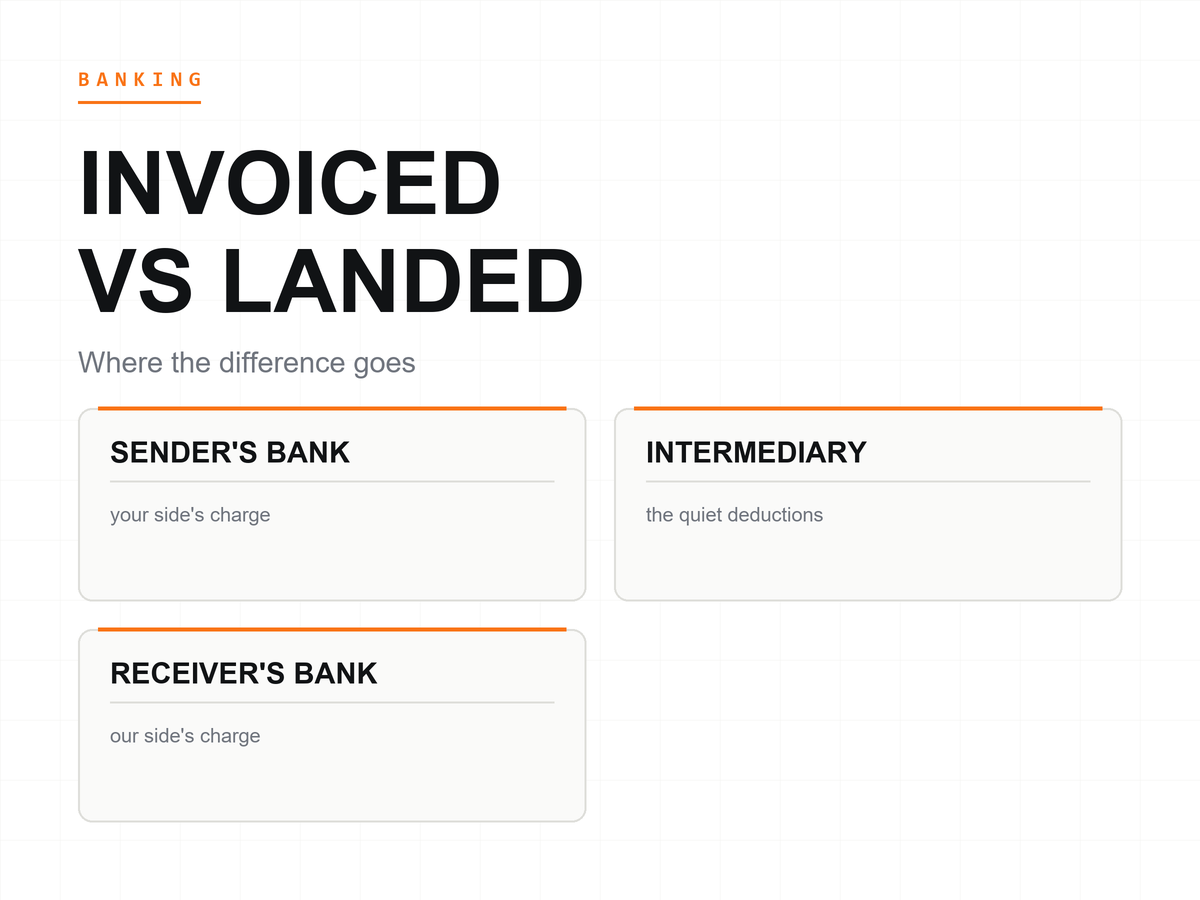
Fees gather at three points. Your own bank bills you for sending, and that charge is usually taken from you at the point of transfer. Intermediary banks along the way can deduct their handling from the payment as it passes, layer by layer; the longer the route, the more layers it may meet. The receiving bank bills the receiver — at our end, our own bank applies its charge to the account that accepts the payment.
None of these charges belongs to the supplier. We do not set them, we do not collect them, and we cannot waive them. What a buyer controls is the arrangement that decides who absorbs each one, and that arrangement is chosen before the payment moves.
Three Ways to Split the Charges
Cross-border trade payments are usually sent under one of three arrangements. The first is the sender covers the route: your bank charges you a figure calculated to carry the whole journey, so the receiving account is credited, in principle, with what left yours. The second is the split: each side pays its own bank, and the intermediary deductions come off the payment in transit. The third is the receiver absorbs the rest: the payment arrives trimmed by the route's deductions, and the receiving account carries whatever the sending side did not cover.
Banks label these arrangements with letter codes on the transfer form, and codes vary by bank — different institutions can use different letters for the same idea. Read the form rather than the label. Ask which arrangement a code stands for, and what that arrangement does to the figure that lands.
Which Arrangement Should a First-Time Buyer Choose?
That is a question for your bank rather than a rule in an article. Each arrangement moves the same class of charges to a different pocket; none of them makes the charges disappear. What changes the outcome is the arithmetic you do in advance. Ask what net figure arrives under each arrangement, and compare. A buyer who sends under an arrangement that trims the receiving amount should expect the shortfall conversation; a buyer who wants the receiving account credited with the full invoice figure should pick the arrangement that does that and accept a larger outlay on the sending side.
How to Keep More of the Payment You Send
A few habits limit what leaks on the route. Ask in terms of the net figure — the amount that will be credited to the receiving account — rather than the amount you send; that is the only figure that matters to the goods. Then ask whether a routing with fewer intermediaries exists for the corridor you are paying into, because fewer hands usually means fewer deductions. And on a first payment of meaningful size, put the same questions to both banks before anything moves: the sending side answers for its own charges, and the receiving side can answer only for ours.
On our side the picture is short. Charges at the receiving end belong to our bank, and we do not quote bank fee schedules — rates differ from institution to institution, your bank's schedule governs your side of the route, and the figures that matter are the ones the banks themselves state.
Put the Arrangement in Writing Before the Payment Moves
A split that lives only in a conversation protects neither side. When the arrangement is named on the order confirmation, both parties know which net figure to expect, and a difference between the invoice and the credit advice reads as a route event instead of a dispute. The exercise is short. Take the product list behind the first payment and write the fee arrangement on the same page as the named lines. The split works the same whether the payment covers a kickstand SKU on the list — a clear MagSafe case for the iPhone 18 Pro — or a wider assortment across the catalog; what matters is that the arrangement and the lines sit in one document, where a treasurer, an accountant, or a customs clerk can find them later.
Common Questions From Buyers
Why Does the Landing Figure Move From Payment to Payment?
Because the route is not under your control. Correspondent banks can route a payment differently from one transfer to the next, and a corridor that cleared through one intermediary last time may clear through another this time. That is precisely why the net figure should be asked about per payment, not assumed from the previous one.
Does the Arrangement Change What the Route Charges?
Mostly it changes who pays, not what is charged. The banks along the route apply their own schedules regardless of the label on the form, and the arrangement decides which side absorbs each charge. Some banks even price their own charge differently depending on the arrangement selected — one more reason to ask each bank what it will bill under the one you intend to use.
What Should a Buyer Ask Each Bank Before Sending?
Ask your bank which arrangements it offers on the transfer form, what its own charge is under each, and what net figure it can state for the receiving account. Ask the supplier only for the receiving details, because the receiving bank's charge is the receiving bank's answer. Put the two sets of answers side by side and the split chooses itself.
What to Do Next
Run these checks once and they carry forward. Choose the arrangement with your bank, ask both ends to state the net figure, and write the split onto the order confirmation next to the named lines — whether those lines begin with a smoke-finish pick for the iPhone 18 Pro Max or a full shelf plan. The first payment is the cheapest moment to fix a fee arrangement. Every later payment inherits what the first one settles.
Send iFunSmart your first-order list and the arrangement you intend to use, and we will carry the split on one written confirmation.
Apple and iPhone are trademarks of Apple Inc. iFunSmart is an independent manufacturer of phone cases and accessories and is not affiliated with, authorized, sponsored, or endorsed by Apple.