
Business Solutions
Receiving a Carton: Three Stages, Three Jobs
Signing, opening, and shelving each decide something different. What to do at each stage so a problem gets caught while it is still fixable and claimable.
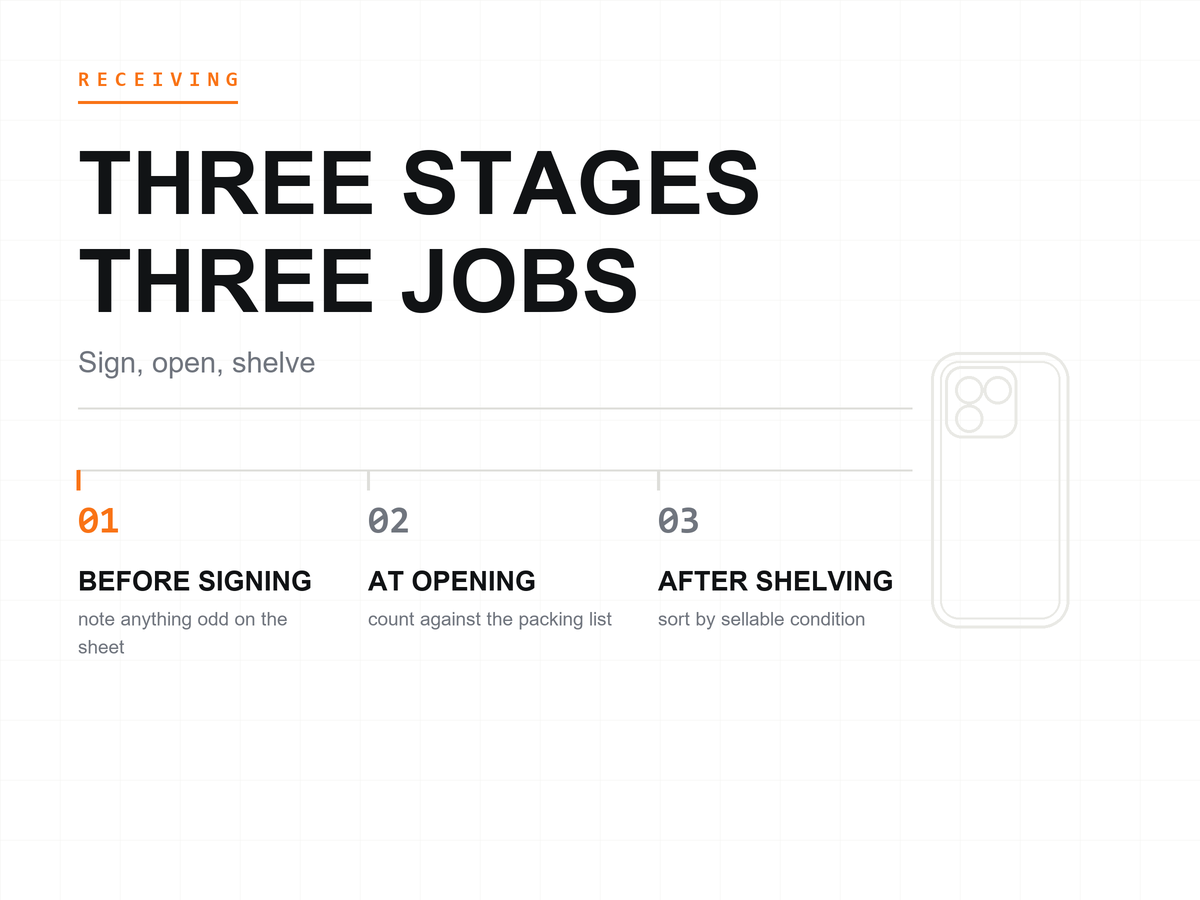
Receiving a carton looks like one task and is really three: sign for it, open it, shelve it. iFunSmart manufactures iPhone cases in Guangzhou, and the buyers who keep their claims intact treat those three as separate jobs with separate records. Sequence matters more than speed.
Last updated: November 4, 2026.
Why Three Stages, Not One
A dock rewards speed. The carton lands, the driver waits, and the fastest way through is to sign and stack in one motion. That speed spends every piece of evidence the shipment will offer.
Each moment answers a different question. The signature fixes the condition of the goods at handover. Opening settles what the carton actually contained. Only after shelving can you say whether the stock is sellable. Run them together and a crushed corner found inside is no longer tied to the carrier, nor a short count to the packer.
The receiving window is the stretch between handover and sellable stock, and each part proves only what happens inside it. Treat it as one event and you get one weak story. Treat it as three and each stage produces a record that stands on its own.
A defect caught before signing leaves you options: refuse, note the damage, or accept with a written exception. The same defect caught on your rack leaves you with a phone call and a hope.
Stage One: The Carton Before You Sign
The first job happens while the driver is still there. Look at each carton before it leaves the vehicle. Check the count against the delivery note, and the carton labels against the arrival notice your forwarder sent. Those checks decide how the shipment starts.
Damage is not only a crushed corner. Water staining, a torn label, a soft wall, and a shifted pallet all deserve a second look. Weight matters too. A carton of a bulky armor case can crush a lighter carton beneath it, and the damage shows on the lower box rather than the one that caused it.
When something is wrong, write it on the delivery receipt before you sign. Name the carton and the visible problem in plain words. A clean signature is harder to dispute than a note added later, and that note is where a claim begins. If the count runs short, write what you received beside the stated figure.
Photographing that exception is its own routine, covered in our article on receiving exception photos; the photo extends the note rather than replacing it.
Who bears the risk at each stage depends on the terms you agreed with your forwarder. This article can describe the sequence. It cannot read your contract for you.
Stage Two: When the Carton Opens
The second job starts when the seal breaks. Work from the paper first. Open the carton, take out the packing list, and check the count and the SKU codes before you judge any case. A carton can hold the right total and the wrong mix, and a small card-holder SKU is easy to mistake for another flat case through clear film. Only the list states the intended mix.
Then look at the contents. Not every unit, and not only the top layer. Pick from the middle, turn a case over, and check the finish against the sample you approved. A carton packed in a hurry can hide a color drift under a neat top layer.
When something does not match, stop. Keep the carton as you found it and touch nothing before you record what you see. Tidying destroys the most useful fact on the dock: the packer's arrangement. A carton that has been sorted no longer shows whether it left the factory short or arrived short.
Name each problem by type, because the four types travel different paths. A delay goes to the forwarder's timetable, while a wrong SKU or a damaged unit raises an identity or condition question between you and the supplier. A short count is settled by the packing list.
Labels and packing lists are built on the shipping side; this stage only uses them.
Stage Three: After the Carton Is Shelved
The third job happens after the carton has been checked and before the stock is treated as normal. Sort what you found by sellability: ready for the shelf, or in need of repacking. Units still waiting on a decision form a third group. The piles can be physical or lines on a form, as long as each unit has a place.
Repacking covers the middle ground buyers often skip. A case can be fine while its retail box is crushed, and a unit that needs a new box or a fresh label is neither sellable nor scrap. For cartons we packed, we print and apply labels in-house, so a damaged label can still be traced to the run that produced it.
Pending units need isolation more than any other pile. Put them in a named location away from sellable stock, with the carton number attached. A pallet that mixes pending units with good stock turns the next stocktake into an argument about which batch a case came from.
Last, write the result into your arrival record. One line per carton: what arrived, what did not match, which category the contents went into, and who handled the decision. That record is what a supplier can match against a packing file. Ask your supplier which document carries the carton-level count, and keep the answer beside your form. We do not decide your carrier claim.
What Not to Do at the Dock
Moving a carton into the warehouse before you sign is the costliest mistake. The rack is the line between a carrier problem and a warehouse problem. The refusal option lives in that moment. Once the carton sits inside, the condition of the goods becomes your word against a signature that says they arrived in good order.
Opening and tidying in the same motion is the second habit to drop. Unpacking is a reading exercise; sorting is a filing exercise. Do both at once and the carton loses the only arrangement that proves how it was packed.
Exception units that go to the shelf because they are only slightly damaged are a slow leak. A unit sold from the wrong batch creates a complaint you cannot trace, and that complaint costs more than a unit held back. The shelf is for stock you have classified, not stock you have not decided about.
Common Questions From Buyers
Does a note on the delivery receipt replace photographs?
No. The note records that a problem existed at handover; the photographs record its extent and identify the carton. Keep the note short enough for the driver to sign beside. Images without a note are harder to attach to the handover moment.
What if the driver will not wait while I check the cartons?
Check what the driver will allow, then write the exception for the cartons you could not inspect. A written line naming those cartons keeps the question open; a clean signature closes it. How long a driver must wait depends on the forwarder's terms, not on this article.
Should I refuse a damaged carton instead of accepting it with a note?
Refusal is a commercial decision, not a receiving habit. Visible damage that makes contents untrustworthy is the usual reason to consider it, and the trade terms decide whether refusal is available and who carries the cost. Accepting with a note keeps the goods and the claim. Refusing keeps neither until the carrier agrees. We do not decide your carrier claim.
What to Do Next
Write the three stages into your receiving workflow while the next shipment is on the water. Name who signs, who opens, and where pending units go. A written routine survives a busy morning; a remembered one does not.
Send iFunSmart the arrival record your warehouse uses, and we will match the packing list and carton label fields to it before the next shipment.
Apple and iPhone are trademarks of Apple Inc. iFunSmart is an independent manufacturer of phone cases and accessories and is not affiliated with, authorized, sponsored, or endorsed by Apple.