Oct 14, 2026Business Solutions
Card Holder Cases: The Slot Depth Question
A card slot can grip too much or grip too little. How the depth and friction boundary works, and how to test a sample before you place the bulk order.
A card slot grips through depth and friction, and either one carried too far turns a wallet case into a daily annoyance. iFunSmart is a Guangzhou factory that builds card-holder cases for iPhone, and the honest answer to how deep a slot should be is that it depends on how your buyers load it.
Last updated: October 14, 2026.
The Slot Holds by Depth and Friction
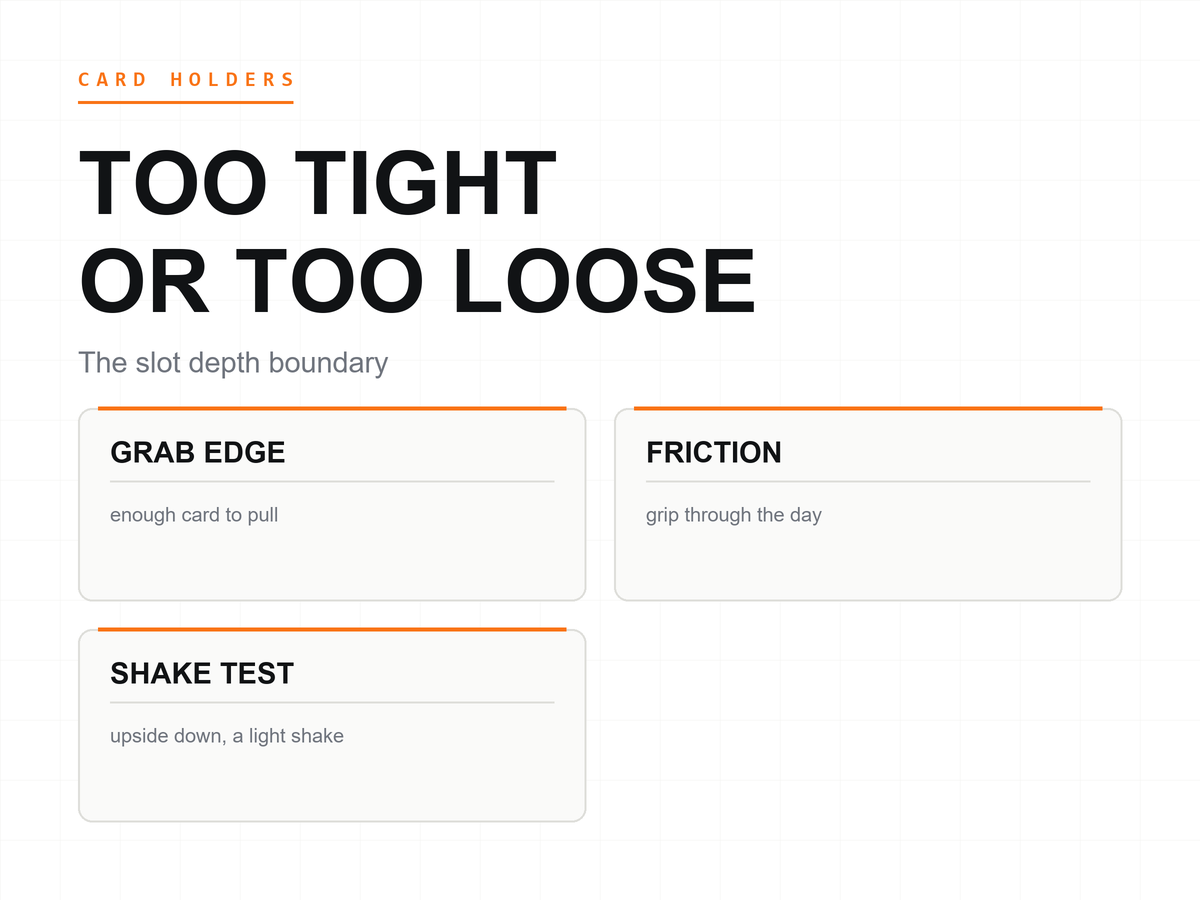
Slot depth sets how far a card sinks into the pocket, while friction and the lip set how much force it takes to move that card again. The grab edge is the strip of card left standing above the pocket lip, and it is the only part a thumb can use. A slot that swallows the whole card leaves nothing to pull. A slot that leaves too much card standing stops holding it at all.
The feel of a pocket comes from variables that a product photo cannot show. The lining is one. Suede and leather bite into a card with a soft grip, while a smooth hard-plastic pocket lets it slide, so the same outer shell can feel firm in one build and slippery in the next. The stack is another. A lone card has only the lining holding it, and a stack presses the cards against each other and against the lining, so resistance climbs as the pocket fills. Card surface matters as well, since embossed account numbers and worn corners catch a lip in ways a smooth card does not.
A slot pulled too tight costs the end user in small ways that add up. The card has to be dug out with a thumbnail, corners scuff against the lip on every pull, and a full stack may refuse to seat at all. A slot left too loose fails in the other direction. Cards creep upward in a pocket, slip when the phone is held at an angle, and drop free when the case is shaken. Neither setting is the safe default. Tightness and looseness are two sides of one balance point, and that balance depends on the person carrying the case.
Testing a Sample Before the Bulk Order
A sample is where slot feel gets settled. Buyers who work through small details one by one ask about pocket feel early, and the test belongs on a sample loaded with the cards that will actually live in it. Load a lone card first, then the stack the end user typically carries. Pull the top card the way a thumb would, at the corner, and judge whether it comes with steady resistance or drags against the edge. When the stack is all the way in, it should seat without a fight.
Then run the failure tests. Hold the case face-down and give it a light shake. A card that creeps over the lip on the first shake will not stay put in a coat pocket. Bend the case gently, the way a phone flexes in a hand, and watch the opening. Seat the cards in a clear card-holder build and the pocket reads through the shell, which shows how far each card has sunk and whether the stack sits even. A test with your own cards says more than any written description can. Run the pull test on a sample before you commit to a range.
What to Tell the Supplier Before Ordering
A slot is built to a habit, so the order starts by describing that habit. Tell the supplier how the end user loads the pocket: a lone card through the day, or a stack that grows before a trip, and whether those cards carry embossed numbers that catch a lip. Say whether the style includes a flip cover, since the fold presses on the stack from the outside. The supplier can then build to the habit you described rather than to an average nobody carries.
Style follows the use scene. A buyer whose market leans toward leather tends to want a cover that closes over the stack, and that is a leather folio with card slots. A buyer serving commuters may want the pocket to read at a glance instead. Whichever direction the range takes, the brief you send should describe the carry habit, not a depth number, because the habit is what the build answers.
Why a Depth Number Would Not Settle It
Buyers often ask for the slot depth as a figure before a sample lands. We do not publish slot depth numbers, and a reason stands behind that. The right depth is judged design by design rather than promised in advance. Depth interacts with the lining, the stack, and the card surface, and a figure that reads well on a spec sheet can read wrong in the hand.
A boundary belongs here too. Tightness is a preference, not a defect. A market that wants a firm bite and a market that wants a loose drop-in both get what they asked for, and neither request is an error. What both markets share is that the pocket should be tested rather than assumed. Whether a slot carries a shielding layer is a separate dimension from how the pocket grips. The two are checked in different ways, and this piece stays on the grip.
Common Questions From Buyers
How deep should a card slot be?
Deep enough to hold the stack and shallow enough to leave a grab edge, which is a range that shifts with the lining and the carry habit. Start from the cards. A market whose users carry a lone card can take a deeper pocket than a market whose users stack cards, because the stack itself supplies part of the grip. Then let the sample answer in the hand, because that is where the balance lands for your buyers. We settle depth on the sample rather than on a number, and the test in your hand is the proof.
Is a tight slot a defect?
It is a preference with costs on both sides, not a defect list. A tight slot keeps cards planted through a shake and a pocket ride, and it charges friction for that grip: corners scuff, thumbnails work harder, and a fuller stack may refuse to seat. A loose slot loads easily and leaves as easily. Judge the direction against how the end user carries the case, and decide which failure would cost your market more. Then put that direction into the brief by name.
What makes a card slide out?
Usually a lip that sits low for the stack, a lining too smooth to bite, or a stack that has shingled so the top card rides above the lip. Pocket friction and the bend of a phone in motion do the rest of the work. The answers are structural: a raised edge on the pocket face, a lining with more grip, or a flap that presses the stack down. No single change answers every carry pattern, so the sample decides, not the spec sheet.
What to Do Next
Settle the carry habit, then the build, then the sample. Describe how the end user loads a wallet, choose the pocket structure that suits that habit, and put the cards that will live in the case through the pull test before the bulk order. iFunSmart builds card-holder cases in Guangzhou, and the way we judge a pocket is the way we ask you to judge it, with cards in the slot and a thumb on the edge.
Send iFunSmart the way your buyers carry cards, and we will match a card-holder build to that habit.
Apple and iPhone are trademarks of Apple Inc. iFunSmart is an independent manufacturer of phone cases and accessories and is not affiliated with, authorized, sponsored, or endorsed by Apple.