Oct 14, 2026Business Solutions
Building a Sample List That Answers Questions
Before a bulk order, the sample list decides what you learn. What to test, how many pieces to request, and where the parcel should actually land.

A sample order is a research budget in miniature. Before a bulk run of iPhone cases, the list you send decides what you learn and what you miss. iFunSmart reads a sample list as a question sheet, and builds the pieces around the answers you need.
Last updated: October 14, 2026.
A Question Sheet in Physical Form
A sample list is a written set of questions that physical pieces are asked to answer, one question per line, with the model and finish each piece should carry named beside it.
Most buyers build the list the other way round. They open the supplier's catalog, pick the styles that catch the eye, and send over a set of product names. The pieces that arrive look right, and the questions that mattered stay open — whether the shell seats on the new handset, or how the finish reads against the photo. A catalog cannot carry that evidence, which is why buyers ask for pieces before a bulk run. Buyers who have worked through a launch before tend to read a sample in more than one pass, and every pass costs a parcel. A list built from questions cuts the passes down. A list built from styles usually adds one.
Questions come first, models second.
A supplier's catalog is organized for browsing. Your order needs a list of answers. The two overlap only where you decide they should.
What to Test: Build From Your Open Questions
Start with everything you cannot settle from your desk: the fit on a handset you have not carried before, a shade that only distinguishes itself in daylight, a hinge that has to move cleanly under its cover, and how a printed label wraps its lines inside a panel. Write each one down as a line, and name on that line the piece that would close it. If you cannot phrase the question, you cannot buy the answer.
Different questions rarely ride on the same piece. On a clear MagSafe flagship build, the lines might read: how the clear back behaves in daylight, and how the magnet ring sits under the panel. On a hinge case for the Duo, the lines turn to motion and clearance — how the hinge cover sits at rest, and whether it drags once the fold works.
Some questions a photo already answers, and those do not need a piece. A photo cannot show how the shell seats on your handset or how the buttons travel. Those lines come back answered only by a physical unit, so they are the ones that earn a parcel.
Keep the list to what you cannot settle any other way — the piece you already stock and the photo your supplier sent answer what they answer. A sample list is for the residue.
Tell us the questions behind your next sample round, and we will suggest the pieces that answer them.
One Piece, One Question
The size of the list follows the number of open questions, and nothing else. One piece answers one question. If two lines ask the same thing, one unit settles both, and if a piece reaches the box with no question attached, it adds freight and handling without adding knowledge. Each sample should answer a question. Extra units bought on the theory that they might prove useful blur the round rather than sharpen it, and a box padded with unasked-for pieces is a review nobody finishes.
Two cases call for more than one piece on a single question. A color line can be judged against a reference you already hold — name the piece you own beside the new shade, and the comparison carries more than either piece alone. A duplicate of the same build earns its place when one unit will be handled daily while the other stays clean as the reference for a later round, so the next comparison does not trade on memory.
Where the Parcel Should Land
Decide the address before the pieces are built, because it decides whether the list gets answered at all. The parcel should land wherever the judgment happens. If you judge fit and finish yourself, that is your bench. If your retail partner or your own staff will make the call, ship the pieces there and name the person who will open the box and report back.
A parcel that arrives at an office where nobody owns the question tends to sit unopened. One that is forwarded twice lands after the window it was meant to protect has narrowed. When two people need the same piece, write the route on the list — first judge, then onward.
The receiving address and a contact name belong on the list, next to the questions. A sample sent to a default office address is a question sent to nobody.
Send the List in One Pass
Send everything at once: the questions numbered, the full model name behind each piece, the finish or color named, and the receiving address with a contact. A list that arrives in pieces — models in one message, the address in another — invites a sample built against half the question set, and the missing half buys a second parcel.
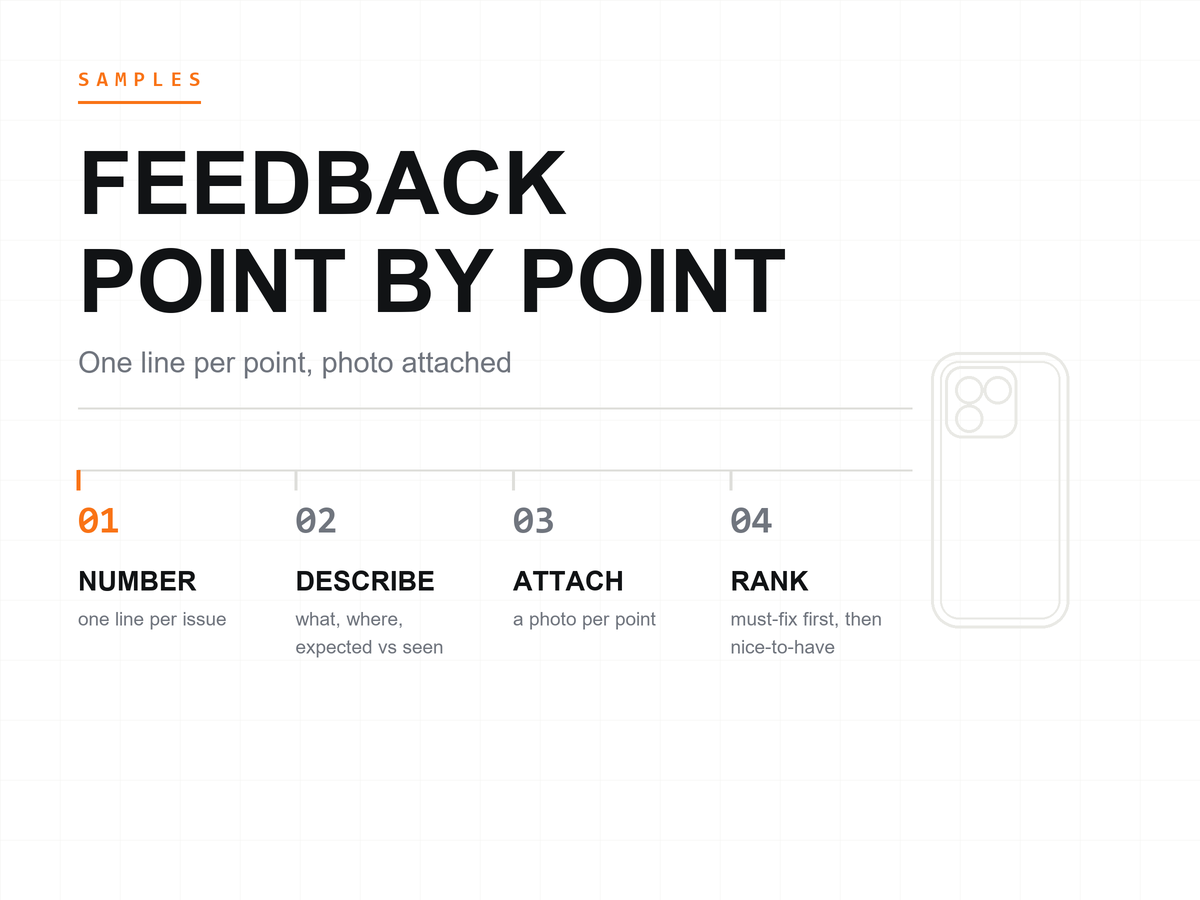
Name the handset and the finish the way your purchase documents will name them, so the piece in the box matches the line on the sheet. Number the lines before you send them, and the answers can come back numbered the same way, point by point. That is the shape a sample review takes against a list, not a chat.
One separation keeps the sheet clean. The commercial side of a sample — its fee, its freight, how the two settle against a later bulk run — belongs on the order confirmation, not on the question sheet. We do not publish a sample fee schedule.
Common Questions From Buyers
How many pieces should the first list carry?
As many as you have open questions, and no more. The list is a question sheet, so its size comes from your questions rather than from a standard package. One question can settle with one piece, and a comparison settles with the pieces the comparison needs. If you cannot name the question a piece answers, leave it off and put the freight behind a line the round will actually read.
Should the sample ship to my retail partner instead of me?
It depends on where the decision is made. If your partner makes the buying call, their address is the right one, provided the list names who opens the box and how the verdict travels back. If you make the call, ship to your own bench and keep the pieces for later rounds. Either route works when it is chosen before the sample is built, and both go wrong when the address is chosen by habit.
Can a photo or a video replace a piece on the list?
Partly. A photo answers what a style looks like, and a video shows a part in motion. Neither carries how a case sits in the hand or how a button feels at the click point, so fit and feel stay on the list as physical lines. A daylight finish cannot be shown on a screen either — a shade judged from a monitor is a guess, while a shade judged beside the piece is a reading. Let the image pick the question, and let the piece answer it.
What to Do Next
Write the questions first. Name one piece per question, and send the list in a single pass with the address and the person who owns the verdict already on it. A round built that way ends in answers; a round built around a catalog ends in another round.
iFunSmart is a Guangzhou factory, founded in 2010, and we would rather see your question sheet before the pieces are built than after.
Send us the questions your next sample list has to answer, and we will build the pieces around them.
Apple and iPhone are trademarks of Apple Inc. iFunSmart is an independent manufacturer of phone cases and accessories and is not affiliated with, authorized, sponsored, or endorsed by Apple.