Oct 13, 2026Business Solutions
Sample Feedback: Say It Point by Point
A sample review buried in chat messages is hard to act on. Format the feedback point by point: what, where, expected versus seen, and what you accept.
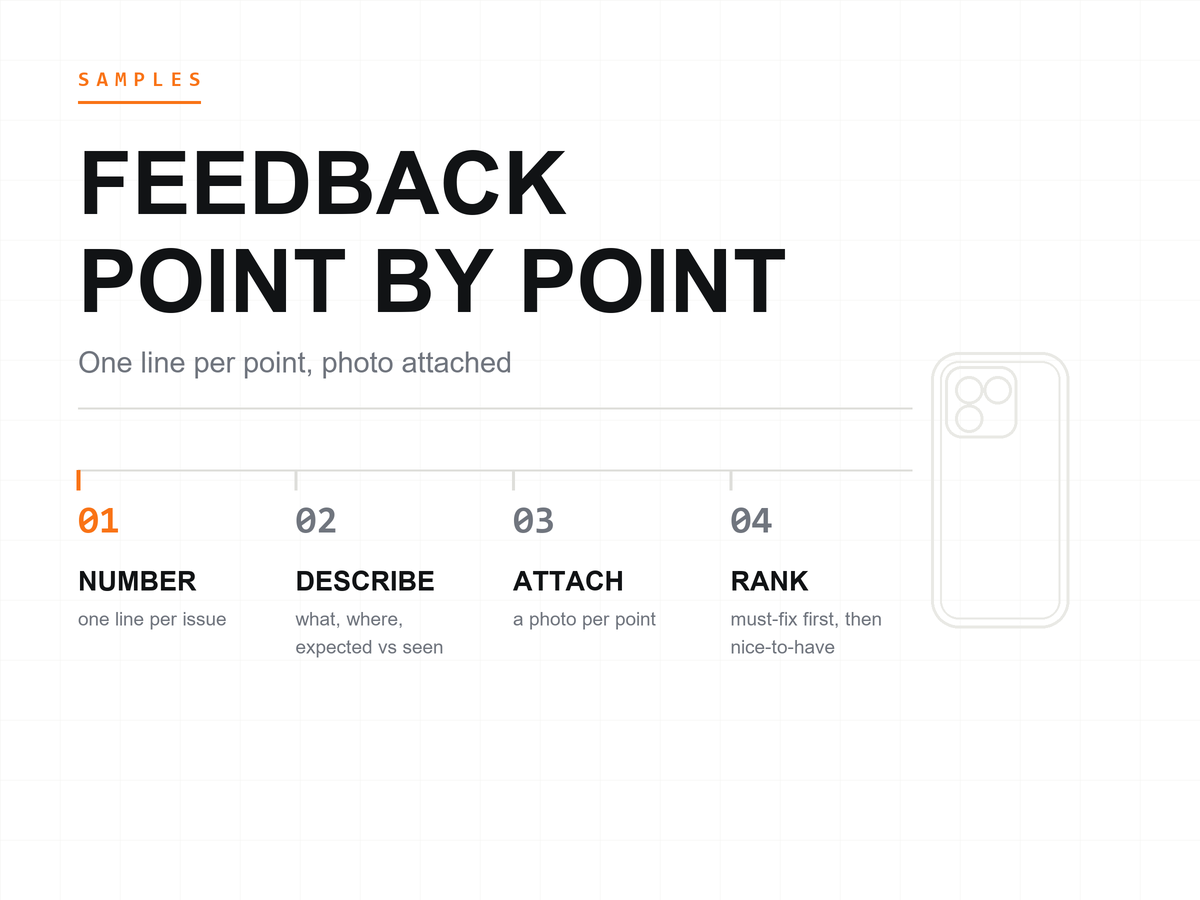
A sample review scattered across chat messages is hard to act on, and it costs you a round. iFunSmart answers a numbered note line by line: one point per line, four fields per point, and a photo bound to each item it shows.
Last updated: October 13, 2026.
Why a Chat Thread Loses Your Points
A sample lands, and the opinions come the way messages tend to: a photo first, a voice note next, the real objection buried in the thread where nobody will find it again. Buyers typically refine in rounds. That part is normal — a physical object has to be handled before it can be judged. The trouble sits in the shape of the round, not in its number. A thread has no structure a supplier can answer against.
Put the same opinions into a note and the round changes character. A sample feedback note is a numbered list, one line per point, so every item can be read, answered, and closed without anyone searching the history to find it. The definition carries the rule that most feedback misses: the line, not the message, is the unit. One point per line. Four fields per line.
The Four Fields Every Line Carries
Format turns a mood into instructions. Every line carries four fields: what the point is, where it sits on the sample, what you expected against what you see, and what you would accept as the fix.
The first field names the thing in plain terms — the tint of the back reads warmer than the approved piece, an opening sits toward one edge, the model line wraps where the panel has room for a single line. Next comes the place: the seam beside the button, the inner edge of the camera frame, the lower corner of the label panel. A place is what makes an item findable. Reference against observation is the third field, and that separation does quiet work. A line that says the finish looks wrong carries no reference; the same line with the approved piece named as the reference carries two facts and a condition. The fourth field names the outcome you would sign off on — a tint brought back to reference, a cutout re-centered, a line of text rewrapped — so the reply has a target instead of a direction.
A point that keeps all four fields stops being a complaint and becomes a job.
Bind Each Photo to Its Item
A block of images with no order leaves the supplier guessing which shot belongs to which point, and guessing is where careful observations get lost. Every photo belongs to the line it illustrates. Shoot the exact spot the line names, from the angle the point is about, and when the point concerns a place — a cutout, a seam, a panel edge — let the frame include the surrounding surface so the place reads clearly.
Some points resist a still image — a hinge cover that drags as it moves, a button that mushes before it clicks. These live in motion and feel, so the line should say so in words rather than lean on a photo that cannot carry it. A point with no photo is fine. A photo with no line is not. Clear builds add one habit: a surface observation only means something against a reference, so the line names the piece it was read against.
The bench stays the same whether the sample is an iPhone Duo build or a flat-back model, and only the entries change. On a hinge build on the sample bench, most lines will concern motion and clearance — a hinge cover brushing the fold, an opening edged off center. Run the same four fields against a clear Duo sample, and the entries turn to surfaces — clarity, a seam that catches a thumb, the exact place a mark settles. If a note is drafted in a looser shape, send it as it reads, and we will set the points into the four fields before the round begins.
Two Priority Tiers, Kept Apart
A flat list makes every point look equally urgent, and a supplier reads a flat list as every point being negotiable. Split the note into two tiers: must-fix, the items that decide whether you approve the sample, and nice-to-have, the items you would carry into a later version. The split tells the factory which points hold the approval and which merely improve it.
Honesty belongs here. We do not promise that every point can be changed. Feasibility depends on the design and on the tooling a change would touch, and it is assessed point by point rather than promised in advance. What the tiers buy you is a clear answer per line: the change, a plan for a later version, or the reason the design will not take it.
Structure In, Structure Out
A numbered note is a numbered job, and a supplier who answers point by point can only do that against a list. The reply comes back in the same numbering, and every entry can be checked against the line it belongs to — answered here, deferred there. Structure in, structure out.
That symmetry is why the note has to be written as a note. An opinion sent as a loose paragraph can be answered as a loose paragraph, with reassurance that commits to nothing. iFunSmart answers a note that arrives in this format line by line, so each entry gets its own reply.
Common Questions From Buyers
Can I raise a point without a photo?
Yes. Feel and motion resist a still image — a button that mushes before it clicks, a cover that drags as it moves — and a blurry picture of the right place proves less than a precise sentence about it. What the format asks is that every photo carries a line, and every line that leans on a photo names the spot it shows. A note is not measured by how many images it carries.
Does every point in the note get changed?
No, and a note written as if every line must win gets worse answers. A change can sit close to the surface of a design or reach into its structure, and the two are judged on different terms, so feasibility depends on the design and on the tooling each point would touch. What the format gives you is an answer, not a yes. The answer may be the change, a plan for a later version, or a reason the drawing will not take it. Ask for that answer in writing, and the round stays honest on both sides.
How do label points fit in the same note?
They fit line by line, like every other kind of opinion. A label comment is a formatting comment, and the four fields hold it: what the element is, where it sits on the panel, what you expected against what you see, and what you would accept — a reworded line, a quieter font, a dropped frame. Label rounds follow the same rule as the rest of the note: each one arrives as a list the factory can answer against, rather than starting over from a picture and a paragraph. Photograph the panel square-on, so a line-break question is judged from the image.
What to Do Next
Put the next sample review into the format. One line per point, four fields on each line, a photo bound to its line, and two tiers that say which items hold your approval. Send it through whatever channel you already use. The shape matters more than the envelope. Then hold the reply to the same numbering and read the round for what it is: a checklist that closes, entry by entry.
iFunSmart is a Guangzhou factory, founded in 2010, and a note that arrives in this format is answered line by line, so the round ends with answers on record rather than impressions in memory.
Format your next sample review as a numbered note, and we will answer it line by line.
Apple and iPhone are trademarks of Apple Inc. iFunSmart is an independent manufacturer of phone cases and accessories and is not affiliated with, authorized, sponsored, or endorsed by Apple.