Oct 3, 2026Business Solutions
Betting on Colors and Models Without Dead Stock
Every new season tempts a wide bet on colors and models. How to split an order so the safe core sells through and the bold shades stay affordable.
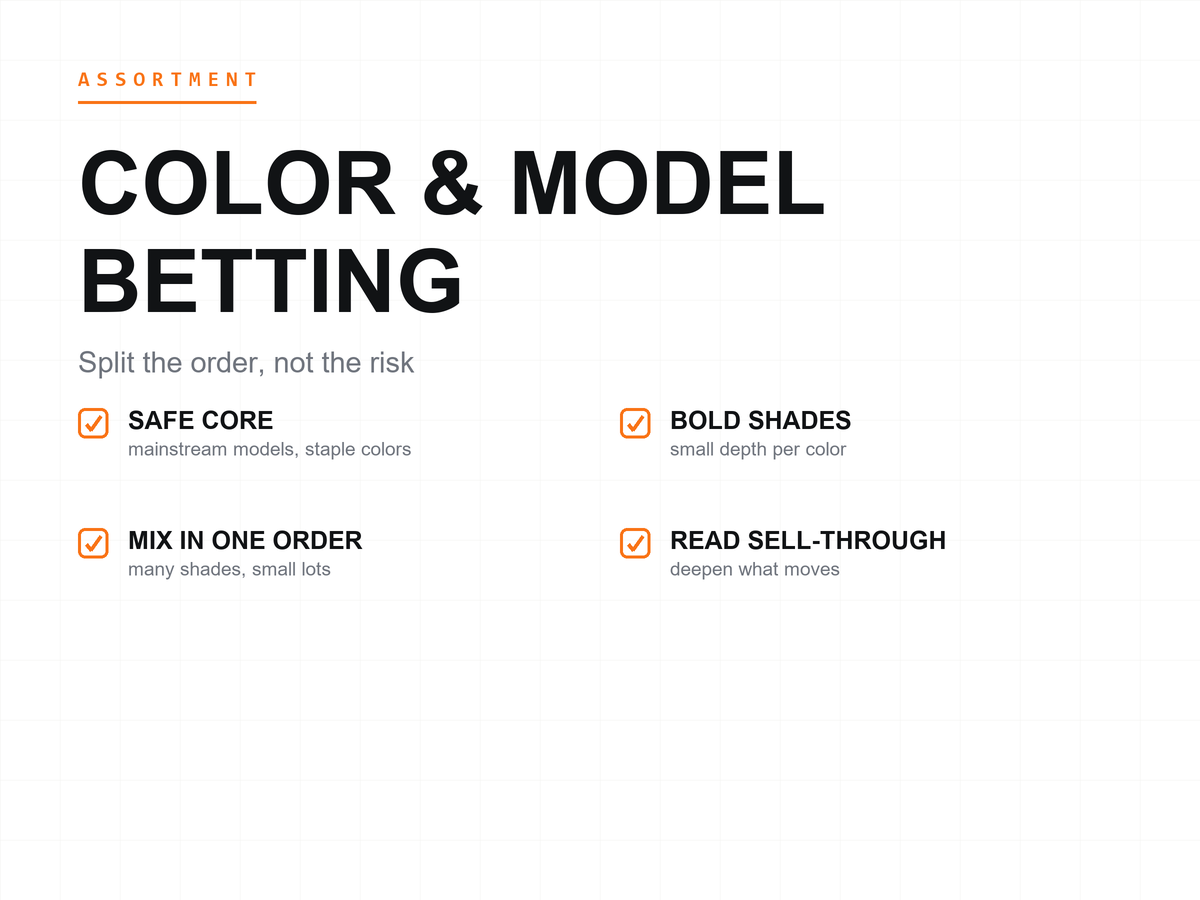
A new season invites a wide order: every shade looks stockable and every model deserves a chance. The way to bet without dead stock is to split the order in two — a safe core in mainstream iPhone models and mass colors, plus a small trial share in bold shades — sized by your own market data.
Last updated: October 3, 2026.
Two Positions, Not One Bet
Dead stock is inventory you paid for before the demand existed, and capping it is what an order structure is for. The structure has two parts. Treat one order as two positions with different jobs rather than as a single bet on taste.
The safe core is the share of an order built on the models your market already carries in the colors it already moves — mass shades such as black and white, plus clear builds. This part answers demand you can point to: the devices in local circulation and the colors that left your shelves last season. Its job is to keep selling while the experiment runs.
The trial share is the smaller slice spent on differentiated shades. A smoke tone or a cherry finish sits here, and so does a build with a function hook. Its job is not to win the season; its job is to buy information cheaply. A miss must stay affordable.
Three Inputs That Set the Split
How far the split leans toward the core is not something we hand down, because the answer depends on data only you hold. We do not publish ratio tables; a split copied from another buyer's market is a guess with paperwork on it. Three inputs do the deciding.
The first input is local installed base, meaning which devices your market actually carries. Cases for a model few people own answer demand that is not there. The models with the deepest local circulation belong in the core, and a model that is newer to your streets can take a trial position instead.
The second is last season's sell-through. Which colors moved and which waited is the same data that drives a reorder decision later. Here it does earlier work, shaping the next order before that order exists.
The third is your channel. A physical shop sells from a wall, and color is what fills a wall — one shop owner who had just finished a store refit told us the walls would be covered in cases, and breadth of shade is how a wall earns its keep. An online catalogue sells each shade on its own page, where a narrow range carried in depth is easier to keep in stock and easier to explain than a wide range carried thin.
Three Rules for the Trial Shades
The first rule is shallow depth. A trial shade should be small enough that a miss does not block the next reorder of the core, which is what keeps an experiment from becoming a burden.
The second rule is breadth inside the slice. Several shades at small quantities in one order teach you more than a single shade at a larger quantity, because the comparison arrives within the same season. One online seller planning an order with us put the priority plainly: variety ahead of depth in any single design.
The third rule is to let the data promote a winner. A shade that moves earns depth in the next order, and a shade that stalls ends at the quantity you bought. Because we hold 1,000+ molds in Guangzhou, that promotion runs on tooling which already exists rather than a new setup. The experiment closes itself either way.
Two builds from our range show what belongs in this slice. The cherry color MagSafe case for the iPhone 18 Pro is a cherry tone with a smoke-skin finish, a differentiated position on a mainstream model. The smoke MagSafe case for the iPhone 18 Pro Max is the darker take on the same idea for the larger device, with a metal lens kickstand in the design. Both earn depth only if your data calls for it.
If you are weighing which shades exist for the models you stock, ask us and we will name the finishes and builds we run for each model.
What the Structure Does Not Do
It does not promise a winner. We do not predict color trends, and no split turns a bold shade into a safe one; what the structure does is cap the cost of being wrong. We cannot promise sell-through for any shade, and we do not publish sales figures for colors or models.
It also does not remove the counting. The inputs above are yours to gather, and the split depends on them. A buyer who skips that work is not betting; they are ordering blind.
Common Questions From Buyers
Which models anchor the safe core?
The ones with the deepest circulation where you sell, counted from the devices you see carried and traded around you. Our mold list covers the iPhone 18 Pro and Pro Max, the iPhone Duo, the iPhone 17 series, and the Galaxy S25 and S26. Which of those belong in your core is a question about your streets, not about the launch calendar.
How many trial shades belong in one order?
There is no fixed count. Each shade you add is another position to photograph and another listing to judge, so the ceiling is your capacity to read results, not the catalogue. The budget rule holds regardless: core first, trials second, and every trial small enough to close without a clearance sale.
Can iFunSmart suggest a color and model mix for us?
We can. The mix we draft is assortment guidance rather than a forecast: it is drawn from the shades we run for your models, and it is meant for you to review and adjust. It is not a promise that any shade sells; your market decides that. Share your model list and rough quantity, and the draft comes back with the core and the trial slice marked.
What to Do Next
Every position in this structure sits on tooling that already exists. We mold cases in Guangzhou, the library holds 1,000+ molds, and we ship to buyers in 30+ countries. A trial shade that earns depth becomes a reorder on a known build, and one that stalls ends at the quantity bought. The bet you take is on quantity, not on tooling.
Send us the models your market carries and roughly how many pieces the order holds, and we can put a recommended color and model mix together for your order.
Apple, iPhone, Samsung, and Galaxy are trademarks of their respective owners. iFunSmart is an independent manufacturer of phone cases and accessories and is not affiliated with, authorized, sponsored, or endorsed by Apple or Samsung.