Business Solutions
Samsung Galaxy S26 Cases: What Buyers Should Order First
The Galaxy S26, S26+ and S26 Ultra have been on sale since March 2026 — and none of them has magnets inside. The case supplies the magnets. Three styles to order first, and what to check on a sample.
BLUF
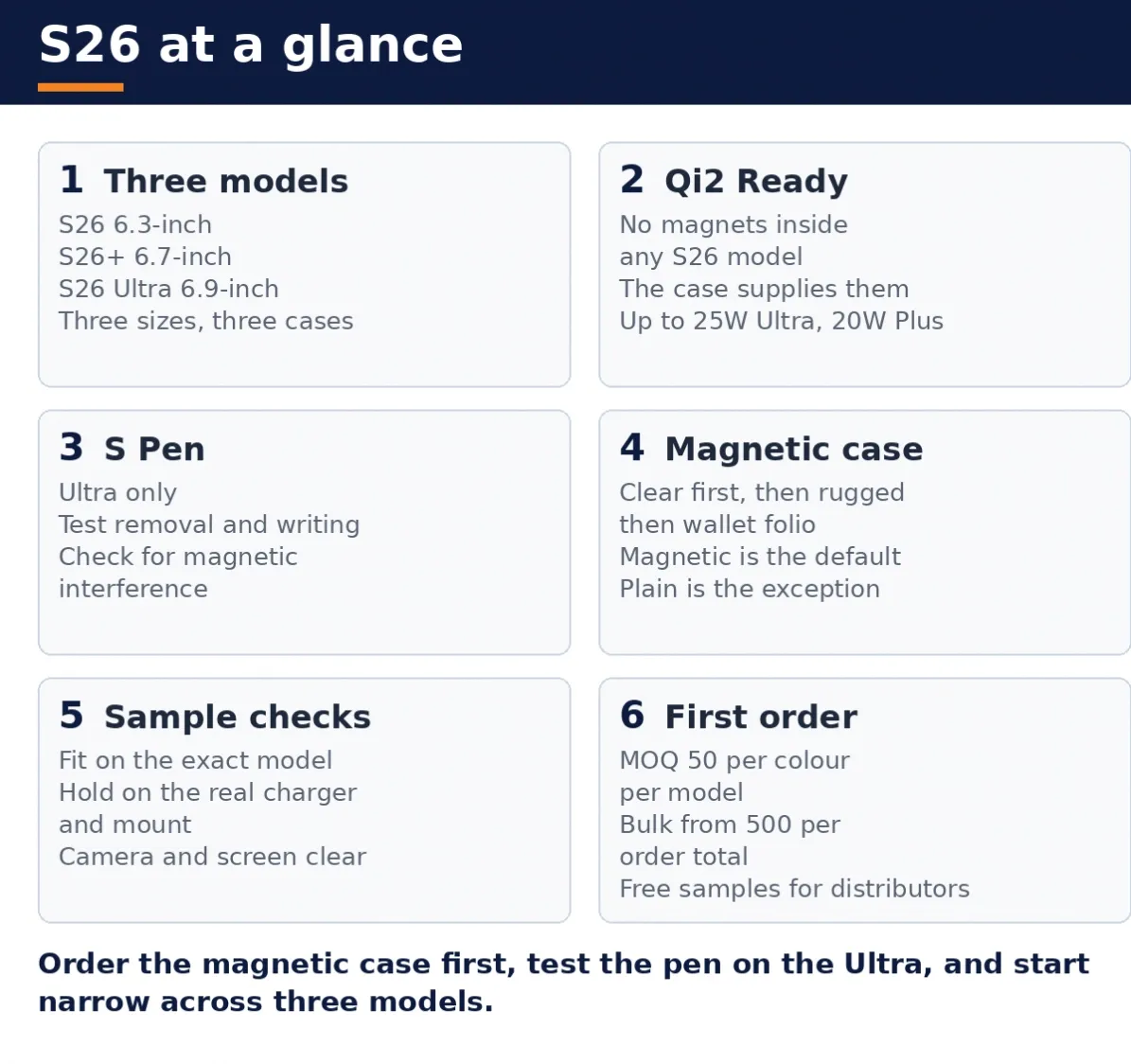
The Galaxy S26 line has been on sale since March 2026, and none of the three models has magnets inside the phone. The case supplies the magnets. Order a magnetic clear case, a rugged case and a wallet case — then test the S Pen and charger on a sample.
Short answer
Samsung announced the Galaxy S26, S26+ and S26 Ultra on 25 February 2026 at Galaxy Unpacked in San Francisco, opened pre-orders the same day, and put all three on general sale on 11 March 2026. The phones have been in customers' hands for eight months, and the case market for them is already settled: buyers know what the phones are, what they are not, and which case styles sell. The one fact that decides the whole range is on the spec sheet in two small words — "Qi2 Ready". It means the phone speaks the Qi2 wireless-charging protocol and can charge at Qi2 speeds, but there are no magnets inside the chassis. The magnets are in the case you buy separately. A buyer who orders a plain, non-magnetic case for the S26 Ultra is selling a case that cannot hold a charger, a mount or a wallet — and a buyer who orders a magnetic case without checking it against the real charger is selling a promise the case may not keep.
This guide covers the three models, the three styles to order first, the S Pen check that only applies to the Ultra, and the sample tests that decide whether the range is right. It follows the same structure as the wholesale guides we publish for every new launch: the models first, the styles ranked by use, then the checks.
1. The three models — and why they are three different orders
The S26 line is three phones, not one phone in three sizes, and a case for one does not fit another. Order them as three separate lines.
Galaxy S26. The compact model, with a 6.3-inch display. It is the volume model in most markets — the one that sells to buyers who want the new Samsung flagship without the Ultra's size or price. For a case range, the S26 is the model that takes the most colours and the most styles, because it is the model the most customers carry.
Galaxy S26+. The middle model, with a 6.7-inch display, a 4,900mAh battery, 45W wired charging and 20W Qi2.2 wireless charging. It has no S Pen. Buyers who choose the Plus over the Ultra usually do so for the larger screen without the stylus, and they buy cases the same way they buy cases for any large phone: clear to show the phone, rugged for protection, wallet for carrying cards.
Galaxy S26 Ultra. The flagship: a 6.9-inch QHD+ display, the Snapdragon 8 Elite Gen 5 for Galaxy processor, a 5,000mAh battery, 60W wired charging, 25W Qi2.2 wireless charging, a 200MP camera system, a built-in Privacy Display that narrows the viewing angle so the person next to the owner cannot read the screen, and the integrated S Pen. It measures 163.6 x 78.1 x 7.9 mm and weighs 214 g. The Ultra is the model where the case decision matters most, because it is the most expensive phone in the line, the one with the pen, and the one whose buyers spend the most on accessories.
Two things are true of all three models. First, the phones are already on sale — this is not a pre-launch order. The launch risk that applied to the iPhone 18 Pro in September and the S27 tooling we cut before announcement does not apply here: the dimensions are published, the phones are in shops, and a case can be checked against a real device before the bulk order runs. Second, none of the three has built-in magnets. Samsung left the magnet array out of the chassis, citing its thinner, lighter design commitment and concerns about S Pen interference on the Ultra. The result is the same for all three models: the case is what makes the magnetic ecosystem work, or what breaks it.
2. "Qi2 Ready" — the case supplies the magnets
Qi2 is the wireless-charging standard from the Wireless Power Consortium, and its defining feature is the Magnetic Power Profile: a ring of magnets in the charger and a matching ring in the phone, so the two align exactly and hold together. The S26, S26+ and S26 Ultra all support Qi2 wireless charging — the Ultra at up to 25W and the Plus at up to 20W with a compatible charger — but they implement it without the magnets. Samsung calls this "Qi2 Ready". It is closer to a disclaimer than a feature: the phone can charge at Qi2 speeds, but only a case with a proper magnetic ring makes the magnetic part real.
That makes the magnetic case the most important style in the S26 range, and it makes the difference between two kinds of magnetic case the thing to get right. A case with magnets in it will hold a charger and a mount. A case that is genuinely Qi2-compatible will also complete the Qi2 handshake at the full speed — the Ultra's 25W, the Plus's 20W — with a compatible charger. Not every magnetic case does. Some magnetic cases hold the phone firmly and still charge slowly, because the magnet ring is in the wrong place, the wrong strength, or the wrong alignment for the charging coil. The buyer who orders on "magnetic" alone is ordering the holding force, not the charging speed. The buyer who orders on "Qi2-compatible" and tests it on the real charger is ordering both.
The test is in section 5. The buying rule is simple: for the S26 line, a magnetic case is not an option in the range — it is the default. A non-magnetic case is the exception, for a customer who has already decided they do not use magnetic accessories. Stock the magnetic version first, and treat the plain version as a second order.
Our magnetic lines use N52 magnets at 2700 Gauss, and our Qi2 guide covers what to order for Android magnetic cases in general — the magnet grade, the ring position and the hold test are the same questions, and the S26 answers them the same way.
3. Three styles ranked by use — what to order first
A wholesale range for the S26 line does not need twelve styles. It needs three, ranked by what the customer uses the case for. This is the same ranking our competitors use for the Ultra, and the same ranking we use for every new model: start with the style that serves the most buyers, add the style that serves a different buyer, and add the style that covers the rest.
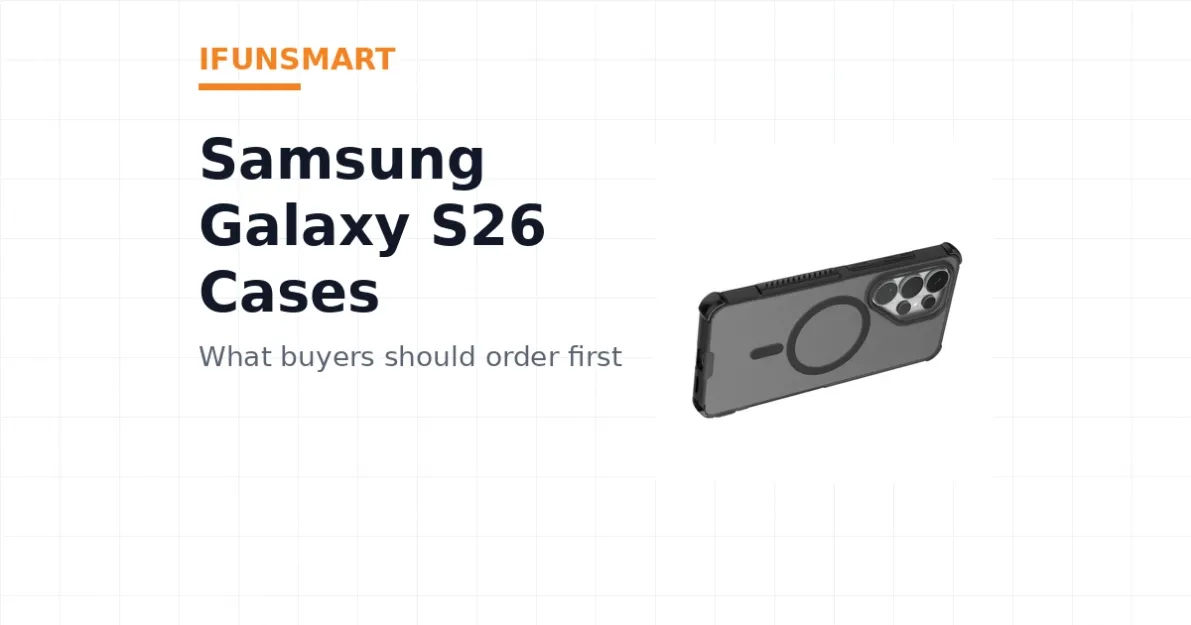
First: the magnetic clear case. Best for showing the phone and for mounts and chargers. A clear case with a built-in magnetic ring is the default S26 Ultra case for most buyers: it shows the phone's own colour and the camera system, it snaps onto a Qi2 charger and a car mount, and it holds a magnetic wallet. The checks are the magnet ring and the camera: the ring must sit exactly over the charging coil, the camera opening must clear the 200MP camera array with a raised edge that keeps the lenses off a table, and the clear material must be the anti-yellowing kind — clear TPU yellows over time, and a buyer who sells a clear case that turns yellow in three months sells a complaint, not a case. Our clear MagSafe lines include an anti-yellowing option; ask us which S26 Ultra clear case carries it.
Second: the rugged armor case. Best for protection and for buyers who treat the phone roughly. A rugged case for the Ultra is a different product from a rugged case for the S26: the Ultra is the largest and heaviest phone in the line, and its camera array is the part that needs the most protection. The checks are the corners, the camera frame and the buttons: reinforced corners, a raised frame around the camera that stands proud of the lenses, and button covers that still press cleanly. The rugged case is also the style where the S Pen check matters most, because a thick case is the one most likely to cover the pen's slot — section 4 covers that test. Order the rugged case in the colours that sell protection — black and dark tones first — and keep the range narrow until the first sell-through tells you which colour moves.
Third: the wallet folio case. Best for carrying cards and for buyers who want the phone and the wallet in one piece. A leather-look folio with card slots, a cash pocket and a fold-out stand serves a different buyer from the clear case and the rugged case, and it is the style that carries the highest price in the range. The checks are the ones that only show up in use: the card slots must hold the cards without stretching, the magnetic clasp must close with the cards inside, the stand must hold the phone at a viewing angle without slipping, and the case must still let the S Pen out on the Ultra. Our leather wallet lines for Samsung include RFID-blocking layers on some styles — ask us which S26 styles carry one, and do not assume every wallet case has it.
Those three styles cover the range. A card wallet that snaps onto a magnetic case, a ring stand, or a second clear colour can follow once the first three are selling. Do not start with twelve styles and three colours each: the S26 line is three models, and three styles across three models is already nine lines before colour is counted. Start narrow, watch which style and which model sells, and widen from the sell-through, not from the catalogue.
4. The S Pen — the Ultra-only check
Only the S26 Ultra has a stylus. The S26 and S26+ do not, and no case or accessory adds one. That makes the S Pen the one check that applies to exactly one model in the line, and the one that is easiest to get wrong — because a case that fits the Ultra perfectly can still ruin the pen.
The S Pen lives in a silo in the bottom edge of the Ultra, and it slides out from there. A case for the Ultra must leave that silo open and must not press on the pen. Three things to test on the sample, with the real phone and the real case together.
Remove and reinsert the pen with the case on. Take the pen out, put it back, and do it several times. It should slide freely and click home. If the case edge catches the pen, or if the pen sits proud of the case and snags on a pocket, the case is wrong for the Ultra — no matter how well it fits the rest of the phone. Test this with the case fully fitted, not held loosely, because a case that is slightly loose in the hand can still press on the silo when it is seated.
Write with the case on. Hold the phone the way its owner will hold it — in one hand, pen in the other — and write near the edges of the screen. The case rim must not lift the palm or push the pen off the glass. A thick rugged case with a high rim is the style most likely to fail this test, so test the rugged style first and most carefully. If the case has a stand or a ring on the back, test the writing with the stand open and closed, because the stand changes how the phone sits in the hand.
Check the magnets against the pen. Samsung's stated reason for leaving the magnets out of the phone included concerns about S Pen interference, and the same question applies to the case: a magnetic ring in the wrong place can affect the pen's accuracy near the centre of the screen. Test the pen across the whole screen with the magnetic case on, and write a line through the middle of the display. If the line wavers or breaks where the magnet ring sits, the ring is too strong or too close to the coil position for that case — say so, and ask for a case with the ring placed for the Ultra, not a generic magnetic ring fitted to three models at once.
The S Pen check is the reason to order the Ultra sample first and to test it on the real phone. A case that passes the fit check and fails the pen check is not an Ultra case. It is a case for a phone that does not have a pen.
5. The sample: five checks before the bulk order
The phones are on sale, so there is no excuse for approving a bulk order without a sample fitted on the real device. Five checks, in order, on the exact model — S26, S26+ or Ultra, not "the S26 family".
Fit on the exact model. Fit the case on the real phone, not on a drawing and not on the next model up. The three models are three different sizes, and the camera layout moves between them — the Ultra's camera array is not the S26's. Check the camera opening, the button covers, the port cutout and the speaker holes. Take the case off and put it on again, and check that it still sits flat. A case that fits the Ultra will not fit the S26+, and a supplier who tells you one case covers two models is selling you a case that fits neither properly.
The magnetic hold, on the real charger and the real mount. Put the cased phone on your actual Qi2 charger and check that it charges, that it centres on the coil, and that it holds when you lift the phone by the charger. Put it on your actual car mount and check that it holds on a bump, not just on a desk. Then check the speed: the Ultra should charge at up to 25W and the Plus at up to 20W with a compatible Qi2 charger and a genuinely Qi2-compatible case. If it charges slowly, the case is magnetic but not Qi2-compatible — the ring holds, the handshake fails. That is a different case, and it needs a different order.
The camera and the screen. Set the cased phone face down and check that the camera lenses do not touch the table — the raised frame must stand proud of the lenses. Set it face down the other way and check that the screen does not touch either. On the Ultra, check the Privacy Display as well: the built-in privacy screen narrows the viewing angle, and a case with a high rim can make the off-angle view worse. Look at the screen from the side with the case on, and confirm the display is still readable straight on and private from the side.
The S Pen, on the Ultra. The three tests from section 4: remove and reinsert the pen, write near the screen edges with the case on, and write a line through the middle of the display to check for magnetic interference. If you are not ordering for the Ultra, this check does not apply — but the fit check does, on the exact model, with the exact phone.
Colour, material and finish. Compare the sample colour with the colour you ordered, in daylight. Check the material the way the customer will: bend a TPU frame, feel a silicone back, look at a clear back against a white surface for haze. Our materials guide covers what each material does over time — clear TPU yellows, PC scratches, silicone picks up lint, leather patinas — and none of those is a defect, but all of them are a reason to choose the material with the customer in mind, not from a photograph. Distributors receive free samples from us, so there is no reason to approve a bulk order from a photograph alone.
6. The first order — shape it like a test, not a bet
The S26 line has been on sale since March, so the first order is a test of sell-through, not a bet on a launch. Shape it that way.
Order the three styles across the three models, in the colours that sell first. The minimum order is 50 pieces per colour per model, and distributor and bulk orders start from 500 pieces per order in total — the 500 is the order total, not per model, so a mixed order across the three models and the three styles reaches it without over-committing to any single line. Start with the magnetic clear case in the most colours, the rugged case in black and one dark tone, and the wallet folio in black and brown. That is a range a distributor can sell from on the first day, and a range that tells you within weeks which model and which style your market wants.
Ask for the model list in writing. Our S26 Ultra cases are in production now, and our mould list covers the S26 family — but the exact list of S26 and S26+ styles, colours and magnetic options changes as new tooling is cut, so ask us for the current list in writing for your order, with the model, the style and the magnet grade stated. Our magnetic lines use N52 magnets at 2700 Gauss; ask for the grade in writing on your order, and match it to how you will sell the case — a charger-and-mount customer needs the hold, and a wallet customer needs the ring to sit flat.
Keep the payment terms in the order. Payment is by T/T or Western Union; new customers may pay a 30% deposit first, and after the goods are ready we send photos, a video and the packing list before the balance is paid and the goods ship. Those terms are part of the order, not a footnote to be settled after the sample is approved. And send the order the way our RFQ guide describes it: the models, one line each; the styles; the colours; the magnet requirement; the logo and packaging requirements — in one message, so the quote that comes back matches the case you asked for.
The S26 line rewards the buyer who orders the magnetic case first, tests the pen on the Ultra, and starts narrow across three models. It punishes the buyer who orders a plain case for a phone that needs magnets, or who orders twelve styles before the first sell-through. Order the three styles, test the sample on the real phone, and let the second order follow what sold.
FAQs
1. Which Galaxy S26 model should I stock first?
Stock all three, with the most depth on the model your market buys most. The S26 is the compact volume model, the S26+ is the large-screen middle model, and the S26 Ultra is the flagship with the S Pen and the highest accessory spend. The minimum order is 50 pieces per colour per model, and distributor orders start from 500 pieces per order in total, so a mixed order across the three models reaches the bulk level without over-committing to one model.
2. Does the Galaxy S26 Ultra have built-in magnets for Qi2 charging?
No. None of the three S26 models has magnets inside the phone — all three are "Qi2 Ready", which means they support Qi2 wireless charging but the magnets must come from the case. The Ultra charges at up to 25W and the Plus at up to 20W with a compatible Qi2 charger and a genuinely Qi2-compatible magnetic case. A plain case cannot hold a charger, a mount or a wallet.
3. Will an S25 Ultra case fit the Galaxy S26 Ultra?
No — assume it will not until the dimensions are confirmed. A case is cut to one device's dimensions, button positions and camera layout, and the S26 Ultra measures 163.6 x 78.1 x 7.9 mm with its own camera array. Order cases cut for the S26 Ultra, and check the fit on the real phone before the bulk order runs. The same rule applies between the S26, S26+ and S26 Ultra: three models, three different cases.
4. Does a magnetic case block the S Pen on the S26 Ultra?
It should not, but it must be tested. Remove and reinsert the pen with the case on, write near the screen edges, and write a line through the middle of the display to check for magnetic interference where the ring sits. If the line wavers, the ring is too strong or too close to the coil position for that case. Only the Ultra has a pen — the S26 and S26+ do not, and no case adds one.
5. What is the minimum order for Galaxy S26 cases?
The minimum order is 50 pieces per colour per model. Distributor and bulk orders start from 500 pieces per order in total — the 500 is the order total, not per model — so you can mix the S26, S26+ and S26 Ultra, and mix the clear, rugged and wallet styles, in one order. Distributors receive free samples. Payment is by T/T or Western Union, with a 30% deposit first for new customers; ask us for a written quote on your exact combination.
About iFunSmart
iFunSmart has made phone cases in Guangzhou since 2010, with more than 1,000 designs, more than 500 models and a monthly capacity of more than 500,000 pieces, supplying buyers in more than 30 countries. Our magnetic lines use N52 magnets at 2700 Gauss. The minimum order is 50 pieces per colour per model, distributor and bulk orders start from 500 pieces per order in total, and distributors receive free samples. Payment is by T/T or Western Union; new customers may pay a 30% deposit first, and after the goods are ready we send photos, a video and the packing list before the balance is paid and the goods ship. Ask us for a written quote on your first order.
Contact us on WhatsApp at +86 13632248734, or click "Contact Us" now to get our full model range and latest price list!
Read more
- Qi2 and Android Magnetic Cases: What to Order — https://www.ifunsmart.com/posts/qi2-android-magnetic-cases-guide
- Which Phone Models Do We Hold Moulds For? — https://www.ifunsmart.com/posts/phone-case-model-mould-coverage
- Phone Case Sampling: How to Evaluate a Sample Before a Bulk Order — https://www.ifunsmart.com/posts/phone-case-sampling-how-to-evaluate-a-sample-before-bulk
- TPU vs PC vs Liquid Silicone vs Leather: Which Phone Case Material Should You Order? — https://www.ifunsmart.com/posts/phone-case-materials-tpu-pc-silicone-leather
- Phone Case MOQ Explained: What 50 Pcs per Colour Really Means for Your First Order — https://www.ifunsmart.com/posts/phone-case-moq-50-per-colour-first-order
- Ordering Before a New iPhone or Samsung Launch: Fit, Moulds & Timing — https://www.ifunsmart.com/posts/ordering-before-a-new-iphone-or-samsung-launch
- Phone Case RFQ: What to Send a Factory in Your First Enquiry — https://www.ifunsmart.com/posts/phone-case-rfq-what-to-send-a-factory-in-your-first-enquiry
- MagSafe Cases in 2026: N52 vs N45, 2700 Gauss, and How to Test the Magnet Before You Order — https://www.ifunsmart.com/posts/magsafe-cases-2026-n52-2700-gauss-test-magnet