Business Solutions
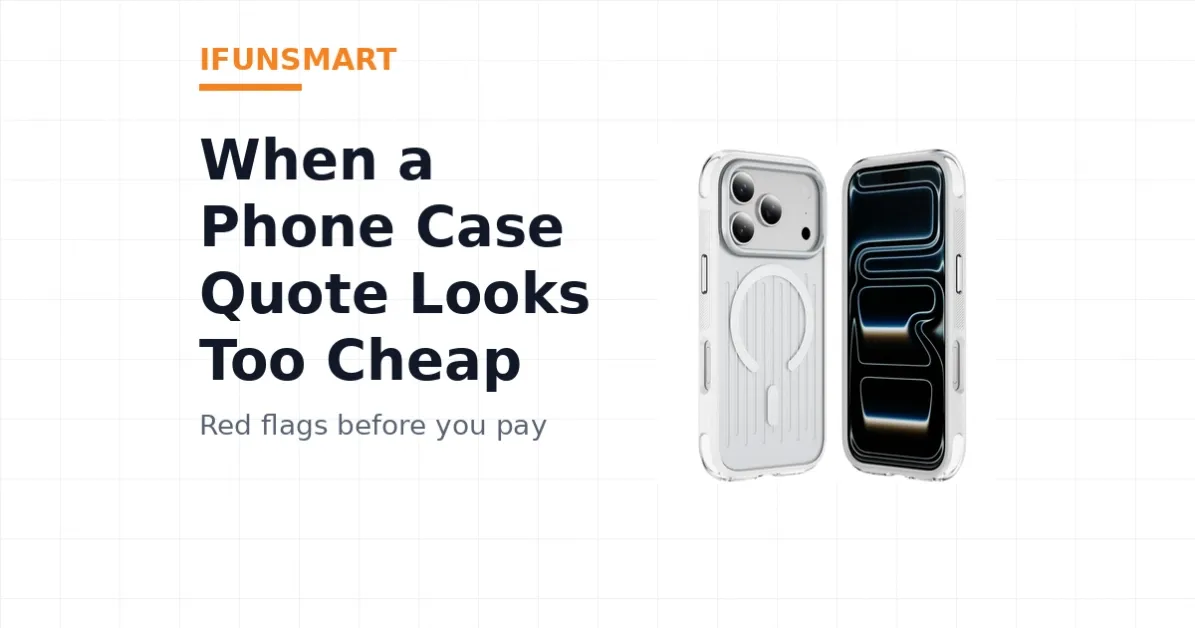
When a Phone Case Quote Looks Too Cheap
A phone case quote far below every other supplier is usually missing something — the specification, the sample, or the protection. Six red flags to check before you pay anything.
BLUF
A phone case quote far below every other supplier is rarely a bargain. It usually means something is missing from the quote — the specification, the sample, or the protection around your payment. Check the six red flags in this guide before you pay anything.
Short answer
Every wholesale buyer has had the same experience: three or four quotes arrive in a normal range, and one arrives far below them all. The instinct is to celebrate. The right instinct is to ask what was left out. A phone case price is the sum of a model, a material, a magnet grade, a finish, a print, packaging and a set of payment terms — and a quote that leaves most of those out is not cheaper, it is incomplete. We know this from the other side of the desk: a retailer in Sweden wrote back to us in November 2026 to say our price level was totally wrong, and asked which of our cases could sell at twenty US cents per case, free on board. The honest answer is that no case we make sells at that level, because the materials, the magnets, the moulds and the inspection behind a case cost what they cost. A supplier who says yes to that number is either quoting a different product, a different specification, or nothing at all. This guide explains the six red flags that separate a genuinely competitive quote from one that will cost you more than it saves, and what to ask for in writing before any money moves.
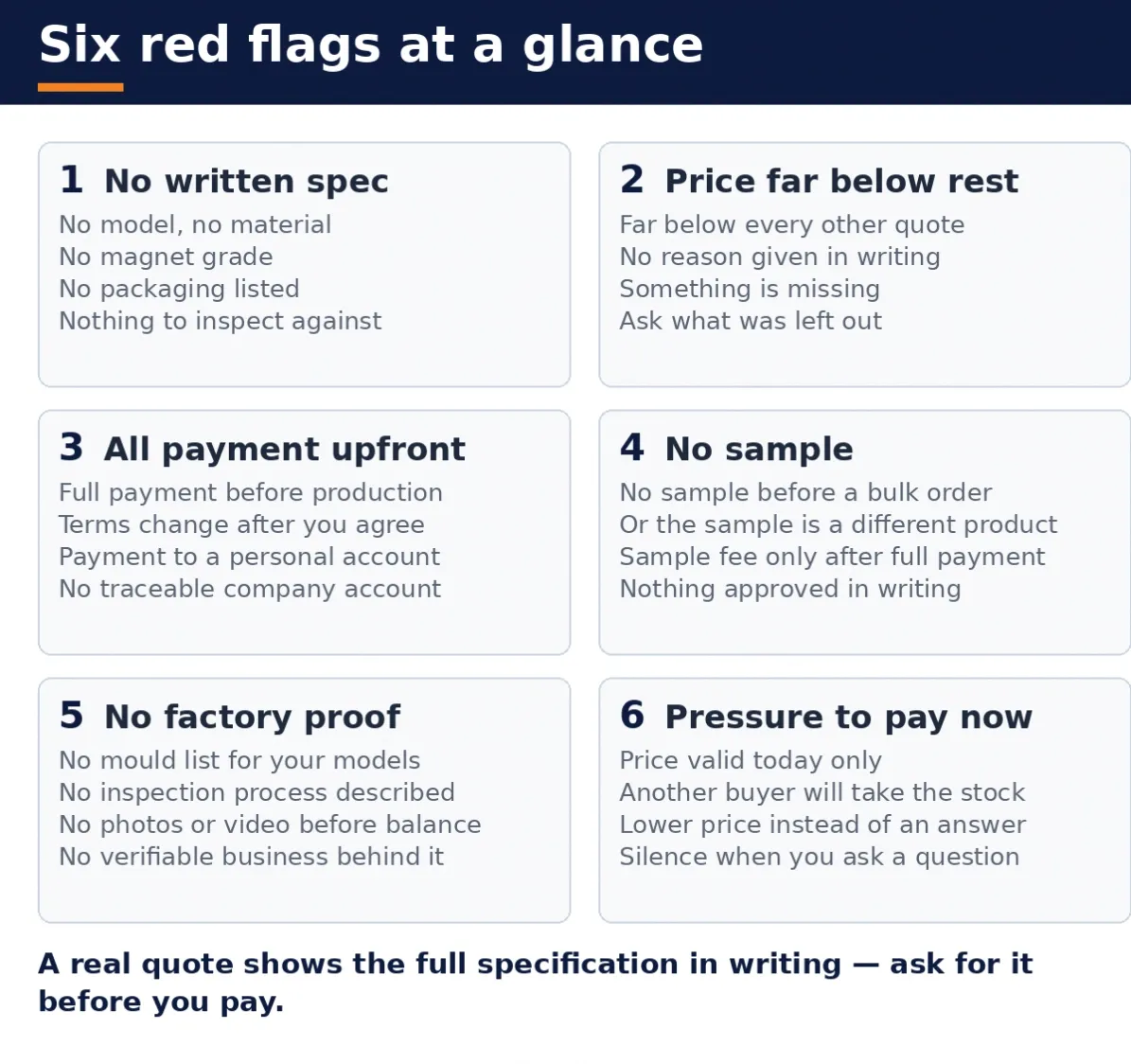
- What a real quote shows in writing
Before the red flags, the baseline. A real phone case quote is a written document, not a number in a chat message, and it names every element that determines the price. If any of these is missing, the quote cannot be compared with another quote — and that is the first thing to check.
The model, exactly. The quote names the phone model and the case style — not "iPhone case" but the exact model and the exact design. Our mould-coverage guide lists the models we hold tooling for, and a quote for a model with no mould behind it is a quote for a mould charge the supplier has not mentioned, or a fit that has not been tested.
The material and the construction. TPU, PC, liquid silicone, leather, or a combination — and which part of the case is which material. A clear case, a magnetic case and a leather folio are three different products with three different costs, and a quote that says only "phone case" is quoting none of them.
The magnet grade, where magnets are involved. A magnetic case that attaches properly uses a named magnet grade — our magnetic lines use N52 magnets at 2700 Gauss — and a quote that does not name the grade is not promising the attachment your customer will test on the first day. Our MagSafe guide explains how to test magnet strength before you order.
The finish and the print. Matte or gloss, the colour, the logo method — UV printing, IMD, silk screening or heat transfer — and the artwork version. A print that is almost right is a print your customer will photograph and return, so the artwork version belongs in the quote, not in a later message.
The packaging. A plain polybag, a retail box, a pegboard hang tab, a barcode — each has a cost, and each changes what arrives at your warehouse. Our packaging guide covers boxes, barcodes and the dieline. A quote that does not mention packaging is quoting the case alone, and the packaging will appear later as a second charge.
The payment terms, in full. How much is paid first, what happens before the balance is paid, and by which method. Our terms are T/T or Western Union; new customers may pay a 30% deposit first, and after the goods are ready we send photos, a video and the packing list before the balance is paid and the goods ship. Those terms are part of the quote, not a footnote to be settled after you agree the price.
The order terms. The minimum order — 50 pieces per colour per model — and the distributor and bulk tier, which starts from 500 pieces per order in total. A quote that never states a minimum is a quote that can change its price when you state your quantity.
Our quotation guide explains how to read each of these lines. This article is about what it means when they are missing — or when the number at the bottom does not match the lines above it.
- Red flag 1: there is no written specification
The most common red flag is also the simplest: the supplier will not put the specification in writing. The quote arrives as a single price in a message, or as a one-line document with no model, no material and no packaging. When you ask for the details, the answers come one at a time, change between messages, or never arrive at all.
A supplier who cannot write down what they are selling has not decided what they are selling — or has decided not to be held to it. Everything that goes wrong later will be a disagreement about a specification that was never written down: the material is thinner than you expected, the magnets are weaker, the colour is a different shade, the packaging is a polybag instead of a box. Without a written specification there is nothing to inspect against, nothing to approve, and nothing to claim on. Our sampling guide makes the same point from the buyer's side: approve the sample in writing against the brief, with the model, material, colour, artwork version and tolerances recorded, because the approval is the specification the bulk order is judged against.
What to do: ask for the full specification in one written document before you discuss price at all. If the supplier cannot produce it, you have your answer — the quote is not comparable with any other quote, and it should not be the basis of an order.
- Red flag 2: the price is far below every other quote, with no explanation
This is the flag the Swedish retailer raised, from the other direction: a price so low it cannot be explained by the specification. When one quote sits far below three or four others for what appears to be the same case, something in the quote is different — and the difference is never in your favour.
There are only a few honest explanations for a much lower price, and each one should be visible in the quote. A simpler material. A thinner construction. No magnets, or weaker magnets. No packaging. A much larger minimum order that spreads the mould cost. A different model that shares a name but not a mould. If none of those appears in the quote, the price is not explained — and an unexplained price is a price that will be explained later, by a change in the product, a second charge, or a delivery that never arrives.
The test is simple: ask the supplier to explain, in writing, why their price is lower than the others. A real supplier can answer — a different material, a different finish, a larger run, a stock clearance with a named quantity. A supplier who cannot answer, or who answers with pressure instead of an explanation, is telling you the price was never built from the product. Do not state a "right price" for any case, and do not let any supplier state one for you: the right question is not what the price should be, but what the price includes. A quote that cannot answer that question is not a bargain. It is a blank space where the product should be.
- Red flag 3: all of the payment is upfront, or the terms keep changing
Payment terms are where a too-cheap quote stops being a bad deal and starts being a risk to your money. Watch for three patterns.
The whole amount before production. A supplier who asks for the full payment before anything is made is asking you to carry all of the risk: the mould, the material, the production, the shipping. Established factories do not need to work that way, and they do not ask new customers to work that way either. Our terms are a 30% deposit first for new customers, with the balance paid only after the goods are ready and we have sent photos, a video and the packing list. That structure exists so that both sides have something at stake at each stage — and so that you see the finished goods before you pay for them in full.
Terms that change after you agree. The deposit was 30% in the first message and 50% in the second. The balance was due after inspection and is now due before shipment. The payment method was T/T and is now a personal account or a method you have never used. Terms that move are terms that were never fixed, and a supplier who moves them once will move them again — usually at the moment when changing supplier would cost you the most time.
A payment method you cannot trace. A wire transfer to a company account under the same name as the factory is normal. A payment to a personal account, a wallet, a third party in another country, or a method with no record of who received it, is not. If the supplier cannot tell you, in writing, the exact account name, the exact amount and the exact trigger for each payment, do not send anything.
What to do: agree the payment terms in writing, in the same document as the specification, before you pay the deposit. If the terms change after that, stop and ask why — in writing — before you send anything further.
- Red flag 4: there is no sample, or the sample is a different product
A supplier who will not send a sample is a supplier who does not want you to hold the product before you pay for a thousand of them. There are only two honest reasons to refuse a sample: the product does not exist yet, or the sample would show something the supplier would rather you did not see. Neither is a reason to order.
The subtler version of this flag is the wrong sample: a sample arrives, it looks good, and the bulk order does not match it. The sample is a different material, a different colour, a different print, or a case for a different model. This is why the sample stage needs the same discipline as the quote: know which stage the sample is — a raw moulded piece, a finished blank, or a fully customised case — and approve it in writing against the brief, with the model, material, colour, artwork version and tolerances recorded. Our sampling guide explains the seven checks to run on a sample before you approve a bulk order: fit on the exact device, materials and surface, buttons and ports, camera clearance, magnetic attachment with the real charger, print and logo, and the written approval itself.
Distributors receive free samples from us, and that is the right way to start: hold the case, approve it, then order. A supplier who charges a large sample fee, who sends a sample only after full payment, or who sends a sample that does not match the quoted specification, is showing you the same thing three different ways — that the product you will receive is not the product you were quoted.
- Red flag 5: there is no factory to verify
A real factory can be verified, and a real supplier expects you to verify it. The checks are ordinary, and none of them requires a visit.
A mould list. A factory that makes cases holds moulds, and it can tell you which models it holds tooling for. We publish our coverage — 93 iPhone designs in the IQ line, 60 Samsung foldable designs in the ISF line, leather lines across 14 brands, and more than 500 models in total — and we ask buyers to confirm the exact models against our mould list before they finalise an order. A supplier who cannot name the models it holds moulds for is a supplier who will order your cases from someone else, at a price and a quality you will not control.
A pre-shipment inspection. A factory inspects before dispatch and can describe the checks: fit, finish, function, packaging, count. Our pre-shipment QC checklist runs through the seven checks to run before goods leave the factory. A supplier who cannot describe an inspection process is a supplier who does not run one.
Evidence of the finished goods. Photos, a video and the packing list before the balance is paid — that is our standard, and it is the minimum a buyer should accept from any supplier. A supplier who will not show the finished goods before the final payment is asking you to pay for goods you have not seen.
A real business behind the quote. A company name, a verifiable address, a website with real product pages, a reply within a working day. Our factory has made phone cases in Guangzhou since 2010, with more than 1,000 designs and a monthly capacity of more than 500,000 pieces, supplying buyers in more than 30 countries. Those are facts a buyer can check, and a supplier with nothing to check should be treated as a supplier with nothing behind the quote. Our factory-versus-trading-company guide explains how to tell the difference before you order.
- Red flag 6: the supplier pressures you to pay now
Pressure is the flag that appears when all the others have failed to close the sale. The price is only valid today. Another buyer is about to take the stock. The mould slot will be gone by tomorrow. The discount disappears if you do not pay within the hour.
Real factories do not sell this way. Production is planned in runs, moulds are held for models, and a price that is real today is real tomorrow — because it is built from the specification, not from the urgency of the moment. A supplier who needs your money today is a supplier whose price cannot survive a night of thought, and that is the most honest thing they will tell you.
The same applies to the opposite pressure: a supplier who goes silent when you ask a specific question, then returns with a lower price instead of an answer. The lower price is not a concession. It is a change of subject. Ask the question again, in writing, and wait for the answer. A supplier who will not answer a question about their own product will not answer a question about your order either.
What to do: give yourself a rule before you start talking to suppliers, and keep it. No payment is sent on the day a price is first quoted. No deposit is sent before the specification, the sample approval and the payment terms are all in writing. A supplier who respects that rule is a supplier you can work with. A supplier who fights it has told you everything you need to know.
- What to do instead: a quote you can trust
A trustworthy quote is not the cheapest quote. It is the quote you can compare, verify and hold someone to. The steps are the same ones this guide has been building toward.
Get two or three comparable written quotes. The same specification, sent to each supplier: the same model, material, magnet grade, finish, print, packaging and quantity. Comparable quotes can be compared. A single low number with no specification cannot be compared with anything, and it should not win an order on its own.
Ask for the sample, and approve it in writing. Hold the case, run the seven checks, and record the approval with the model, material, colour, artwork version and tolerances. The approved sample is the reference the bulk order is judged against. Distributors receive free samples from us — start there.
Agree the payment terms in writing. A deposit first, and the balance only after you have seen photos, a video and the packing list of the finished goods. T/T or Western Union, to a company account, with the amount and the trigger for each payment written down. If a supplier's terms cannot be written down, they are not terms.
Verify the factory. Confirm the mould coverage for your models, ask how the pre-shipment inspection works, and check that the business behind the quote is real. A factory that has made cases since 2010, with more than 1,000 designs and buyers in more than 30 countries, can show you all of that without difficulty.
Keep the order in the confirmed terms. The minimum order is 50 pieces per colour per model, and distributor and bulk orders start from 500 pieces per order in total — the 500 is the order total, not per model. Ask us for a written quote on your exact mix, and for the sample cost and timing for your model — both depend on the style and the customisation, so they are confirmed per order.
A cheap quote that passes all of these checks is a genuinely competitive quote, and it deserves the order. A cheap quote that fails any of them is not a bargain. It is a cost that has not arrived yet.
FAQs
- Is a very cheap phone case quote always a scam?
No — but it is always a question that needs an answer in writing. A lower price can come from a simpler material, a thinner construction, no magnets, no packaging, or a larger run. Ask the supplier to explain, in writing, why their price is lower than the others. If the explanation matches the specification, the quote may be genuine. If there is no explanation, treat the price as unexplained, not as a bargain.
- What should a phone case quote show in writing?
The exact model and case style, the material and construction, the magnet grade where magnets are involved, the finish and print method with the artwork version, the packaging, the payment terms in full, and the order terms — the minimum order and the distributor tier. If any of those is missing, the quote cannot be compared with another quote. Our quotation guide explains how to read each line.
- How much deposit should I pay a new phone case supplier?
There is no universal figure, and any supplier who tells you there is one is selling you a rule instead of a term. What matters is the structure: a deposit first, and the balance only after you have seen photos, a video and the packing list of the finished goods. Our terms for new customers are a 30% deposit first, by T/T or Western Union, with the balance paid after the goods are ready and documented. Agree the structure in writing before you pay anything.
- The supplier will not send a sample. Should I still order?
No. A supplier who will not send a sample does not want you to hold the product before you pay for a bulk order. Distributors receive free samples from us, and the sample stage is where the fit, the material, the magnets and the print are checked against the brief. Order only after you have held the sample and approved it in writing.
- The supplier says the price is only valid today. What should I do?
Wait. A real price is built from the specification, not from urgency, and it is still real tomorrow. Give yourself a rule before you start: no payment on the day a price is first quoted, and no deposit before the specification, the sample approval and the payment terms are all in writing. A supplier who respects that rule is one you can work with.
About iFunSmart
iFunSmart has made phone cases in Guangzhou since 2010, with more than 1,000 designs, more than 500 models and a monthly capacity of more than 500,000 pieces, supplying buyers in more than 30 countries. Our magnetic lines use N52 magnets at 2700 Gauss. The minimum order is 50 pieces per colour per model, distributor and bulk orders start from 500 pieces per order in total, and distributors receive free samples. Payment is by T/T or Western Union; new customers may pay a 30% deposit first, and after the goods are ready we send photos, a video and the packing list before the balance is paid and the goods ship. Ask us for a written quote on your first order.
Contact us on WhatsApp at +86 13632248734, or click "Contact Us" now to get our full model range and latest price list!
Read more