Oct 3, 2026Business Solutions
Custom Retail Packaging: The Cost of Shelf Presence
A custom box costs more than a poly bag and buys something no price list shows. How to trade packaging cost against shelf presence and shipping weight.
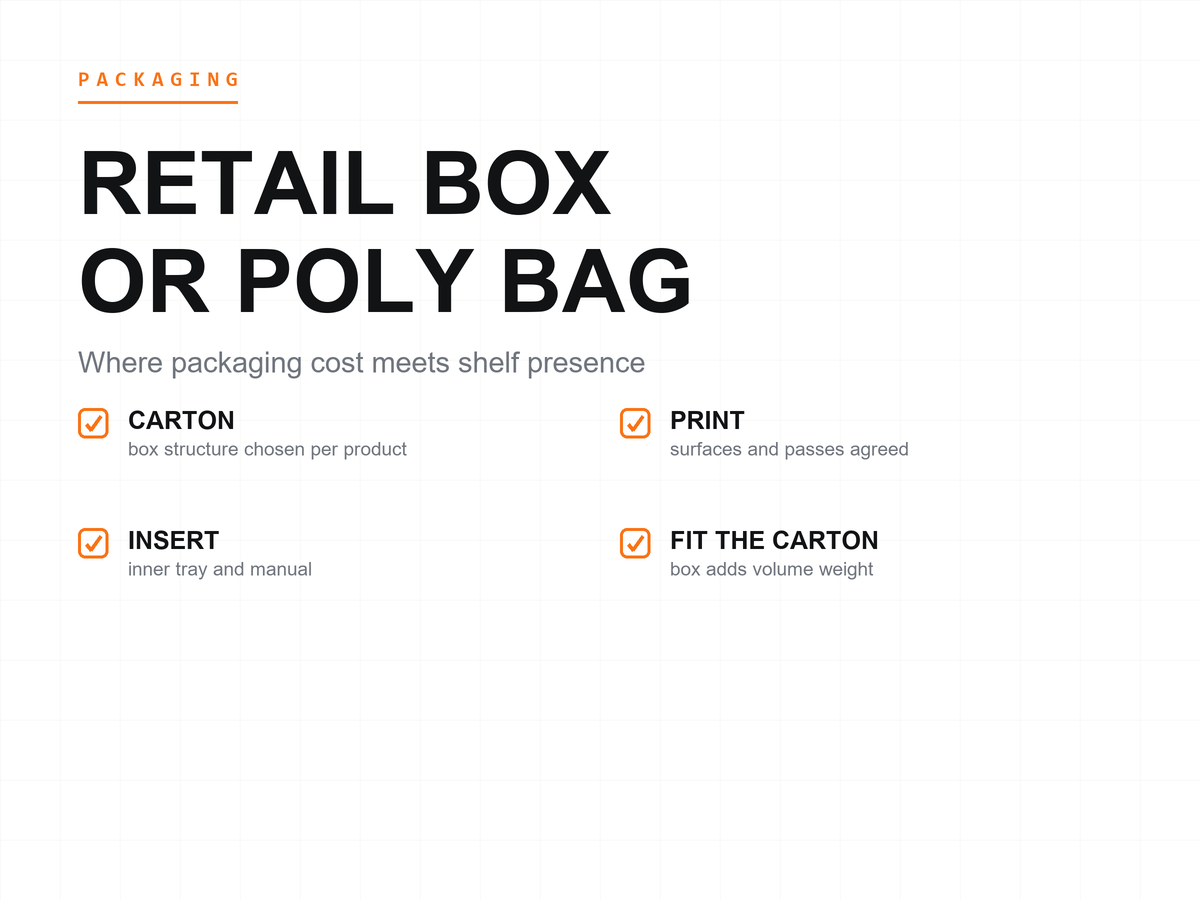
A custom retail box costs more than a poly bag, and it buys something a price list never shows: a case that sits on the shelf in your brand's clothes, ready to sell the moment it arrives. iFunSmart offers that packaging alongside the cases themselves. Where the money goes decides whether the premium pays.
Last updated: October 3, 2026.
Where a Retail Box Budget Goes
Custom retail packaging refers to the box, the insert, and the printed sheet a buyer adds to a standard case so the unit arrives as a branded product instead of a loose shell in a poly bag. Three levers set its cost, and each is a stack of small processes.
Box structure comes first. A tuck-end carton and a magnetic flip-top box are different builds; the second needs more material, more assembly steps, and more hand work. Windowed lids, die-cut trays, and folded footers each add a process too, and processes are what a packaging price is made of.
Printing is the lever buyers notice first, because it carries the brand. The number of faces you print, the color count, and finishing such as spot varnish or foil stamping all add steps on the press. Every face adds cost.
What sits inside the box forms the last lever. A die-cut tray holds the case steady on its hook; a printed insert explains the material, the magnet, and the fit. Inserts sound trivial next to the box, yet they are cut, printed, and folded like everything else.
None of these levers has a public price; they interact with the design, and the same SKU can be packaged several ways. The budget question is not what a box costs. It is which box this product needs.
What Shelf Presence Actually Buys
A case in a poly bag is sold; a case in a box is merchandised. Shelf presence means the package does the selling work that staff at a busy counter have no time for: name the model, show the color, state the material, and carry a barcode that scans. When a shopper takes a box off a phone store wall, the decision has started, and the box either confirms it or stalls it.
Some SKUs earn their box more easily than others. A colorful cherry SKU reads from across the shop: the shade is the reason someone buys it, and a box that shows the color honestly protects that reason. A crystal build for the Duo poses the opposite problem: a transparent case photographs as almost nothing, so the box text has to carry what the eye cannot see. The packaging decision is not cosmetic in either case. It is where the product's most sellable fact gets stated.
Labels do the same job at smaller scale, and this is where detail shows. We print and apply labels in-house, and in practice customers refine label layouts in rounds before production: model names on a single line, font sizes evened across models, compatibility notes reformatted until the sample is right. Those rounds are not friction. They are the packaging being finished, and the shelf is where it shows.
Before you settle on a box, stand one finished sample on a shelf next to competing products and look at it the way a shopper would.
The Freight Ledger Runs Parallel
Unit price is not the whole cost. A retail box changes the freight math before goods reach the shelf, because packaging decides how many units a master carton holds and how much space a pallet occupies. A poly bag squeezes cases tight. A structured box with a tray takes more cube per unit, so fewer pieces fit the carton. Carriers bill space, and a taller box is a dearer cube. None of that appears on the packaging invoice; it appears on the freight invoice, per carton, per pallet, until the shipment lands.
Read packaging cost as one sum across two ledgers: what the box adds per unit, plus what it adds to the shipment. Against that sum set the shelf premium, the margin a branded package can carry over a loose case. The shelf premium must cover the cube. If the box adds more in freight than the shelf gives back in margin, the design is not wrong; the budget is. The box you chose belongs to a price point your market will not pay, and that decision lives on the retailer's shelf, not at the packaging table.
How Packaging Decisions Go Wrong
The typical failure is not an ugly box. It is a box decided in the wrong order. A buyer locks the case price, then asks for packaging, then discovers the box needs a different insert and carton count, and the landed cost no longer matches the retail plan. Ask for the packaging conversation while the case is still being chosen, not after. Structure, faces, and finishing change the box, which changes the carton, which changes the freight. Decisions made in that order stay made.
The second failure is pricing the box before it is designed. A box price has no meaning without a structure, a print specification, and an insert, and we do not publish packaging prices. We quote each design on what it actually asks for; two boxes that look alike can be built and printed very differently. A supplier who hands you a number before you have described the box is quoting some other box.
The third failure is skipping the sample gate. Production of your packaging starts after you confirm the finished sample, not before. Layout rounds happen inside that sample window, where changing a line of text costs only time. Once production runs, a typo on the model line prints on every unit, and the shelf you paid to win advertises the error. Confirm the sample the way a shopper reads it, slowly, at arm's length.
Common Questions From Buyers
What drives the cost of a custom retail box?
Three levers: the box structure, the printing, and the insert or instructions inside it. A magnetic flip-top takes more material and more steps than a tuck-end carton. Print that bleeds across every face costs more than one printed face, and a die-cut tray costs more than no tray. Pull any lever and the price moves; a design brief matters more than a number.
Does a nicer box really move a case off the shelf?
It cannot create demand that is not there. What it does is decide the seconds when demand already exists. The shopper who wants an iPhone case is standing in front of the wall; the box that names the model, states the material, and shows the color truthfully gets picked up first, and the box that hides the model loses the moment. Shelf presence is not persuasion. It is permission to be considered, and in a wall of cases, being considered is the whole contest.
Can one box design serve several models?
Sometimes, and it depends on the case itself. Slim shells for a slab phone share a footprint, so one box with a shared insert can often hold them. A folding phone changes the math: an iPhone Duo case is deeper, and the insert and the carton count both move, and sometimes the box does. A design that stretches across models only works if the thickest case and the deepest tray still close cleanly. We would rather check the fit on a sample than assume it, because a box that will not close is a box that will not ship.
What to Do Next
Start with the shelf, not the box. Decide where the case will be sold and what the package must say at arm's length, then bring us the models and branding direction. We offer custom retail packaging alongside the cases themselves, and we can take the packaging through the same rounds as the product: structure, print spec, insert, label layout, sample confirmation, production. The box that costs you the least is the one that was specified once.
Tell iFunSmart where your cases will sit, and we will build the packaging around that shelf instead of around a budget guess.
Apple and iPhone are trademarks of Apple Inc. iFunSmart is an independent manufacturer of phone cases and accessories and is not affiliated with, authorized, sponsored, or endorsed by Apple.