Oct 28, 2026Business Solutions
Before You Pay: A Document Consistency Check
Most payment delays start with a name or a figure that does not match. Four checks to run before the invoice leaves your desk, and what to fix first.
Most payment delays are paper problems, and paper problems are cheapest to catch before the money leaves your account. A document consistency check is a field-by-field comparison of the contract, the proforma invoice, the packing list, and the transport document against one confirmed order. iFunSmart works its own document sets through this check before an invoice goes out.
Last updated: October 28, 2026.
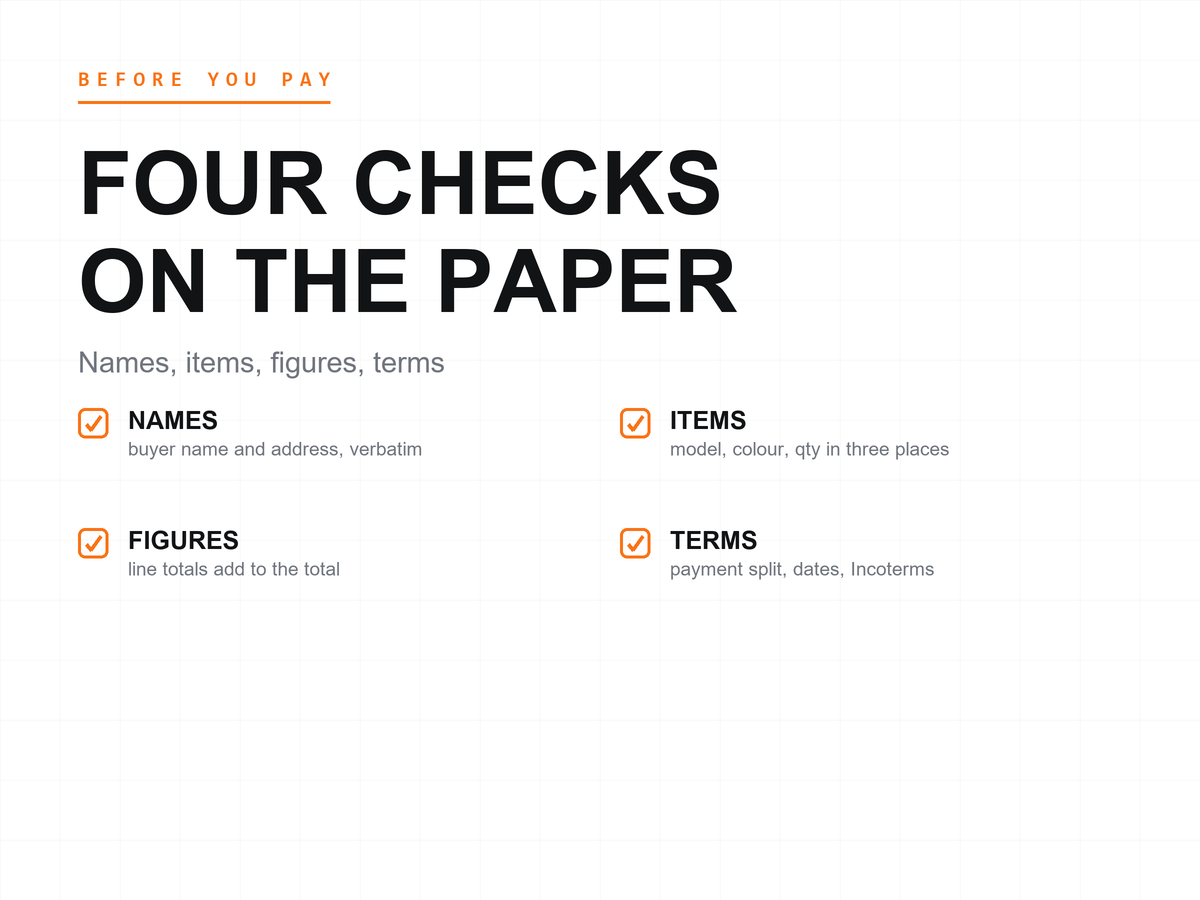
Run it while the set is still a draft, because every field is cheaper to fix before it is signed or presented. Four fields carry the risk: the parties, the line items, the arithmetic, and the terms. Compare each one against a single source, the order confirmation both sides signed, not against the other documents.
Check One: The Buyer Name, Letter for Letter
Start with the party names. A bank pays against a registered name and reads characters rather than intent, so the buyer's legal name and address should read the same on the contract, the proforma invoice, the packing list, and the transport document. That looks clerical until the invoice carries a trading name and the payment instruction does not.
Watch the small differences. A company registered with Limited but invoiced as Ltd is one company to a human reader and two strings to a checking system. Floor and suite notations matter for the same reason: a package addressed to a building name and a bill addressed to a unit leave open where the goods go. A forwarder in the consignee field with the buyer in the notify field is normal only when every paper tells that story.
Then check the seller's side. The beneficiary name on the proforma invoice and the account the money will reach should be the same string. Where the payer is not the buyer, as with group companies and agents, confirm in writing that the bank will accept the name on the instruction.
Check Two: Every Line Item, One Spelling
Item lines drift more quietly than names. Each row on the proforma invoice should name the same model, color or finish, and quantity as the row it came from on the quotation, and the packing list should repeat it once the goods are packed. Three documents, one row, one spelling.
Model names are the usual failure. A short form and a full form describe different handsets, and mixing them across a set leaves the checker unable to tell which was meant. Settle one naming convention at the quotation stage and carry it into every later document. Take the SKU on the invoice: its model, color, and quantity should be findable, unchanged, on the quotation and the packing list.
Color names drift the same way. Two labels for one shade may describe one product, but a checker comparing fields sees two, and the query that follows costs a round. Keep a color list and pull names from it. Pieces, sets, and cartons are different units; a packing list counting cartons where the invoice counts pieces is not a harmless typo.
Check Three: The Arithmetic That Has to Close
A closed set is one fewer reason for anyone to hold your payment. Closing it takes three statements that must be true at once: unit price times quantity equals the line subtotal, the subtotals add to the invoice total, and every charge other than the goods sits on its own line.
Run the multiplication line by line instead of checking the total alone. A total can be right while a line is wrong, which happens when an old quantity sits beside a new unit price. Keep freight, tooling, and handling charges separate from the goods. Fold a freight figure into a unit price and the line stops matching the quotation; the buyer can no longer see where the goods cost ends and the transport begins.
The invoice also has to agree with the payment schedule, not only with itself. Consider a premium line item: a higher unit price multiplies any quantity error into a visible gap between line and total, and a share due at one stage should equal the stage the contract describes.
Check Four: Terms Written Once, Referenced Everywhere
Terms are short phrases with long consequences. The trade term should read the same on the contract and the proforma invoice, with the same named place after it. A contract that says FOB and an invoice that says DDP is not a typo; it is a disagreement about who pays for the ocean leg.
Lead times need the same treatment. A production period counted from the deposit on one paper and from confirmation on another gives two answers to one question. Write the trigger and the duration together. The payment split follows the rule: the share due before production and the share due against shipping documents should read the same on both papers, and each share should name its trigger. We do not publish a standard split, because the structure belongs in the order confirmation for the specific order.
Partial shipment and insurance are the two clauses most often left out of one paper and kept in another, so give each one a line everywhere.
Fix What You Find in the Right Order
Finding a mismatch is the easy half. The order of the fixes decides whether the payment date holds.
Correct what you control first. Your purchase paperwork, your internal approval, and the names registered with your bank are yours to change today. Then send the requests that depend on the other side in one message: a corrected proforma invoice, a revised packing list, a carrier amendment, a new certificate from the body that stamped the old one. Asking together keeps the slowest paper from being the last requested.
Re-present the complete set, not the corrected sheet alone. One replacement page leaves a checker guessing which version governs. Name what changed, send the whole set, and keep the earlier version.
The cheapest correction is the one made before signature. If you want a second reading of a draft set while it is still editable, our team will walk the same four checks with you. We do not give legal or customs advice; the document set your bank or destination authority requires is set by them, not us.
Common Questions From Buyers
Which Document Should I Check First?
Start from the confirmed source, the signed order confirmation, and move outward through the quotation, the proforma invoice, the packing list, and the transport document. Checking the invoice against the packing list only proves the two disagree. Checking both against the confirmation tells you which one is wrong.
What If the Buyer Name Differs From the Bank Account Name?
It happens with group companies, agents, and financing parties, and it works when documented before the money moves. Ask both banks which name they will match against the instruction, and put the payer-buyer relationship in writing. A transfer instruction naming one entity while the invoice names another is the shape of a payment that comes back. Confirm the requirement with your bank; we do not give legal advice.
How Do I Stop a Repeat Order From Drifting?
Build the new set from the approved one instead of retyping it into a fresh template. Change only what actually changed, then compare the two versions side by side. Repeat orders drift because someone retypes an old invoice, keeps an old quantity, and updates the total by eye.
What to Do Next
We issue the proforma invoice and the packing list for your order, and we can send a draft set for your review before you pay, so the names, the lines, the totals, and the terms are settled while a change still costs one message. iFunSmart is a Guangzhou factory, founded in 2010, with 15+ years in phone case and accessory manufacturing and buyers in 30+ countries. We print and apply labels in-house, so the carton label follows the invoice line.
Send us your draft document set before you pay, and we will check the names, the lines, the totals, and the terms against the confirmed order with you.
Apple and iPhone are trademarks of Apple Inc. iFunSmart is an independent manufacturer of phone cases and accessories and is not affiliated with, authorized, sponsored, or endorsed by Apple.