Sep 21, 2026Business Solutions
Drop-Test Claims: What "10 ft / 3 m" Actually Means
"10 ft drop-tested" appears on thousands of listings. The three parts that make the claim checkable: height, method, and who ran it — and how to verify.
A buyer sourcing iPhone cases asked us for RoHS documents and drop-test reports in the same message, and both questions deserve the same answer: show the test, name the tester, and put it in writing. The phrase "10 ft / 3 m drop-tested" appears on thousands of listings, and on most of them nobody can say who dropped the case, from what, onto what. Here is how to read the claim.
Last updated: September 20, 2026.
What a Drop-Test Claim Should Include
A drop-test claim is a statement that a case survived a fall from a stated height under stated conditions. The claim is only as good as its three parts: the height, the test method, and who ran it.
Strip any one part and the phrase becomes decoration. "Drop-tested" without a height is not a claim, because every case survives some fall. A height without conditions is weak, because concrete and steel punish a case differently than a lab floor. And a test without a named tester is a story, because the party selling the case is the least reliable witness to its own testing.
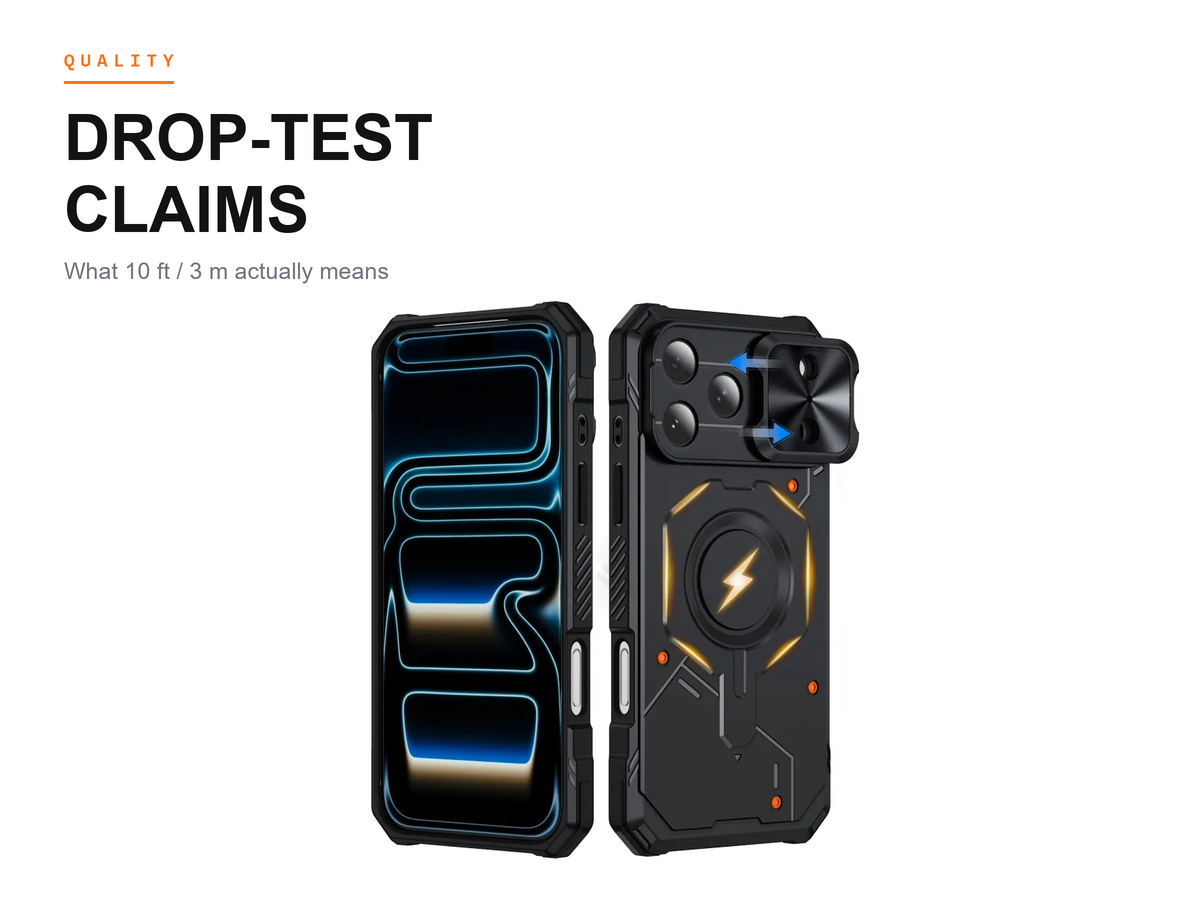
This is why our rugged lines are specified the way they are: 10 feet, with a defined protocol, and documentation available on request. The phrase is short; what backs it is not.
Who Ran the Test Matters More Than the Height
Two suppliers can both say "10 ft drop-tested" and be making completely different claims, because the tester changes the meaning.
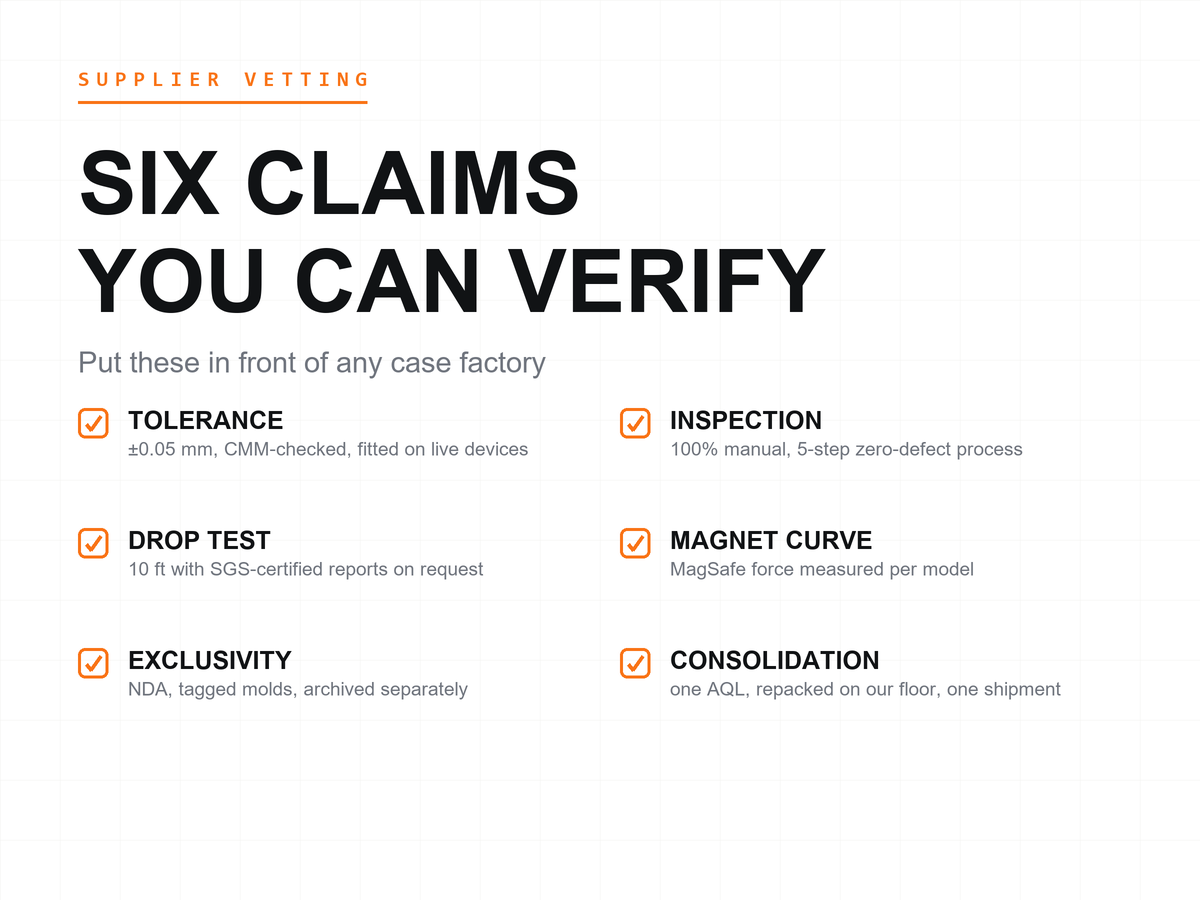
The strongest form is third-party testing, where an independent body runs the protocol and signs the results. Our own SGS-certified drop validation works this way, and material aging tests sit alongside it, because a case that survives a drop fresh from the mold can fail one after months of heat and pocket wear.
The weaker form is self-testing, where the factory drops its own cases and reports its own results. Self-testing is not worthless — a factory that drops cases daily learns faster than one that never does — but it is a different tier of claim, and the honest word for it is self-validated rather than certified.
Apple's own spec pages make the same distinction quietly. The iPhone Duo specifications cite IEC standard 60529 for its water rating, naming the standard behind the claim. A case listing that names nothing is asking you to trust what a flagship listing does not.
What the Height Does Not Tell You
A single height number hides the variables that decide whether the number means anything for your customers.
The surface the case hits matters: the same case survives differently onto steel, tile, and playground rubber. The angle matters: flat face drops and corner drops load different parts of the shell, and corners are where cases actually fail. The count matters: one lucky drop is not a protocol, and repeated drops are what pocket life looks like. And the phone inside matters, because weight and rigidity change the impact.
This is why a real protocol states its conditions, and why a buyer should ask for them. "10 ft, six faces, eight corners, onto a defined surface, at room and aged condition" is a test. "10 ft drop-tested" is a mood.
How to Put This Into Your Sourcing
The practical move is to make the claim a line item in your purchase conversation, with three asks attached.
Ask what the stated height was tested onto, and how many drops. Ask who ran the testing, and whether an independent report exists for the line you are buying. And ask for a sample you can drop yourself, because your own floor is the test your customers will believe. We have written before about the five checks to run before bulk production, and a self-run drop is the cheapest of them.
One boundary belongs here, the same one we state everywhere else: a case that passes a drop test is not indestructible, and no case makes a phone unbreakable. What a good test tells you is how a case behaves under defined, repeatable conditions — which is exactly what a mood cannot tell you.
Common Questions From Buyers
Does "military grade" mean anything on a case listing?
Only when the standard behind it is named and the report is available. Military-grade phrasing borrowed from standards such as MIL-STD-810 means the product was tested against defined procedures, and a seller using the phrase should be able to say which procedures and show the documentation. Without that, it is an adjective, and adjectives do not protect a phone.
Is self-tested worse than third-party tested?
It is a different tier of claim, not automatically a worse case. A factory that self-tests daily may build better cases than one that certifies a batch once a year. What third-party testing adds is independence — a name that is not selling the case standing behind the result. Ask for the report either way, and weigh the answers.
Can I see the drop test before ordering?
Ask for it. Some factories can share test footage or reports for the line you are buying, and the fastest check of all is a sample you drop yourself onto your own floor. Our rugged armor line is where to start that comparison. Your own test on your own sample is the one your customers will believe, because you ran it.
What to Do Next
Our drop-test protocol, the aging tests behind our materials, and the documentation on our rugged lines are available to buyers who ask, alongside a sample you can test on your own floor. The RFID card-holder case shows the same raised-lens protection philosophy in a slimmer build.
Send us the models and rugged finishes you are sourcing, and we will share how the testing runs and what the documentation covers for those lines.
Ask us for the drop-test documentation and a sample, and test both before you commit.
Apple, iPhone, and iPhone Duo are trademarks of Apple Inc. iFunSmart is an independent manufacturer and is not affiliated with, authorized, sponsored, or endorsed by Apple Inc. Apple product names are used solely to indicate compatibility with our products.