Business Solutions
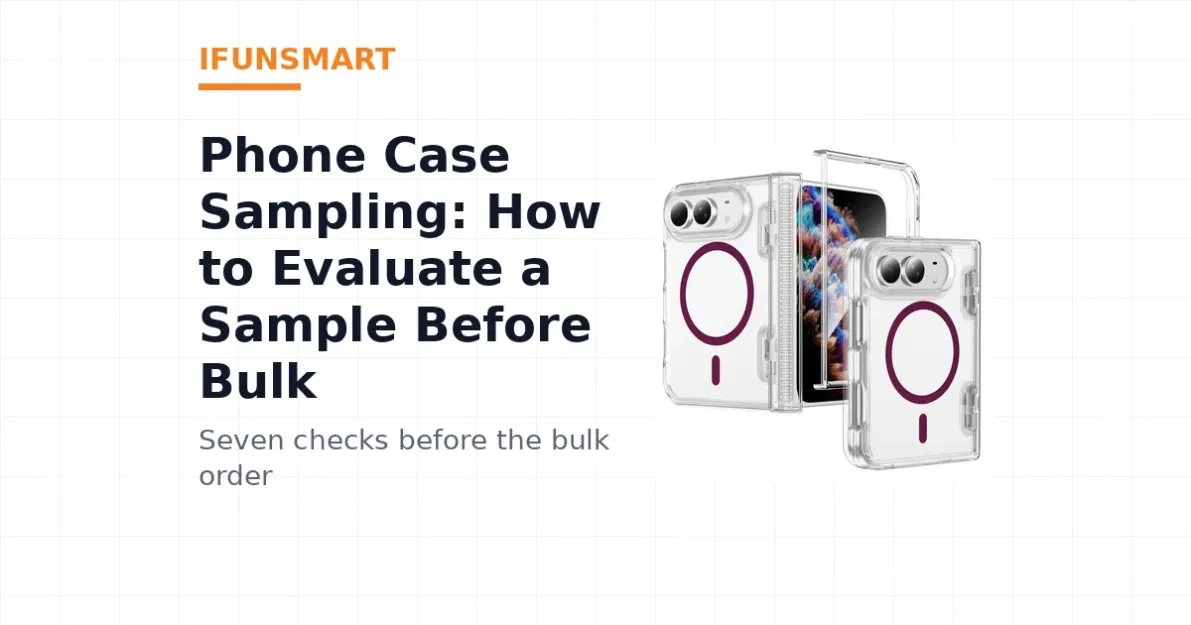
Phone Case Sampling: How to Evaluate a Sample Before Bulk
A sample is the cheapest insurance on a bulk order. Seven checks — brief, fit, materials, function, print, stages and approval — that turn a sample into a binding specification before you commit.
BLUF
A sample is the cheapest insurance on a bulk order. Check it against your written brief, fit it on the real phone, test the buttons, charging and magnets, inspect the print, know which sample stage you hold — then approve it in writing. Looks alone are not approval.
Short answer
Sampling is the stage between the quotation and the bulk order, and it is where most avoidable problems are cheapest to find. A sample lets a buyer check whether the case matches the design, fits the phone, works with the charger and accessories, and carries the artwork correctly — before committing to hundreds of pieces. But a sample only protects the buyer if it is evaluated systematically and approved in writing. A case that looks right in a photo can still be wrong in the hand: the wrong model variant, a button that is hard to press, a magnet that holds a charger but drops a wallet, a logo printed a few millimetres off, or a finish that was never part of the agreed specification. This guide works through seven checks in the order a buyer should run them, what each check proves, what a sample cannot prove, and what the written approval must say so the bulk order is judged against the same specification the sample passed.
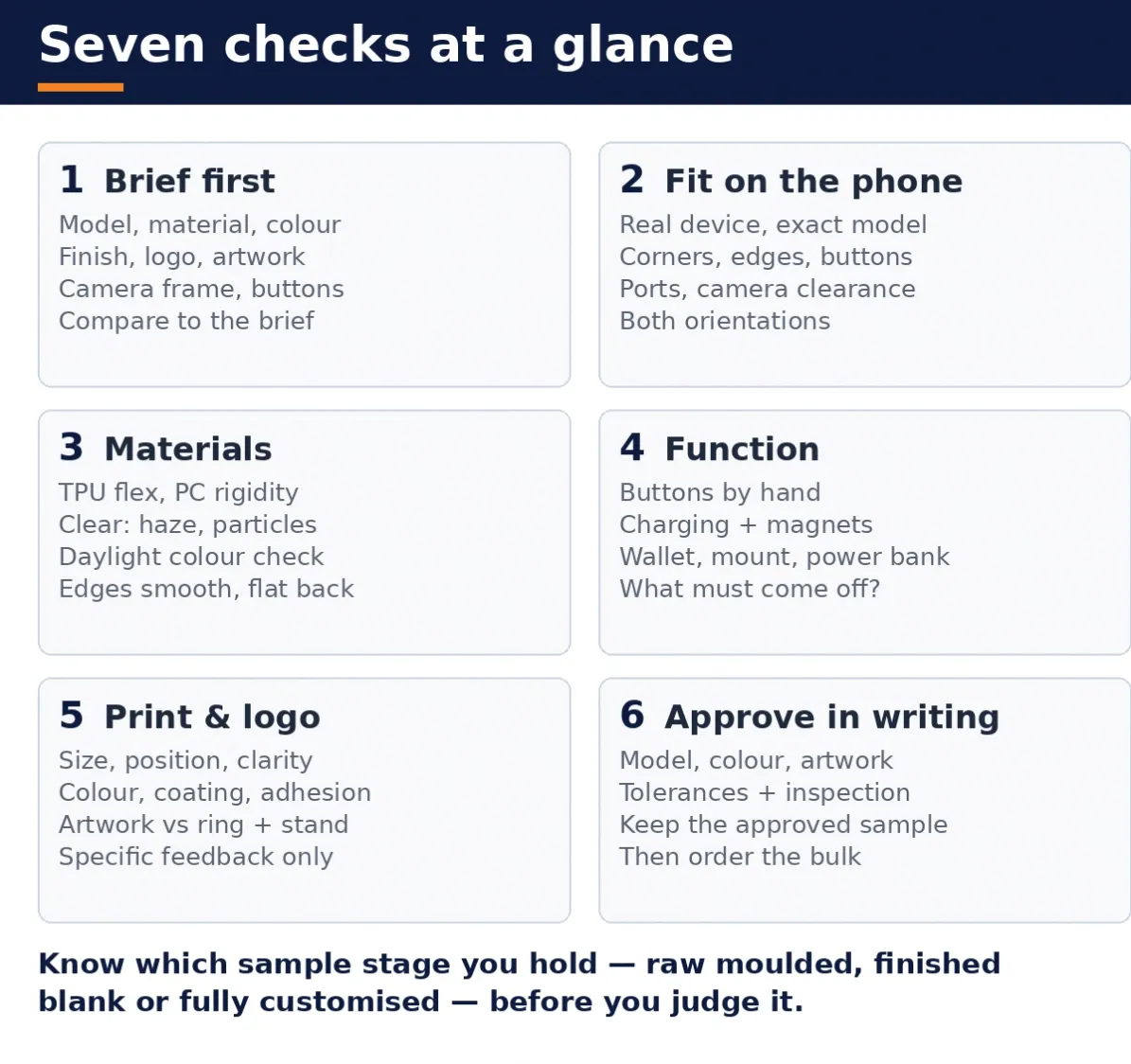
- What a sample proves — and what it does not Start with the limit, because it shapes every check that follows. A sample proves that one finished case, made to one specification, fits one phone and carries one artwork. It does not prove that a production run of 500 or 5,000 pieces will be identical, and it does not prove long-term performance. Colour can drift between batches, a material can behave differently after months of use, and a finish that looks perfect on a single sample can vary across a run. That is why the sample is paired with a written approval record (section 8) and a pre-shipment inspection (our quality checklist explains what to check before goods leave the factory). The sample sets the standard; the approval record and the inspection hold the bulk order to it.
The three questions a sample must answer. First, is this the product in the brief — the right model, material, colour, finish and artwork? Second, does it work on the real phone — fit, buttons, charging, magnets, accessories? Third, is it the product you would put your brand on — appearance, print quality and consistency? If any of the three is unanswered, the sample is not ready to approve, whatever it looks like in a photograph.
Distributors receive free samples. That is a confirmed iFunSmart offer for distributor and bulk buyers, because a distributor who has held the case can sell it with confidence. For other orders, ask us for the sample cost and timing for the model you need — both depend on the style and the customisation, so they are confirmed per order, not stated as a flat figure.
- Match the sample against your written brief first Before touching the case, put the brief next to it. The brief is the document from your first enquiry — the model, the structure, the material, the colour and finish, the logo and artwork, the camera-frame design, the button and opening positions, and the magnetic components where applicable. Our RFQ guide explains what a complete first enquiry contains; the sample check starts by comparing the physical case against that same list, item by item.
Check the identity of the case before its quality. Confirm the phone model and variant first — a case for one model in a series is not a case for the whole series, and a sample for the wrong variant proves nothing about the one you will sell. Then confirm the structure and material: a two-part case is not a single-piece case, and a PC back with a TPU bumper is not an all-TPU case. Then the colour and finish, the logo and artwork, and the camera-frame design. A sample that looks similar to the reference image can still differ in dimensions, material or functional details, so compare it against the written specification, not against a photo.
Label every sample you receive. If a project involves several models or designs, identify each sample clearly — model, colour, artwork version, date received — so feedback is applied to the right version. Two samples that look alike can carry different artwork versions or different finishes, and a correction sent against the wrong sample wastes a revision round. Keep one sample as the approved reference and do not use it as a daily-carry case; it is the standard the bulk order is judged against.
The common mistake at this stage is approving on appearance alone. Appearance is one check among seven. A case can look right and still fail the fit test, the charging test or the print-position test. Work through the list in order and record the result of each check as you go.
- Fit on the real phone — the test that matters most Correct fit is the most important sample criterion, and it can only be tested on the exact phone the case is made for. Install the case on the real device, not on a display model of a different variant, and not on a drawing. A drawing verifies geometry; it cannot tell you whether the case is comfortable to install, whether a corner lifts after a day in a pocket, or whether a button is easy to press with the case on.
Run the fit check in five steps. First, install the case and confirm it sits securely around the device, with the corners properly positioned and the edges giving the intended coverage. Second, check the buttons: press each one the way a customer would — quickly, one-handed, without looking — and confirm the alignment and the feel. Third, check the openings: the charging port, the speakers and the microphone must stay fully accessible, and the camera openings must give the lens and flash enough clearance. Fourth, remove the case and install it again, and confirm it comes off and goes back on without forcing or marking the phone. Fifth, test both orientations: hold the device vertically and horizontally, and look for an edge that interferes with normal use. A case edge that is fine in portrait can dig into a finger in landscape.
Do not assume cross-model fit. A case should not be assumed to fit another phone model because the dimensions appear similar. Two phones in the same series can differ by a fraction of a millimetre in the camera area or the button position, and that fraction is the difference between a case that sells and a case that comes back. Our mould-coverage guide explains how to confirm which models a factory actually holds tooling for — ask us to confirm the exact model against our mould list before you approve the sample.
What to do when fit fails. Record exactly what fails — which corner lifts, which button is stiff, which opening is tight — and send that list with a photo. "It does not fit" is not feedback a factory can act on; "the lower-left corner lifts 2 millimetres after installation" is. The same rule applies to every check in this guide: specific feedback gets a specific revision.
- Materials and surface quality The material should match the agreed specification and the intended product positioning. A sample is the only chance to judge that match by hand before the bulk order, so handle the case the way a customer will: flex it, press it, look at it in daylight, and check the edges.
Check by build, not by a single rule. For TPU cases, examine flexibility, edge finishing and material appearance — the bumper should flex without whitening at the bend, and the edges should be smooth, not sharp or rough. For PC cases, check rigidity, surface condition and dimensional consistency — the back should sit flat and not rock on a table. For clear cases, inspect transparency, colour consistency, haze, scratches and visible particles, and look at the case against a white background as well as in the hand. Our materials guide explains how TPU, PC, liquid silicone and leather behave differently, and our anti-yellowing guide explains what to ask about clear cases specifically — a clear sample that looks perfect on arrival can still yellow over time, and the material grade is what decides how fast.
Check the surface in daylight. Indoor light hides colour drift and surface defects that daylight shows. Compare the sample colour against the approved colour reference in daylight, not only under office lighting, and check the finish — matte, glossy, textured — across the whole case, not only at the centre. A finish that is uneven at the edges will be uneven on every piece in the run.
A visual sample cannot prove long-term performance. If the product claims a particular performance characteristic, request the relevant specification and test documentation rather than judging it from the sample alone. The sample shows appearance and construction; it does not independently establish how the material will behave after months of use. That distinction belongs in the approval record, so nobody later treats the sample as a guarantee of durability.
- Function: buttons, charging, magnets and accessories A phone case must maintain the normal usability of the phone. Test the finished case as a system — phone, case, charger and accessories together — because a case that works alone can fail with the accessories the customer will actually use.
Work through the function list. Button responsiveness, charging-port access, speaker and microphone openings, camera clearance, installation and removal, and compatibility with the intended accessories. For magnetic cases, test with the real charger and the real adapter, and with the wallet, mount and power bank the range will actually sell. Our MagSafe guide explains the magnet grade to ask for — N52 at 2700 Gauss on our magnetic lines — but the grade alone does not guarantee the result: check alignment first, then attachment stability, then whether a stand, a decorative plate or a wallet needs to come off before the phone charges. Find that out on the sample, not from a customer. Our Qi2 guide covers the same test for Android magnetic cases, where the phone may have no built-in magnets and the case carries the whole magnetic system.
Test the conflicts before the listing goes live. A lifestyle photo that implies a wallet, a stand and a charger all work together is a return waiting to happen if one of them has to come off. The listing should say what must be removed, and the sample test is where that fact is discovered. The same applies to screen protectors and lens protectors: check the case, the screen protector and the lens protector as a complete combination, because a case that fits alone and fails with a screen protector fitted is a case that fails in the customer's hand.
Protective claims need documentation, not a sample. For protective cases, review the construction and request the applicable test documentation if drop-protection performance is part of the product specification. A sample can show the construction; it cannot prove a protection rating. Do not list a protection figure on a listing unless the documentation supports it.
- Print, logo and decoration Customisation is often the reason a brand requests a sample in the first place, so the print check deserves the same discipline as the fit check. Compare the printed case against the approved artwork, not against a screen preview, and check it in daylight.
Check seven things on every printed sample. Logo size and position, artwork alignment, colour consistency, print clarity, coating uniformity, visible bubbles or contamination, and edge coverage. For a printed case, also check surface adhesion where relevant — a print that lifts at the edge on the sample will lift faster in use. Our private-label guide explains the three routes to a branded case and what to settle before the first order; the sample is where the artwork decision becomes physical, and the artwork version on the sample must be recorded in the approval.
Give specific feedback, not a verdict. If the sample is not satisfactory, say exactly what must change rather than saying the appearance is not correct. Identify whether the logo needs to move, the colour needs adjustment, or the coating surface requires improvement. Clear feedback helps the factory identify the necessary revision, and it creates a written record of what the next sample must fix. A revision round without a written list of changes is a round that repeats the same mistake.
Mind the magnetic area. For artwork printed around a ring or stand, confirm that the full custom artwork can be printed without affecting magnetic charging — a question one of our buyers raised on a Samsung design, and one that should be settled on the sample, not after the bulk order. Check the print position against the ring, the stand and the charging area together, and confirm the artwork stays readable and permanent where the case flexes or the stand moves.
- Sample stages: know which sample you are holding Some customised projects involve more than one sample stage, and the checks that apply depend on the stage. Before evaluating a sample, confirm which stage it represents and which details are still pending — this avoids rejecting a sample for features that have not yet been applied.
Three stages a buyer will meet. A raw moulded sample evaluates the case structure before printing, coating or other finishing is completed — judge it on fit, structure and material, not on appearance. A finished blank-shell sample includes the final surface treatment but not the customer's artwork — judge it on colour, finish and function, and do not reject it for missing artwork. A fully customised sample represents the completed product, including logo, decoration and other requested features — judge it against the full brief, because this is the sample the bulk order is measured against.
Ask which stage each sample is, in writing. If the factory sends a sample without saying which stage it is, ask before you evaluate it. A blank-shell sample judged as a finished product produces a false failure; a raw moulded sample approved as a finished product produces a false approval. The stage, the artwork version and the date should be written on the sample label and in the approval record.
One sample is not a production run. Even a fully customised sample is a single piece. It proves the design and the specification; it does not prove that every piece in the run will match it. That is why the approval record matters, and why the pre-shipment inspection exists: the sample sets the standard, the inspection checks the run against it.
- Approve in writing before the bulk order Once the sample meets the agreed requirements, document the approval. A verbal "looks good" is not an approval, because it cannot be checked against the bulk order later. The approval record is the document that turns a sample into a binding specification.
The approval record should identify eight things. The product model and variant, the material and structure, the colour and finish, the artwork version, the magnetic components where applicable, the functional requirements, and any agreed tolerances or inspection criteria. Add the sample stage, the date, and the name of the person who approved it. Keep the approved sample itself as the physical reference, labelled with the same details, and do not use it as a daily-carry case.
If changes are required, consolidate the feedback into one revision list. Confirm whether each change affects the unit price, the tooling, the production schedule or the MOQ — a change that looks small, such as moving a logo or changing a finish, can change any of those four, and the buyer should know before the revision is made, not after. Our quotation guide explains what a complete quote contains; a revision that changes the specification should come with a revised quote, not a verbal assurance.
The order of operations is the point. Brief, sample, checks, revision if needed, written approval, then the bulk order — with the pre-shipment inspection as the final check before goods leave the factory. A buyer who skips the written approval saves a day and risks the whole order. A buyer who approves in writing has a specification the factory can build to and the buyer can inspect against. That is what a sample is for.
FAQs
- How many samples should I request before a bulk order? Request one sample per model, colour and artwork version you intend to order, and label each one clearly. A sample for one colour does not prove another colour, and a sample for one model does not prove another model in the same series. For a first order, the sample set is the specification set — keep one of each as the approved reference.
- What if the sample is good but the bulk order arrives different? That is what the written approval record and the pre-shipment inspection are for. The approval record names the model, material, colour, artwork version and tolerances the bulk order must meet; the inspection checks the run against that record before goods leave the factory. Raise any difference against the approval record, with photos of the approved sample beside the delivered goods.
- Does a free sample mean the bulk order will be the same quality? A free sample for distributors is the same product, made to the same specification — but a single sample is not a production run. Colour can drift between batches and a finish can vary across a run, which is why the approval record and the pre-shipment inspection exist. Treat the sample as the standard, not as a guarantee of every piece.
- Can I approve a sample from photos instead of holding it? No. Photos cannot test fit on the real phone, button feel, magnetic attachment, charging alignment or print adhesion. A photo can confirm that a sample was made, but it cannot replace the seven checks in this guide. If a supplier offers photos instead of a physical sample for the approval decision, that is a reason to slow down, not to approve faster.
- What should I do if the sample fails a check? Record exactly what fails, with a photo and the specific detail — which corner lifts, which button is stiff, which opening is tight, where the print is off. Send one consolidated revision list, confirm whether the change affects price, tooling, schedule or MOQ, and ask for the next sample at the stage that shows the fix. Do not approve a failed sample on the promise that the bulk order will be different.
About iFunSmart
iFunSmart has made phone cases in Guangzhou since 2010, with more than 1,000 designs, more than 500 models and a monthly capacity of more than 500,000 pieces, supplying buyers in more than 30 countries. Our magnetic lines use N52 magnets at 2700 Gauss. The minimum order is 50 pieces per colour per model, distributor and bulk orders start from 500 pieces per order in total, and distributors receive free samples. Payment is by T/T or Western Union; new customers may pay a 30% deposit first, and after the goods are ready we send photos, a video and the packing list before the balance is paid and the goods ship. Ask us for the sample cost and timing for your model, and for a written quote on your first order.
Contact us on WhatsApp at +86 13632248734, or click "Contact Us" now to get our full model range and latest price list!
Read more
Phone Case RFQ: What to Send a Factory in Your First Enquiry — https://www.ifunsmart.com/posts/phone-case-rfq-what-to-send-a-factory-in-your-first-enquiry
Pre-Shipment QC Checklist: 7 Checks Before Your Phone Cases Leave the Factory — https://www.ifunsmart.com/posts/phone-case-quality-check-before-shipment-checklist
Phone Case Order Lead-Time Planning Guide — https://www.ifunsmart.com/posts/phone-case-order-lead-time-planning-guide
Phone Case MOQ: 50 Pieces per Colour per Model — https://www.ifunsmart.com/posts/phone-case-moq-50-per-colour-first-order
TPU vs PC vs Liquid Silicone vs Leather: Which Phone Case Material Should You Order? — https://www.ifunsmart.com/posts/phone-case-materials-tpu-pc-silicone-leather
MagSafe Cases 2026: N52 2700 Gauss Magnet Test — https://www.ifunsmart.com/posts/magsafe-cases-2026-n52-2700-gauss-test-magnet
Phone Cases for Private-Label & E-Commerce Brands — https://www.ifunsmart.com/posts/phone-cases-for-private-label-e-commerce-brands
Phone Case Packaging: Boxes, Barcodes and the Dieline — https://www.ifunsmart.com/posts/phone-case-packaging-boxes-barcodes-dieline